Home
Product
Contact
Odm/Oem
About
The cost of a custom claw clip is the factory unit price of one finished clip. That price covers the jaw material, molding or cutting, the spring and hinge pin, surface finishing, the logo, packaging, and a share of any new tooling. No honest supplier can give a firm figure from a photo. What buyers can know in advance is which inputs move the price, and by how much relative to each other.
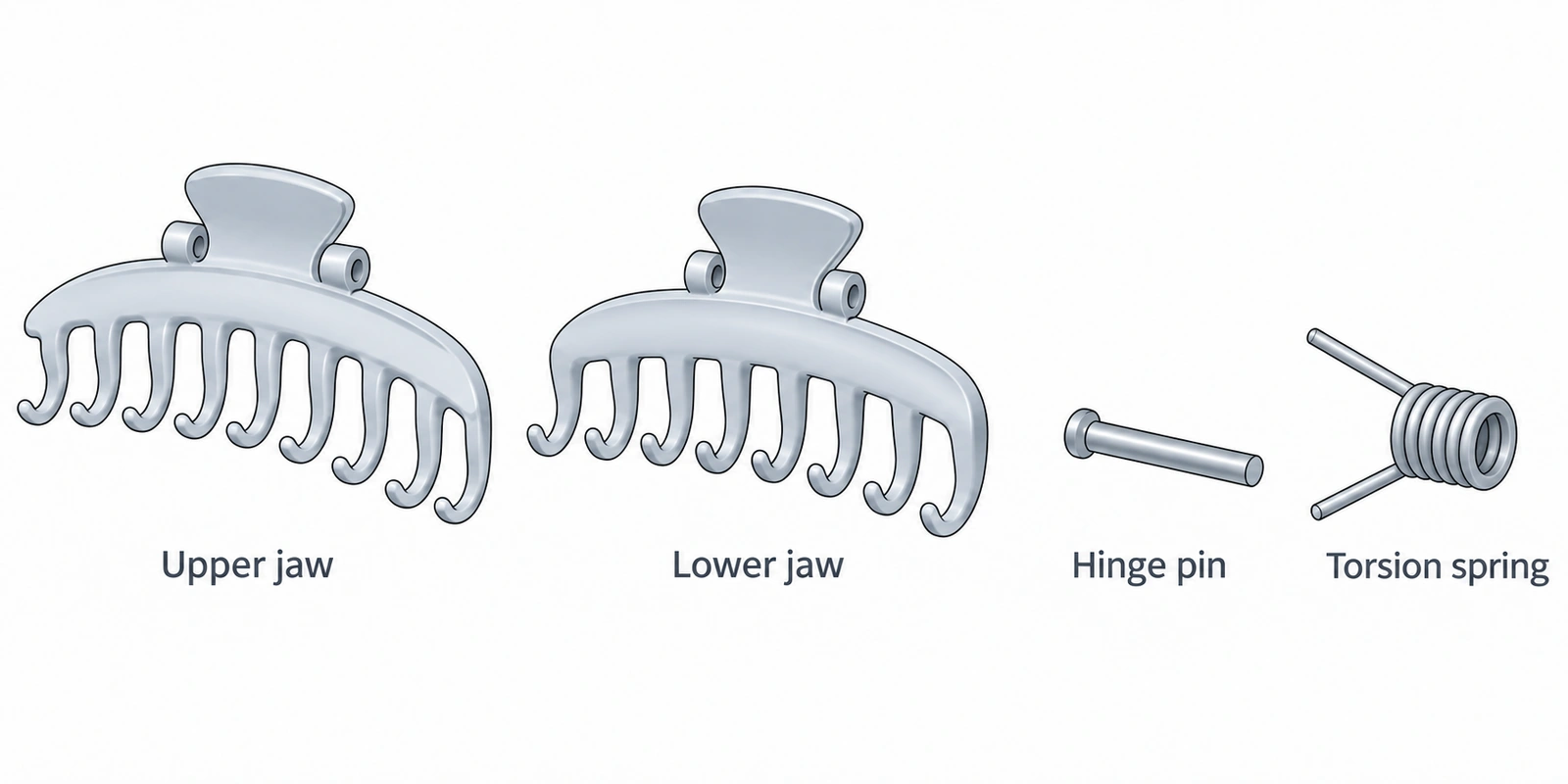
A claw clip looks like one part. In production it is at least four: an upper jaw, a lower jaw, a hinge pin, and a spring. Each part has its own material grade and its own failure point.
Two factories quoting “the same” 9 cm acetate claw clip are rarely quoting the same thing. One may price a thinner sheet, a lighter spring, and machine polishing only. The other may price a thicker sheet with hand polishing. The lowest quote is often the one that leaves the spring specification blank.
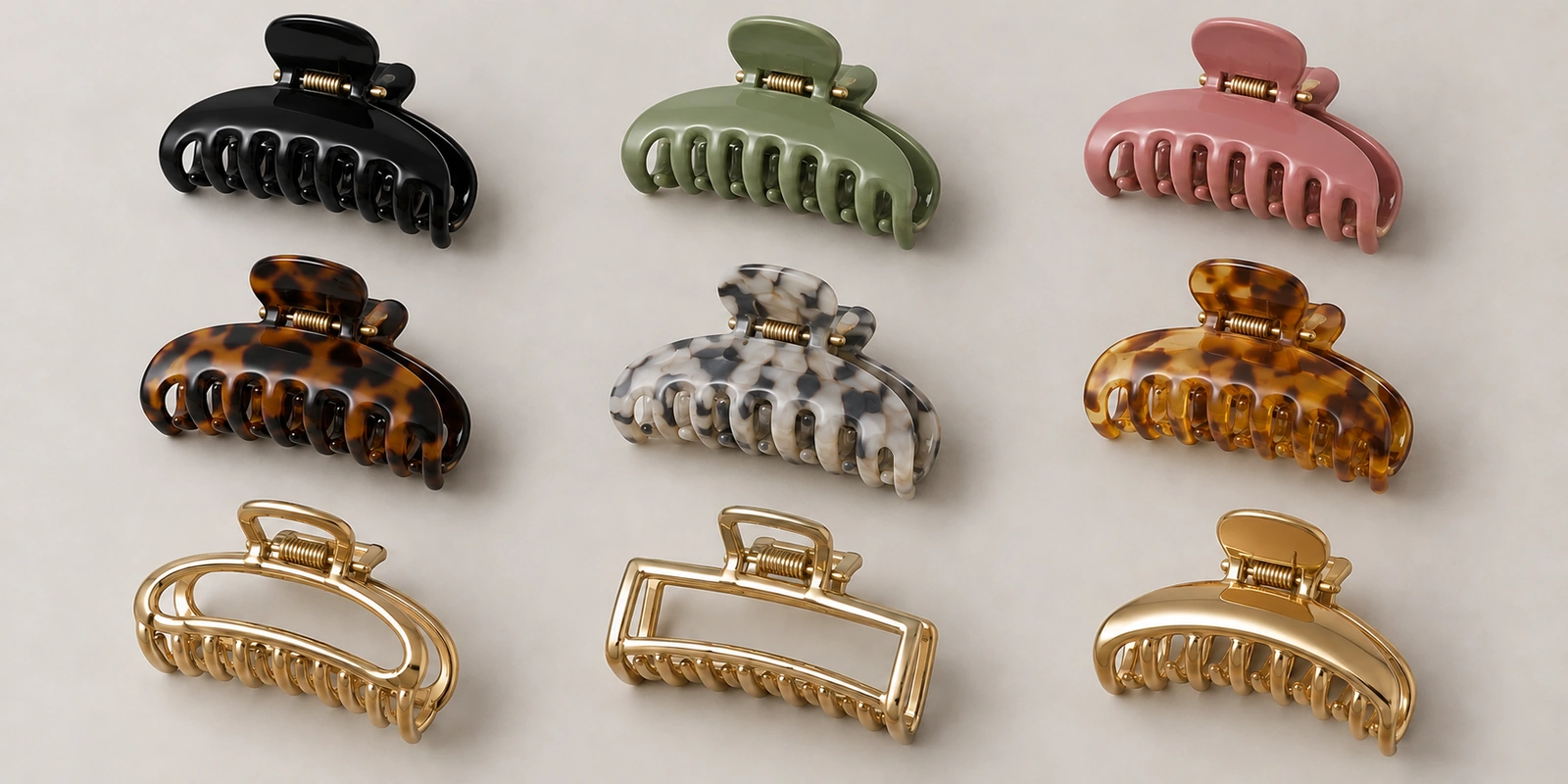
Material sets the floor of the unit price before any other decision is made. The comparison below summarises how the main claw clip materials rank on cost and where each one usually sells.
| Material | Relative Unit Cost | Forming Process | Typical Positioning |
|---|---|---|---|
| ABS / PC plastic | Entry | Injection molding | Mass retail, multipacks |
| Recycled plastic | Entry to mid | Injection molding | Sustainable lines |
| Matte or frosted plastic | Entry to mid | Molding plus surface finish | Fashion basics |
| Cellulose acetate | Mid to upper | Sheet cutting, polishing | Boutique, gift |
| Metal alloy | Mid to upper | Die casting, plating | Statement pieces |
| Decorated acetate or metal | Upper | Hand setting | Occasion, bridal |
Plastic claw clips carry the lowest unit cost because one mold cycle produces finished jaws in seconds. Color is added to the resin, so a new color costs a production changeover, not new tooling. Recycled resin adds material cost and certification paperwork.
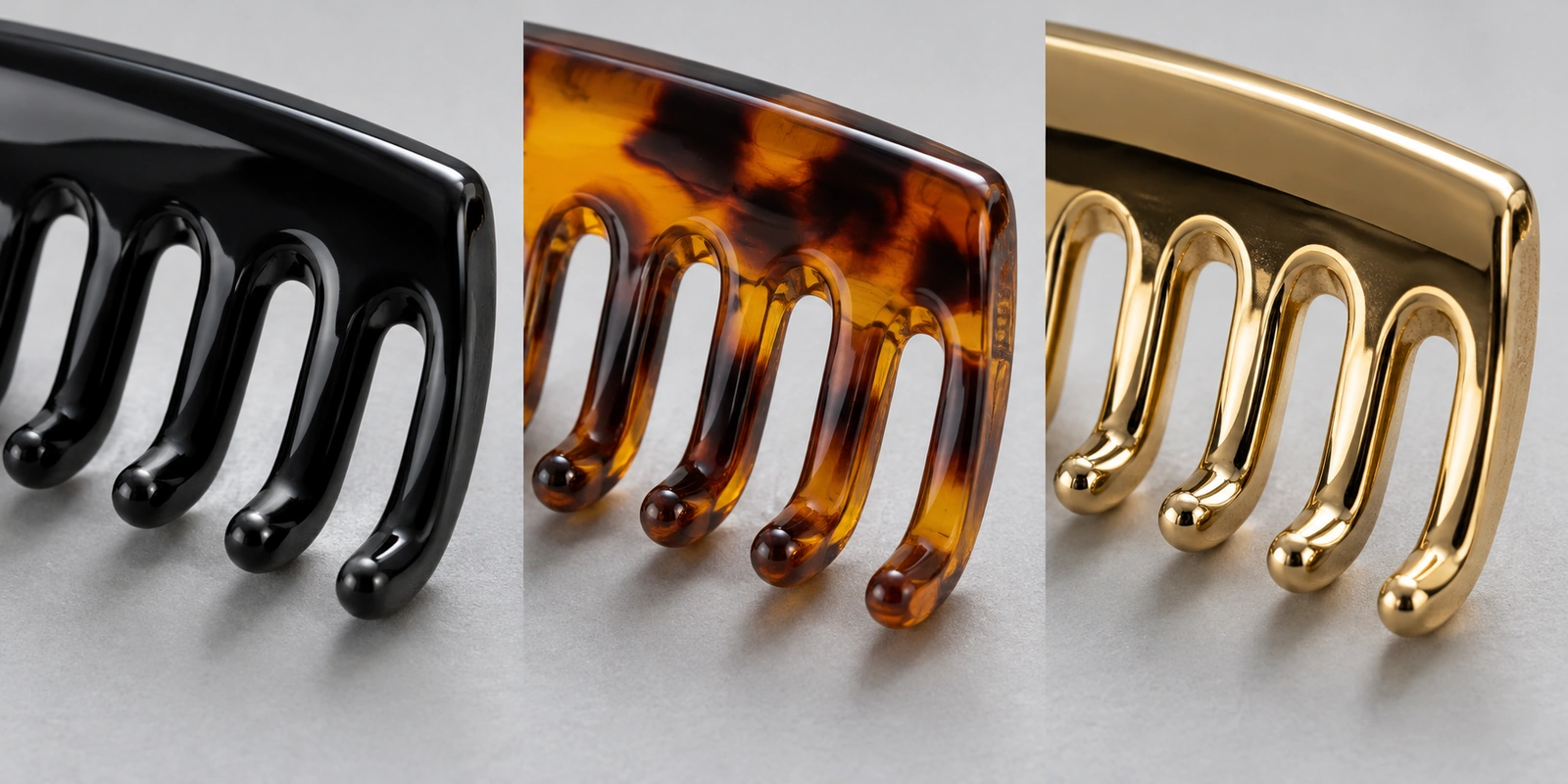
Cellulose acetate arrives as patterned sheet, which is cut, shaped, and polished. The pattern runs through the material, which is why tortoise and marble effects look deeper than printed plastic. It is also why acetate will not reach plastic pricing. A brand that wants both acetate depth and plastic cost has to pick one; the comparison of plastic claw clips vs acetate claw clips sets out the trade-offs in detail.
Metal clips add casting, polishing, and plating steps. Rhinestones and pearls are usually set by hand. Hand labour does not get cheaper with volume the way molding does, so decorated clips keep a high unit price at any quantity.
Quantity changes the price because fixed costs are spread across more pieces. Machine setup, color matching, and sample approval cost the same whether the run is 300 pieces or 3,000.
Ordering an existing design in a color already in production carries the lowest entry point, from about 100 pieces per style at factory-direct suppliers. There is no tooling and no color matching. The unit price is the highest per piece of the three tiers, but total spend is small.
A custom color or logo on an existing mold typically needs 300 to 500 pieces per style per color. The extra minimum pays for color matching and a dedicated run. Unit price drops at this tier because the run is long enough to absorb setup.
A new jaw shape needs new tooling and usually 1,000 pieces or more per SKU. The tooling is either paid upfront or spread into the unit price. Above a few thousand pieces, material and labour dominate and further quantity breaks become small.
Buyers compare claw clips by material and look. Factories price them by size and hardware as well. These details rarely appear on a mood board, yet they decide whether the clip survives retail use.
Material cost scales with jaw size. A large clip for thick hair uses more resin or sheet and a stronger spring than a mini clip. Standard sizes run on existing molds; intermediate sizes such as 5, 7, 9, and 11 cm may need custom tooling. The claw clip size guide lists common lengths and the hair types each suits.
The spring is the part most often cut to lower a quote. A weak spring saves very little per piece. It costs far more in returns when clips slip or lose tension after a few weeks.
Stainless or plated pins resist rust in humid bathrooms. Unplated pins are cheaper and discolor. For EU markets, metal parts that touch skin may also need nickel release testing.
A claw clip mold is a set of four to six components: upper jaw, lower jaw, hinge, and spring housing. That set explains why new claw clip shapes cost more to start than new hair tie colors.
Factories charge tooling in two ways. Some invoice it as a one-time fee. Others build it into the unit price over an agreed quantity. The second option looks cheaper per order and costs more if reorders continue past that quantity.
Ownership should be written into the purchase agreement before tooling starts. Paying for a mold does not always mean the buyer controls it. Ask whether the factory will refrain from selling the shape to other brands, and for how long.
For a first order under 1,000 pieces, an existing mold with a custom color and logo usually makes more commercial sense. Factories with libraries of 2,000 or more existing molds can often match a target shape closely enough. More on how molds are built is covered in the guide to injection molding for hair accessories.
Add-ons change the unit price less than material does, but they also add their own minimums. That second effect surprises first-time buyers more than the price.
A polybag adds almost nothing. A printed backing card or gift box adds print setup, and printers set their own minimum per design. A brand ordering 300 clips may find the box minimum is higher than the clip minimum.
The following video shows how plastic claw clips are assembled by machine, including spring and hinge fitting.
A quote is only comparable when every supplier prices the same specification. Most pricing disputes start with a brief that left decisions to the factory.
Unit price usually excludes freight, import duty, and third-party testing. Confirm the trade term on each quote; the Incoterms rules published by the ICC define where the supplier’s cost ends. An EXW price and a FOB price for the same clip are not the same number.
Ask for a pre-production sample at the quoted specification. If the sample does not match the quote, the quote was not real.
Q: How much does a custom claw clip cost?
There is no single figure. Plastic clips sit at the entry level, acetate and metal sit in the middle to upper range, and hand-decorated clips cost the most. Order quantity, clip size, spring grade, logo method, and packaging then move the price within each range.
Q: Why are acetate claw clips more expensive than plastic ones?
Plastic jaws come out of a mold finished in one cycle. Acetate starts as patterned sheet that must be cut, shaped, and polished, often partly by hand. The sheet itself also costs more than resin, so acetate cannot match plastic pricing at any volume.
Q: What is the minimum order for custom claw clips?
Factory-direct suppliers commonly accept about 100 pieces per style for existing designs in stock colors. Custom colors or logos on existing molds usually need 300 to 500 pieces per style per color. A new mold typically needs 1,000 pieces or more per SKU.
Q: Do I have to pay for a new claw clip mold?
Only if the shape does not already exist. Tooling is charged as an upfront fee or built into the unit price over a set quantity. Many first orders use an existing mold with a custom color and logo, which avoids tooling completely.
Q: What costs are not included in a claw clip quote?
Freight, import duty, and third-party lab testing are usually excluded. Printed packaging may be quoted separately with its own minimum. The trade term on the quote, such as EXW or FOB, shows where the supplier’s responsibility for cost stops.
The cost of custom claw clips is set first by material, then by quantity tier, then by size, spring, logo, and packaging. Buyers get comparable quotes only when they fix those inputs before asking.
Manufacturers such as JunYi Beauty, which runs injection molding and acetate finishing at its Dongguan facility with a library of more than 2,000 existing molds, represent the type of custom claw clip manufacturer that can quote the same clip at several material and quantity levels.
👉 Searching for Hair Accessories ? Your brand deserves the best.