Home
Product
Contact
Odm/Oem
About
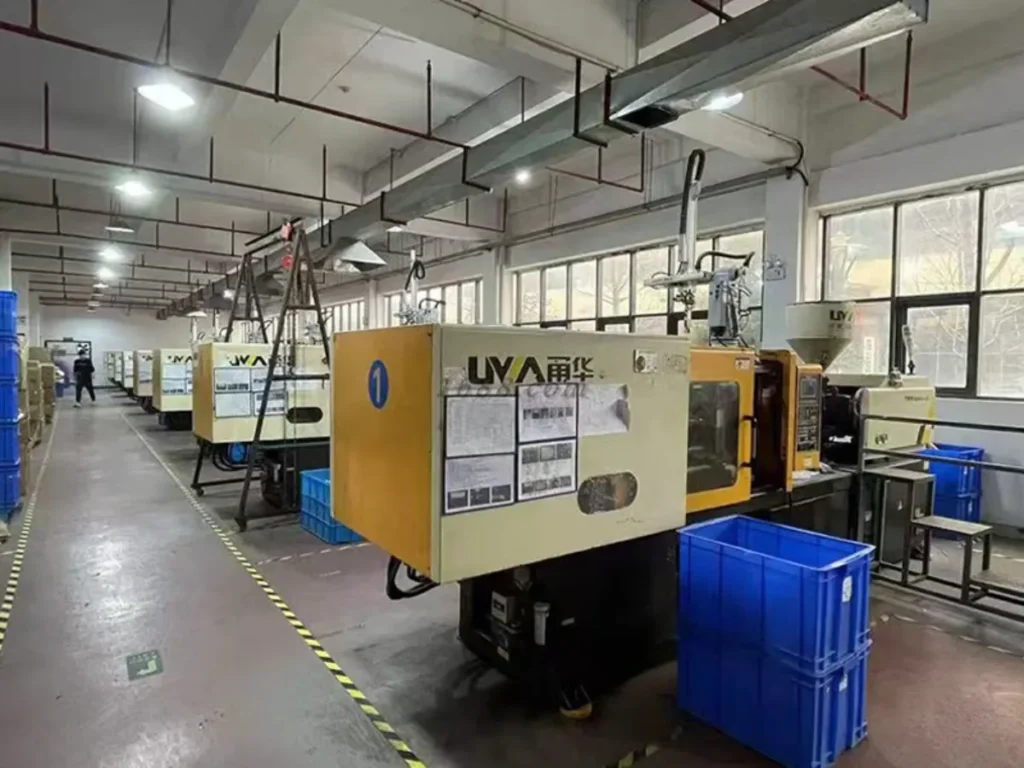
Injection molding is the manufacturing process behind the majority of plastic hair accessories on the market, from claw clips and snap clips to headbands and comb teeth. The process melts plastic pellets, injects the molten material into a precision-machined steel mold under high pressure, cools it into the finished shape, and ejects the part, with a full cycle typically completed in fifteen to sixty seconds. For anyone sourcing hair accessories at scale, understanding the basics of this process explains most of what determines product cost, minimum order quantities, quality consistency, and the economics of custom design.
This guide walks through how injection molding works, which plastics are used for which accessory types, what tooling means for cost and MOQ, the quality defects to look for, and the questions worth asking a manufacturer before committing to production.
The process runs in a repeating cycle with four main stages:
A single mold can contain multiple cavities producing several parts per cycle. A four-cavity claw clip mold running a thirty-second cycle produces roughly 480 clip bodies per hour per machine, which is the arithmetic behind the low unit costs that molded accessories achieve at volume.
Material selection determines the look, feel, durability, and price tier of the finished accessory. The main molding plastics in this category:
| Material | Typical Products | Key Properties | Price Tier |
|---|---|---|---|
| ABS | Claw clips, snap clip bodies, headbands | Rigid, good surface gloss, easy to colour | Low to mid |
| Polypropylene (PP) | Living-hinge parts, budget clips, combs | Flexible, fatigue resistant, lowest cost | Low |
| Polycarbonate (PC) | Transparent premium clips | High clarity, impact strength | Mid to high |
| Nylon (PA) | Alligator clip bodies, comb teeth, spring-stress parts | Tough, flexible, wear resistant | Mid |
| PCTG / Tritan-type copolyesters | Clear jelly-look clips | Glass-like clarity, better chemical resistance than PC | Mid to high |
| Recycled ABS / rPET blends | Sustainability-positioned lines | Comparable function, documented recycled content | Mid |
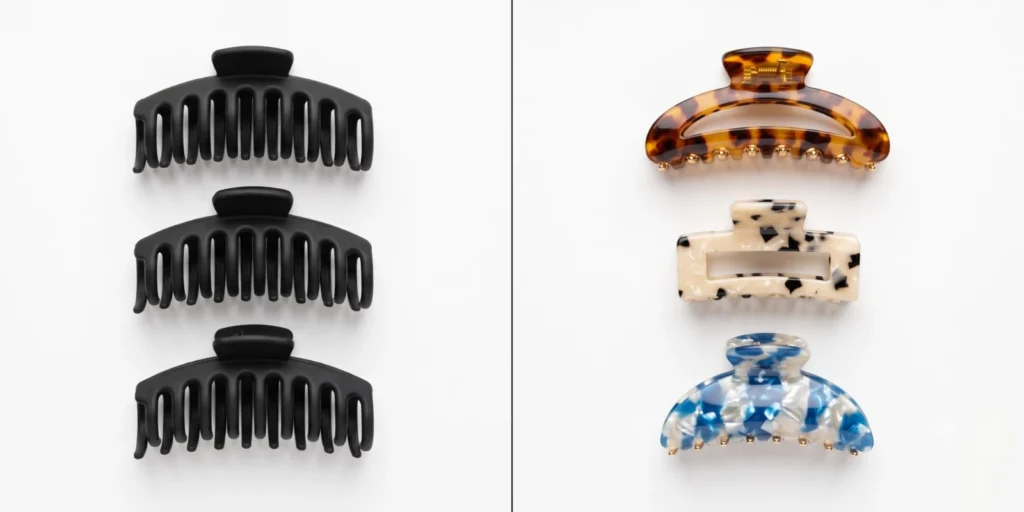
One distinction matters more than any other in this category: cellulose acetate is not injection molded. The marbled, tortoiseshell-pattern premium clips associated with acetate are machined and polished from cast acetate sheets in a separate, more labour-intensive process. When a supplier offers an “acetate-look” clip at an injection-molded price, the product is typically ABS or PC with a printed or in-mold pattern. Both are legitimate products at their respective price points, but buyers comparing quotes should confirm which process and material a quote actually covers. The differences are covered in more depth by any experienced claw clip manufacturer working across both processes.
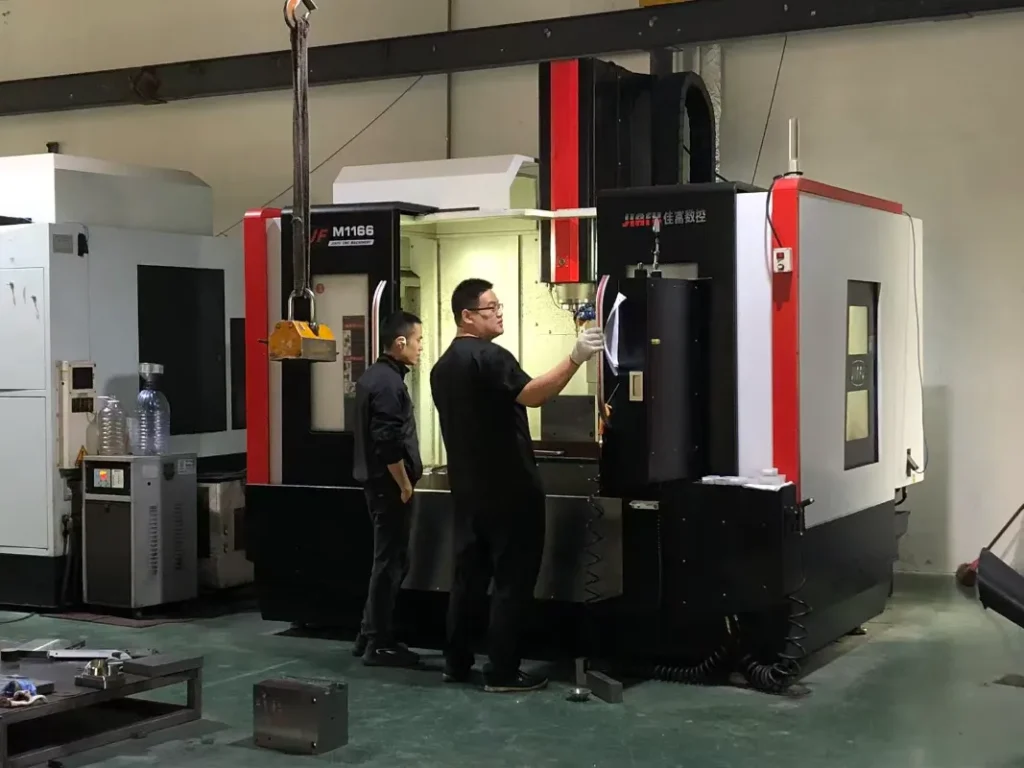
The mold, or tooling, is the precision-machined steel block containing the negative form of the part. It is the single largest fixed cost in molded accessory production and the reason custom designs carry minimum order quantities.
For hair accessories, new single-product tooling commonly falls in the range of a few thousand US dollars, far below the tooling costs of larger consumer goods, because the parts are small. This is why the category supports custom development at relatively accessible volumes: a new claw clip shape can reach production for a tooling investment that a mid-sized brand can amortise over one or two seasonal orders.
Modifying an existing mold, for example adding a brand logo to the cavity or adjusting a dimension, costs a fraction of new tooling, which is why suppliers with large existing mold libraries can offer custom-feeling products at near-stock MOQs. This is the standard entry route in OEM and ODM hair accessories manufacturing, where buyers select from existing tooling and customise material, colour, finish, and branding.
The economics of the process explain the commercial terms buyers encounter:
Typical MOQs in the category follow this structure: stock designs in stock colours from 100 to 300 units, stock designs in custom colours from 500 to 1,000 units per colour, and new custom tooling from 1,000 to 3,000 units to amortise the mold investment.
Molding defects are visible to a trained eye and most are detectable in samples before an order ships. The ones that matter for hair accessories:
A background reference on the process and its engineering variables is maintained by the British Plastics Federation’s process guide to injection moulding, which covers the general mechanics in more technical depth than accessory-specific sourcing requires.
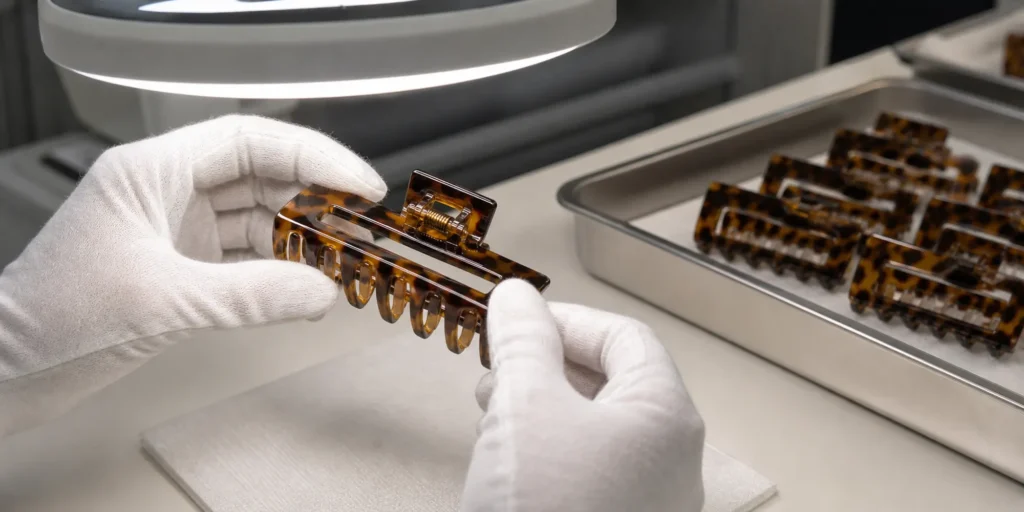
For buyers evaluating suppliers of molded hair accessories, a short list of process questions reveals more than a catalogue ever will:
The tooling ownership question deserves emphasis. When a buyer funds a new mold, the agreement should state that the mold belongs to the buyer and cannot be used for other customers. Reputable manufacturers document this as standard practice; the absence of a clear answer is itself an answer. Established suppliers of custom hair clips handle this contractually as a matter of routine.
Q: What is injection molding in hair accessories manufacturing?
Injection molding is the process that produces most plastic hair accessories: plastic pellets are melted, injected under high pressure into a precision steel mold shaped as the product, cooled, and ejected as a finished part. A full cycle takes fifteen to sixty seconds and a multi-cavity mold produces several parts per cycle, which is what makes molded accessories economical at volume.
Q: Are acetate hair clips injection molded?
No. Genuine cellulose acetate clips are machined and hand-polished from cast acetate sheets, a slower and more labour-intensive process, which is why real acetate products cost several times more than molded plastic equivalents. Injection molded clips offered with acetate-style patterns are typically ABS or polycarbonate with printed or in-mold decoration. Both are legitimate products, but quotes should state clearly which process and material they cover.
Q: How much does a hair accessory mold cost?
Tooling for small accessories typically costs from the low thousands of US dollars for a simple single-product mold, rising with part complexity, cavity count, steel grade, and surface finish requirements. Modifying an existing mold, such as adding a logo or adjusting a dimension, costs a fraction of new tooling, which is why working from a manufacturer’s existing mold library is the most economical route to a customised product.
Q: Why do custom colours increase the MOQ?
Every colour change requires purging the machine barrel of the previous colour and running a dedicated masterbatch, which consumes machine time and material before the first sellable part of the new colour is produced. MOQs therefore apply per colour rather than per design, typically from 500 to 1,000 units per custom colour, so that setup costs are spread across a reasonable production quantity.
Q: What molding defects should buyers check for in samples?
The defects that affect hair accessories in use are flash along teeth edges, which snags hair; short shots that leave teeth or thin sections incompletely formed; weld lines positioned across stress points such as hinges; and warpage that prevents claw clip jaws from closing evenly. Colour consistency between batches is the most common issue in repeat orders and is worth specifying with a physical colour standard.
Q: Who owns the mold when a buyer pays for custom tooling?
When the buyer funds the tooling, ownership should be assigned to the buyer in writing, with the mold held at the factory for production but not usable for other customers. This is standard practice among established manufacturers. Buyers should confirm tooling ownership terms before paying mold fees, since the mold represents both the investment and the design exclusivity of the product.
Injection molding explains most of the commercial logic of the plastic hair accessories market: why unit costs fall so steeply with volume, why MOQs exist per colour rather than per order, why custom tooling is more accessible in this category than in larger consumer goods, and why the acetate distinction separates the premium tier from the molded mainstream. A buyer who understands the four-stage cycle, the material options, and the handful of visible quality defects is equipped to read quotes accurately and evaluate samples with confidence.
Manufacturers such as JunYi Beauty, which operates injection molding alongside sheet acetate processing at its Dongguan facility under ISO 9001:2015 and amfori BSCI certification, offer buyers both processes under one quality system, with existing tooling libraries and custom mold development covering the full span from stock programmes to fully bespoke product lines.
👉 Searching for Hair Accessories ? Your brand deserves the best.