Home
Product
Contact
Odm/Oem
About
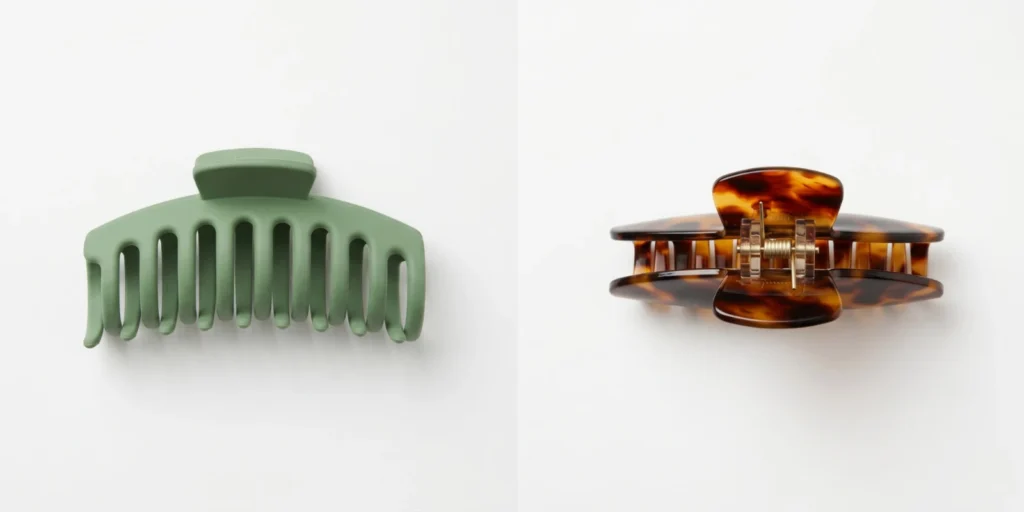
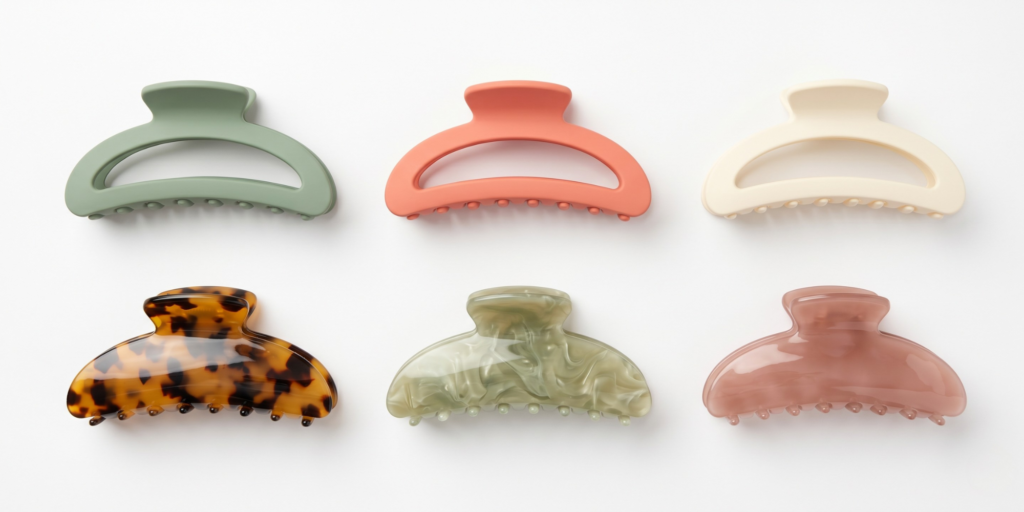
A plastic claw clip is a spring-loaded hair fastening accessory produced from ABS (acrylonitrile butadiene styrene) or similar synthetic polymer substrates through injection moulding — a process that produces consistent dimensional accuracy at high volume and low cost across a wide range of colours and sizes. An acetate claw clip is produced from cellulose acetate, a semi-synthetic material derived from wood pulp cellulose, which is processed into sheets, rods, or blocks before being cut and polished into clip components — a production method that generates distinctive translucent, marbled, and patterned visual effects that injection moulding cannot replicate.
Both product types perform the same mechanical function — gripping gathered hair through spring-loaded jaw tension — but differ substantially in material composition, aesthetic range, tactile quality, durability profile, environmental credentials, and price positioning. This guide examines these differences in detail to support consumers making purchasing decisions and B2B buyers making range and sourcing decisions.
ABS is the dominant substrate for mass-market claw clip production. It is a petroleum-derived thermoplastic polymer that can be injection-moulded at high speed into precise, complex shapes with consistent wall thickness and dimensional accuracy. ABS is lightweight, impact-resistant, and chemically stable — it does not absorb moisture, does not degrade in normal humidity conditions, and maintains its shape across a wide temperature range.
The surface of an ABS clip is typically opaque and uniform in colour — the colour is achieved through pigment addition to the raw polymer before moulding, and the result is a solid, consistent finish with no variation within a single colour run. Some ABS clips receive secondary surface treatments such as electroplating, UV coating, or printed pattern application to extend their aesthetic range, but the base material itself does not produce translucent or depth-of-colour effects.
Cellulose acetate is a semi-synthetic material produced by reacting cellulose — derived from wood pulp, typically sourced from sustainably managed forests — with acetic acid. The resulting material is processed into sheets or rods in which colour pigments and pattern layers are incorporated during production, creating the layered, translucent, and marbled visual effects that distinguish acetate from all synthetic alternatives.
Acetate is denser and heavier than ABS — a characteristic that contributes to its premium tactile feel. It is also more rigid and less impact-resistant than ABS; acetate clips are more susceptible to cracking or chipping if dropped on hard surfaces, a trade-off accepted in the premium segment for the aesthetic and material benefits the material provides. Acetate is not injection-moulded; components are cut or machined from sheet or rod stock and then polished, a production process that is more labour-intensive and time-consuming than injection moulding, which is reflected in higher per-unit cost.
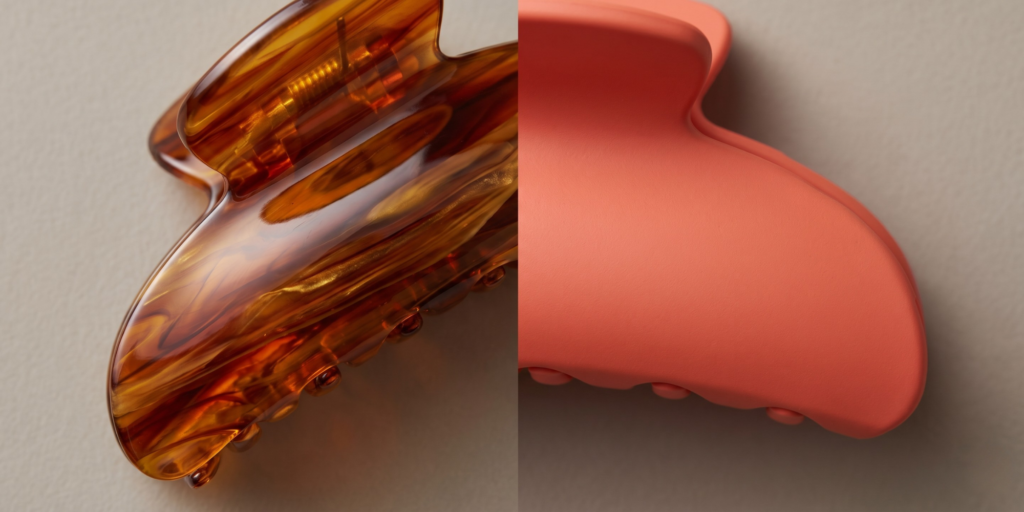
The most significant practical difference between plastic and acetate claw clips — and the primary reason consumers and brands choose acetate at higher price points — is aesthetic. The two materials produce fundamentally different visual results that cannot be replicated by either material in the other’s domain.
ABS plastic produces solid, uniform colour finishes with consistent opacity. The colour range is effectively unlimited — any pigment can be added to the polymer prior to moulding — and the production economics allow a wide colour assortment within a single product range at low cost. ABS clips can be produced in matte, gloss, or semi-gloss surface finishes, and secondary decorative treatments such as metallic plating, glitter encapsulation, or printed pattern can extend their aesthetic range beyond solid colour.
The limitation of ABS is that it cannot produce the translucency, colour depth, or natural pattern variation that characterises premium acetate. A solid green ABS clip and a solid green acetate clip may appear similar in photography — but in hand, the acetate’s layered translucency, weight, and temperature response distinguish it immediately from its plastic equivalent.
Acetate’s defining aesthetic properties are translucency and pattern depth. Because acetate sheets are produced with layered colour pigments, the material has visible depth — light passes through the outer layers and reflects off interior colour layers, creating an optical effect that changes slightly with viewing angle and lighting conditions. This is the characteristic that produces the distinctive tortoiseshell, marble, and colour-block effects that define the premium claw clip aesthetic.
No two acetate clips are precisely identical — the natural variation in how pattern layers interact during sheet production means that each clip has subtle individual character. This variation, which would be a defect in ABS production, is a valued feature in acetate, contributing to the sense that each piece is unique.
The acetate colour and pattern range is also extensive but different in nature from ABS: the effects achievable in acetate — deep amber tortoiseshell, smoky translucent grey, layered floral patterns, gradient colour blends — cannot be produced in ABS regardless of secondary treatment.
Both plastic and acetate claw clips perform the same mechanical function, and for most everyday styling purposes, the hold performance of a well-made ABS clip is equivalent to an acetate clip of the same size and spring specification. The functional differences between the two materials relate to durability, tactile experience, and long-term use characteristics rather than hold performance per se.
| Variable | ABS Plastic Clip | Acetate Clip |
|---|---|---|
| Hold performance | Equivalent for same size and spring spec | Equivalent for same size and spring spec |
| Weight | Light | Heavier — denser material |
| Impact resistance | High — flexible, does not crack easily | Lower — may chip or crack if dropped |
| Surface durability | Scratch-resistant | Can scratch; polish restores surface |
| Temperature response | Minimal — stays cool | Warms to body temperature — premium feel |
| Moisture resistance | Fully resistant | Avoid prolonged water exposure |
| Longevity | High — resistant to physical damage | High if handled carefully; brittle if dropped |
| Spring life | Determined by spring, not body material | Determined by spring, not body material |
| Tactile quality | Light, plasticky | Weighted, warm, premium |
| Hair contact | Smooth — low friction on hair | Smooth — low friction on hair |
According to research on hair cuticle friction and mechanical damage, the surface smoothness of the clip’s teeth and jaw interior is the primary determinant of hair health impact — and both well-finished ABS and acetate clips present similarly low friction to the hair shaft. The material itself is less important for hair health than the quality of the finishing on the tooth surfaces.
The environmental difference between plastic and acetate claw clips is a meaningful purchasing consideration for both consumers and brands positioning on sustainability.
ABS is a petroleum-derived synthetic polymer — its production relies on fossil fuel feedstocks and generates greenhouse gas emissions consistent with petrochemical manufacturing. ABS is technically recyclable but is not widely accepted in municipal recycling streams for small consumer goods, meaning most ABS claw clips end their life in landfill. Some manufacturers offer ABS clips produced from recycled content, which partially addresses the virgin material concern, and certification under the Global Recycled Standard is available for products meeting recycled content criteria.
Cellulose acetate is derived from wood pulp cellulose — a renewable, plant-based raw material — rather than petroleum. This plant-based origin is the primary environmental advantage of acetate over ABS, and it is frequently cited in the premium accessory market as a sustainability credential. However, acetate’s environmental profile is more nuanced than a simple “natural vs synthetic” comparison: the manufacturing process involves acetic acid and other chemical inputs, acetate is not readily biodegradable in landfill conditions, and the sustainability credentials of the wood pulp source depend on responsible forestry certification.
Brands positioning acetate claw clips on environmental grounds should be specific about the claim — “plant-based material origin” is accurate and defensible; “biodegradable” or “eco-friendly” without qualification may not be, depending on the specific product and disposal conditions.
The price difference between ABS and acetate claw clips reflects both the higher material cost and the more labour-intensive production process of acetate. At retail, acetate clips typically command a 2x to 5x price premium over equivalent ABS clips — a premium that is supported by the material’s aesthetic distinctiveness, tactile quality, and perceived sustainability credentials.
| Dimension | ABS Plastic Clip | Acetate Clip |
|---|---|---|
| Typical retail price range | $2–$8 per clip | $8–$35 per clip |
| Target consumer | Everyday, value-conscious, trend-driven | Premium, gift, sustainability-conscious |
| Retail channel fit | Mass market, drug store, fast fashion | Boutique, premium beauty, gift retail |
| Brand positioning | Accessible, colourful, seasonal | Premium, timeless, investment piece |
| Gift suitability | Low to medium | High — perceived value supports gifting |
| Social media appeal | High — wide colour range, trend-responsive | Very high — photogenic material effects |
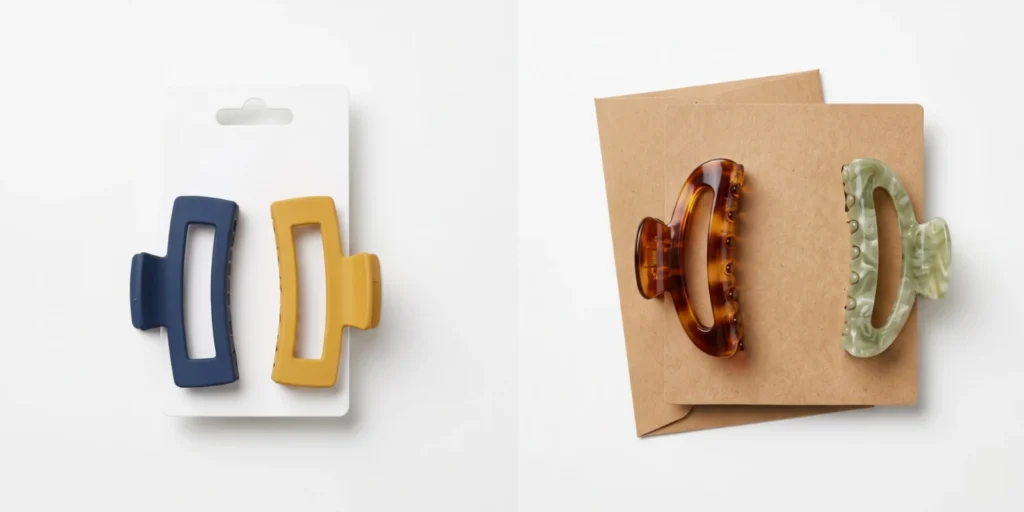
ABS claw clips are the most straightforward category to source from factory-direct OEM suppliers. Injection moulding tooling for standard clip silhouettes is widely available in existing mould libraries, significantly reducing tooling investment for buyers sourcing standard shapes. Production lead times are shorter than acetate, colour minimums are lower due to the ease of colour changeover in injection moulding, and per-unit costs are substantially lower. Standard MOQs from factory-direct OEM suppliers begin at 300–500 units per style per colour for standard constructions.
Key quality control variables for ABS clips include surface finish consistency, colour accuracy across production runs, spring tension uniformity, and hinge pin retention. Buyers sourcing ABS clips for the premium end of the mass-market range should specify smooth, burr-free tooth finishing — this directly affects both hair health performance and perceived quality at point of sale. Brands developing a comprehensive plastic clip range should work with a custom hair clip manufacturer that offers colour matching, surface finish options, and spring tension selection within a single production relationship.
Acetate claw clips require more complex sourcing management than ABS. The material must be sourced as sheet or rod stock before being cut, machined, and polished into clip components — a multi-step process that most injection moulding factories do not operate in-house. Buyers should confirm that their OEM partner either operates their own acetate processing line or has an established relationship with a specialist acetate processor, as quality consistency is difficult to maintain through fragmented subcontracting.
MOQs for acetate clips are typically comparable to ABS — 300–500 units per style per colour — but colour and pattern minimums may be higher if custom pattern sheets need to be produced. Standard patterns (tortoiseshell, solid translucent, marble) are typically available from existing sheet inventory at lower minimums than fully custom patterns. Lead times are longer than ABS due to the multi-step production process. Brands developing a premium acetate clip range should work with an acetate claw clip manufacturer that maintains its own material inventory and finishing capability, ensuring quality control across the full production chain.
For most B2B buyers, the most commercially effective approach is to stock both ABS and acetate claw clips as distinct range tiers rather than choosing between them. ABS clips cover the accessible, trend-responsive, high-turnover end of the range; acetate clips anchor the premium, gift-suitable, brand-elevating end. Together they address the full consumer price spectrum and support both everyday replenishment purchasing and considered gift purchasing within a single product category. Buyers engaging OEM hair accessories manufacturing partners should confirm that the supplier can produce both material types — not all factories combine injection moulding and acetate processing capability.
From a hair health perspective, the material of the claw clip body — whether ABS or acetate — is not a significant variable in breakage or damage risk. Both materials, when well-finished, present smooth surfaces that do not snag or abrade the hair cuticle differently from one another. The variables that affect hair health are the quality of the tooth finishing, the spring tension specification, and whether the clip is correctly sized for the hair volume being held — all of which apply equally to both material types.
The practical considerations that should inform a purchase or sourcing decision between plastic and acetate are therefore aesthetic, tactile, durability, and price — not hair health. If a consumer needs a clip for everyday wear that will be replaced frequently, an ABS clip is the practical choice. If a consumer is purchasing a considered accessory — one they intend to wear for years, that they want to photograph, or that serves as a gift — acetate’s aesthetic and tactile qualities justify its price premium.
Plastic claw clips are produced from ABS polymer through injection moulding, resulting in solid, uniform colour finishes at lower cost. Acetate claw clips are produced from cellulose acetate — a semi-synthetic material derived from wood pulp — which is cut and polished from sheet stock, producing the translucent, marbled, and tortoiseshell visual effects that distinguish premium clips. The two materials perform similarly in terms of hold, but differ substantially in aesthetic quality, tactile feel, durability profile, environmental credentials, and price.
Neither material is inherently better or worse for hair health. The variables that affect how a claw clip interacts with the hair shaft — tooth surface finish, spring tension, and clip size — are independent of whether the body is made from ABS plastic or cellulose acetate. Both materials, when well-finished, present smooth, low-friction surfaces that do not cause meaningful hair damage in normal use. The choice between plastic and acetate is better framed as an aesthetic and value decision than a hair health decision.
In terms of everyday wear durability, ABS plastic is more impact-resistant than cellulose acetate — plastic clips flex on impact, whereas acetate is more rigid and may chip or crack if dropped onto a hard surface. However, acetate clips that are handled carefully can last many years without degradation. The spring — rather than the body material — is typically the first component to fail in either type, and spring quality is a function of the spring material and gauge specification rather than the clip body material.
Cellulose acetate has a plant-based material origin — it is derived from wood pulp cellulose rather than petroleum — which gives it a more sustainable raw material profile than ABS plastic. However, acetate is not readily biodegradable under typical landfill conditions, and its production involves chemical processing inputs. The most defensible environmental claim for acetate clips is plant-based material origin; “biodegradable” or “eco-friendly” claims without qualification may not be accurate depending on the specific product and disposal context. ABS clips produced from recycled polymer content can reduce their virgin material footprint, and Global Recycled Standard certification is available for qualifying products.
At retail, acetate claw clips typically carry a 2x to 5x price premium over equivalent ABS plastic clips, reflecting the higher material cost and more labour-intensive production process. ABS clips typically retail between $2 and $8 per clip depending on size and market; acetate clips typically retail between $8 and $35 per clip depending on size, pattern complexity, and brand positioning. At wholesale and OEM levels, the price gap is similarly substantial — acetate requires more production steps and uses a more expensive raw material than injection-moulded ABS.
Standard MOQs for both ABS plastic and acetate claw clips from factory-direct OEM suppliers typically begin at 300–500 units per style per colour for standard constructions. ABS clips using existing mould tooling and standard colours can often achieve lower minimums than acetate clips, which may require minimum sheet quantities for custom patterns. Buyers sourcing both material types within a single order are often able to negotiate combined minimum requirements with established manufacturing partners that produce both categories.
Plastic and acetate claw clips are not competing alternatives so much as different products serving different consumer needs and price points within the same accessory category. ABS plastic clips offer unlimited colour range, high impact resistance, and accessible pricing — making them the right choice for everyday, trend-responsive, and high-turnover retail segments. Acetate clips offer translucent, marbled aesthetic effects that no synthetic material can replicate, a weighted premium tactile feel, and a plant-based material origin — making them the right choice for premium, gift, and sustainability-conscious segments.
For B2B buyers, the most commercially effective approach is to stock both as distinct range tiers, serving the full consumer price spectrum within a single product category. Manufacturers such as JunYi Beauty, which produces both ABS and acetate claw clips across multiple size formats and finish options at its Dongguan facility under ISO 9001:2015 and amfori BSCI certification, represent the type of factory-direct OEM partner suited to brands looking to build a complete claw clip range across both material tiers within a single supplier relationship.
👉 Searching for Hair Accessories ? Your brand deserves the best.