Home
Product
Contact
Odm/Oem
About
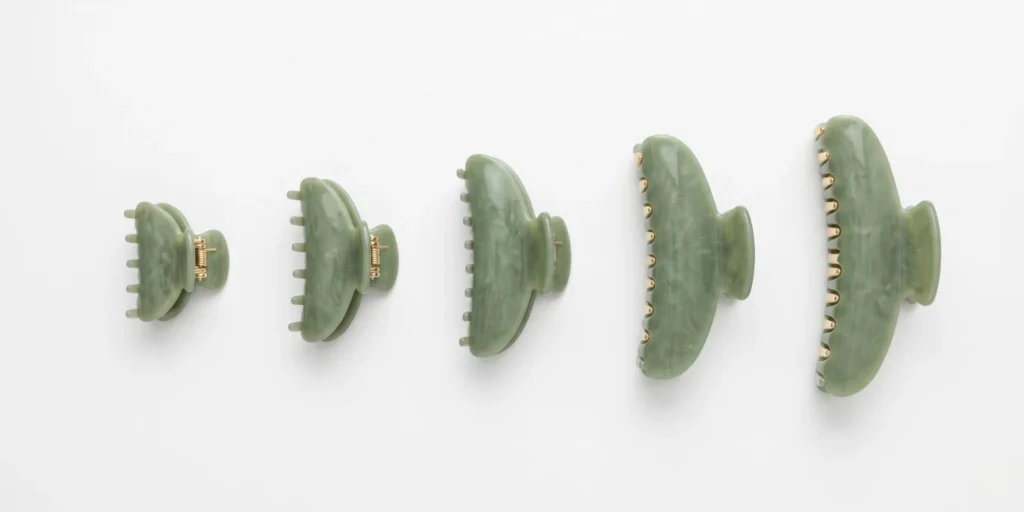
Claw clip size is the single most important variable in whether a clip holds your hair reliably or fails within minutes. The most common reason a claw clip does not hold — popping open during wear, slipping out gradually, or leaving indentations in the hair — is a size mismatch between the clip and the hair volume it is being asked to secure. A clip that is too small cannot close fully around a thick or long gathered section; a clip that is too large grips only a fraction of the jaw’s available surface, producing inconsistent hold.
This guide explains the claw clip sizing system, the relationship between clip size and hair type, and the practical decision rules that determine which size to choose for different hair volumes, lengths, and styling purposes — with sourcing context for B2B buyers developing size-assorted ranges.
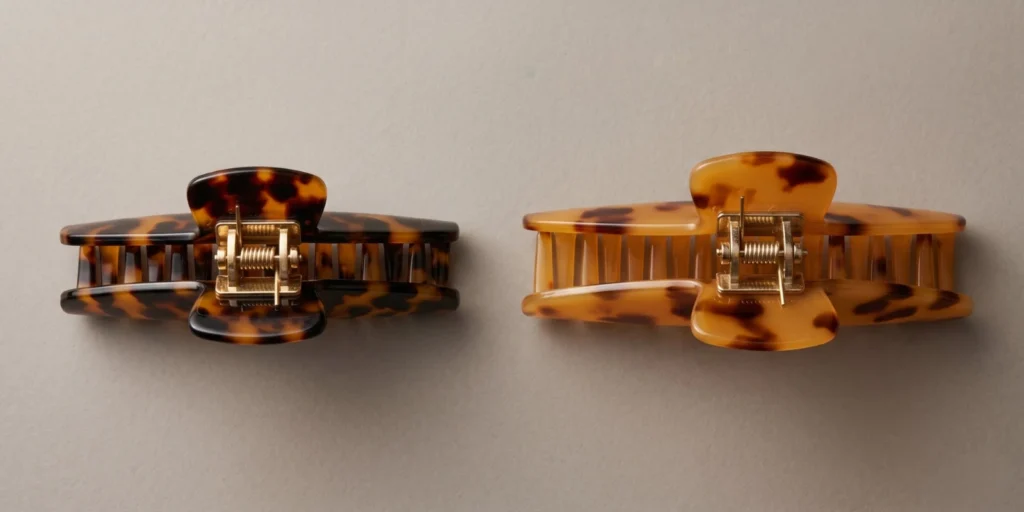
Claw clip size is measured by the length of the clip from one end of the jaw to the other when closed — typically expressed in centimetres. This measurement corresponds directly to the jaw span available to grip the gathered hair section: a longer clip has a wider jaw opening and can accommodate a larger gathered section before reaching the limits of its spring closing force.
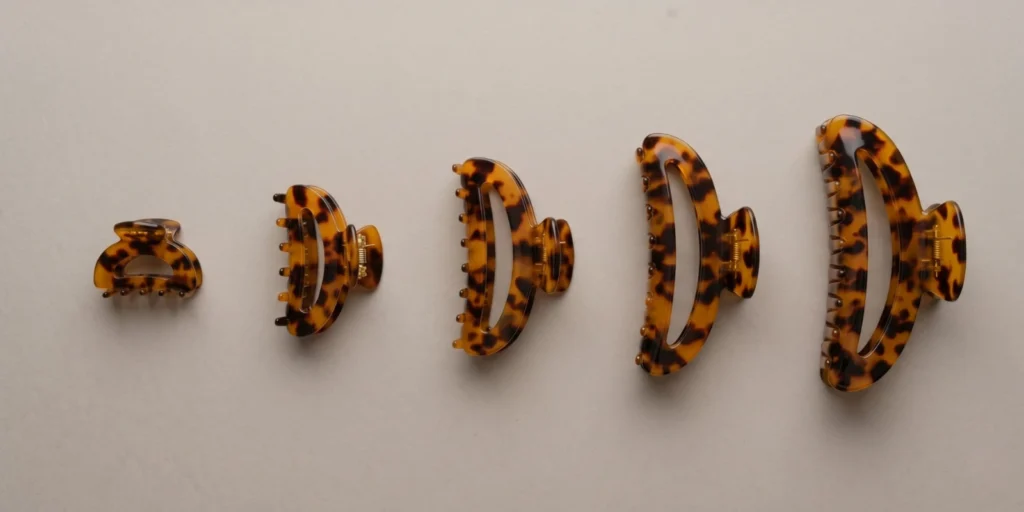
The size range for retail claw clips runs from approximately 4 cm (mini) to 12 cm or more (oversized), with the most common commercial sizes clustering at 4 cm, 6 cm, 8 cm, and 10 cm. Some manufacturers also produce 5 cm, 7 cm, 9 cm, and 11 cm sizes, but these intermediate sizes are less standard and typically require custom tooling. The following size categories are the most widely used in both retail and OEM production:
The most common misconception about claw clip sizing is that hair length determines which size clip to use. In practice, the determining variable is hair volume — the cross-sectional thickness of the gathered hair section — rather than how long the hair is.
A person with fine, straight hair that falls to the waist may need only a medium (8 cm) clip for a full bun, because the gathered section is not voluminous despite its length. A person with thick, coarse hair that only reaches shoulder length may need a large (10 cm) or oversized (12 cm) clip for the same style, because the gathered section is dense even at shorter length. Hair density — the number of individual strands per unit area of scalp — and individual strand diameter are both components of the total volume variable, and both affect which clip size will hold reliably.
Hair texture is a secondary variable: coarser, curlier hair tends to produce more volume in a gathered section than fine, straight hair of equivalent length and density, because the individual strands do not compress as tightly when gathered.
Mini clips are designed for accent and detail styling — they are not hold accessories for the full hair, but decorative or functional fasteners for small sections. Common uses include pinning back individual strands or layers at the temple or nape, creating small accent details in an updo, or securing the end of a braid. Mini clips can also be used as functional accessories for very fine, short hair where even a small section requires only minimal grip.
For B2B buyers, mini clips are a distinct product category from functional styling clips — they are primarily decorative, and their commercial positioning should reflect this. They are frequently sold in multi-pack formats of six to ten clips, and their per-unit retail price is typically lower than functional sizes despite similar production complexity.
Small clips are the primary size for fine hair and partial styling. For consumers with fine or thin hair, a small clip holds a full bun or updo without the excess jaw span that would occur with a medium or large clip. For consumers with medium to thick hair, small clips are most useful for half-up styles, side twists, or securing individual sections rather than holding the full hair volume.
Small clips are also the correct size for children’s hair accessories in the functional styling category — the gathered sections are smaller, and a medium or large clip would have insufficient grip on a small hair section.
Medium clips are the most versatile everyday size and the highest-volume commercial SKU across most claw clip ranges. They are suitable for fine to medium hair in full bun and updo styles, and for medium-density hair in partial styles. The medium size is the default choice when a consumer is unsure which size to buy — it covers the largest share of hair types at a single size.
For B2B buyers, medium clips should represent the deepest stock position within a size-assorted range. Colour and pattern width is typically broadest at medium size, and the medium clip is the most commonly purchased size for gifting and casual styling purchases.
Large clips are designed for medium-thick to thick hair in full bun and updo styling. At this size, the jaw span is sufficient to accommodate a substantial hair volume without the spring being forced to work at the extreme of its closing range — which is where early fatigue and popping-open failures occur. For consumers with genuinely thick hair, large clips represent the minimum functional size for reliable hold in a full bun.
Large acetate clips in the 10 cm range have become a significant fashion accessory category in their own right, driven by social media styling content featuring oversized clips as visible statement accessories. The large size has sufficient visual mass to read as a deliberate fashion element rather than a purely functional item, which has elevated the category’s average retail price point. Brands sourcing large clips should work with an acetate claw clip manufacturer to access the premium material and finish options that support this positioning.
Oversized clips are the correct specification for thick, very long, or high-volume hair — and also for the fashion-forward aesthetic of a deliberately exaggerated clip scale used as a styling statement regardless of hair type. At this size, the clip’s visual presence is substantial, and the jaw span can accommodate even the highest-volume gathered sections.
From a production standpoint, oversized clips require larger mould components and heavier spring specifications than standard sizes, and their per-unit material cost is higher. MOQs are typically comparable to standard sizes — 300–500 units per style per colour — but tooling investment is higher if custom silhouettes are required. Buyers developing oversized clip ranges for the thick-hair segment should specify reinforced spring tension alongside the extended jaw length, as a light spring in an oversized clip will fail under the load of a thick hair section.
| Hair Type | Recommended Size | Best For |
|---|---|---|
| Very fine, thin hair | Small (5–6.5 cm) | Full buns, half-up styles, updos |
| Fine to medium hair | Small to medium (6–8 cm) | Full buns, half-up, everyday styling |
| Medium density hair | Medium (7–8.5 cm) | Full buns, updos, half-up styles |
| Medium-thick hair | Large (9–10 cm) | Full buns, structured updos |
| Thick hair | Large to oversized (10–12 cm) | Full buns, messy buns, updos |
| Very thick or high-volume hair | Oversized (11–13 cm) | Full buns, high-volume updos |
| Short hair (above chin) | Mini to small (4–6 cm) | Accent sections, half-up, detail styling |
| Any hair, accent or detail styling | Mini (3.5–4.5 cm) | Temple pins, braid ends, layer accents |
| Any hair, fashion statement | Oversized (11–13 cm) | Visible statement accessory, editorial styling |
According to research on hair mechanical stress, using an undersized clip — one that cannot close fully around the gathered section — forces the spring to operate at the extreme of its compression range, increasing the localised pressure on the hair strands gripped by the partially closed teeth. Correct size selection reduces this pressure and distributes grip across the full jaw surface, lowering mechanical stress on the hair.
The simplest functional test for correct claw clip sizing is the closure test: gather your hair into the style you intend to wear (bun, half-up, etc.) and apply the clip. If the clip closes fully — the jaws meet and the teeth fully interlock with no visible gap — the size is appropriate or larger than needed. If the clip does not close fully or pops open under the hair’s outward pressure within a few seconds, the clip is too small and a larger size is required.
A secondary test is the slippage test: if a fully closed clip gradually loosens or slides out of the hair section within 30 minutes of normal wear, the clip may be too large — the jaw span is greater than the hair volume, and the teeth are gripping a narrow band of hair rather than the full section. In this case, a smaller clip will provide more concentrated grip on the gathered section.
This is the most common sizing error and the most frequently cited reason for claw clips failing to hold. Signs that a clip is too small include: the jaws do not close fully when applied, the clip pops open during wear, or the clip leaves visible pressure marks or indentations in the hair where the teeth have gripped under high spring compression. The solution is to size up — for most consumers who report that claw clips do not work for their hair, the issue is clip size rather than clip format.
Less common than undersizing but equally problematic, oversizing results in a clip that closes fully but grips only a portion of the available jaw surface. The hair section sits in the centre of the jaw, and the teeth grip it unevenly — often producing a loose hold that slides out gradually. The solution is to size down, or to gather a slightly larger section of hair to fill the jaw more completely.
A single clip size is rarely optimal for all styling contexts. A medium clip that holds a half-up style perfectly may be undersized for a full bun that gathers more hair volume. Many consumers benefit from owning two sizes — a medium for partial styles and everyday half-up wearing, and a large or oversized clip for full bun and updo styles that gather all the hair.
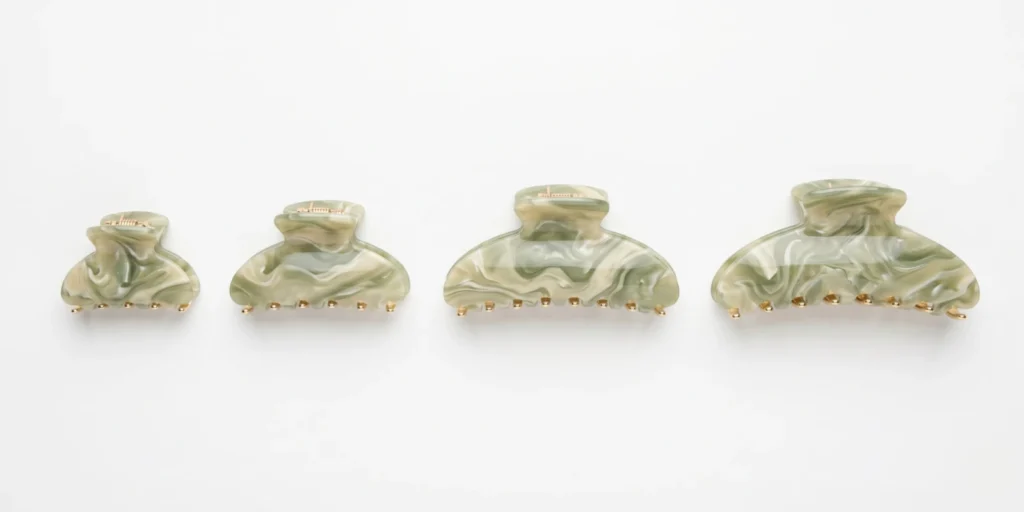
For B2B buyers, building a size-assorted claw clip range is more commercially effective than stocking a single size in depth. Consumers who purchase a clip that fails due to size mismatch typically do not repurchase the same size — they either abandon the category or seek out a correctly-sized alternative. A size-assorted range reduces this dropout rate by ensuring that every consumer finds a clip that works for their hair.
A recommended size assortment for a commercial claw clip range is:
Buyers developing a size-assorted range from a single OEM partner benefit from consistent spring quality, tooth profile, and finish across sizes — variables that are difficult to control when sourcing different sizes from different manufacturers. Consolidated OEM sourcing through a partner that operates across all size tooling also typically supports blended MOQ arrangements, reducing the per-size minimum commitment. Brands sourcing across sizes should explore OEM hair accessories manufacturing partners with confirmed tooling depth across the full size range before committing to a range development programme.
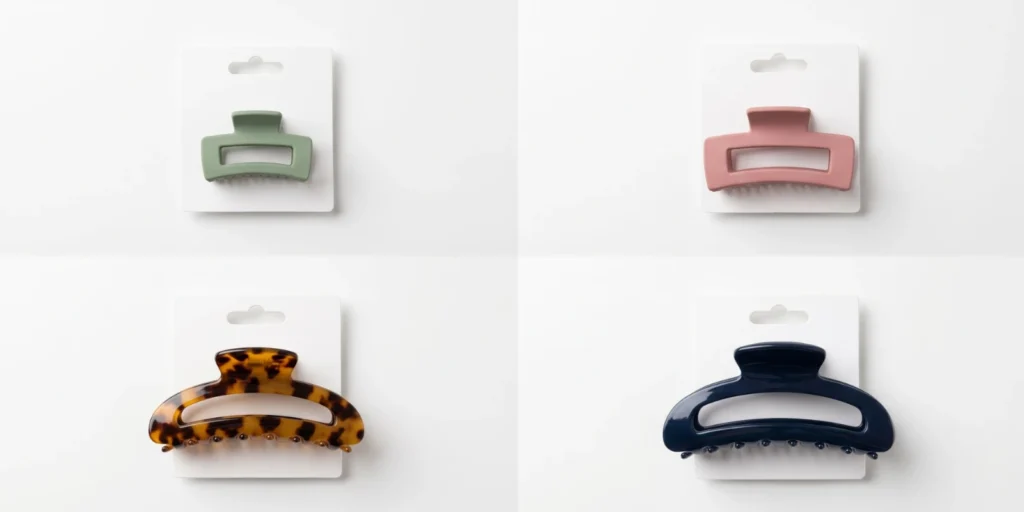
The correct size is determined by your hair volume — the thickness of the gathered section — rather than hair length alone. Gather your hair into the style you want to hold and estimate the diameter of the gathered section. As a practical guide: fine or thin hair typically suits a small clip (5–6.5 cm); medium density hair suits a medium clip (7–8.5 cm); thick hair suits a large clip (9–10.5 cm); and very thick or high-volume hair suits an oversized clip (11–13 cm). If your clip pops open or does not close fully when applied, size up.
Thick hair typically requires a large (9–10.5 cm) or oversized (11–13 cm) claw clip for reliable hold in a full bun or updo. Standard medium clips (7–8.5 cm) will not close fully around a thick gathered section and will pop open during wear. For very thick or long-and-thick hair, an oversized clip with a reinforced spring specification is the correct choice — the spring must be strong enough to maintain closing force against the outward pressure of a large gathered section.
Fine or thin hair is best held by a small clip (5–6.5 cm). A medium or large clip will have excess jaw span relative to the gathered section, gripping only a narrow band of hair in the centre of the jaw rather than distributing grip across the full surface — which produces loose, inconsistent hold. A small clip generates concentrated, even grip on a fine hair section and maintains hold more reliably than an oversized clip.
A large clip on short fine hair will typically produce poor hold — the jaw span exceeds the gathered section volume, and the clip grips unevenly. For short hair, mini (3.5–4.5 cm) or small (5–6.5 cm) clips are the appropriate size. The exception is if the short hair is also thick — in which case a medium or large clip may be needed to accommodate the hair volume even at shorter length.
Medium clips (7–8.5 cm) are the highest-volume commercial size across most claw clip retail ranges, as they are the most versatile size for the median consumer with fine to medium density hair. Large clips (9–10.5 cm) have grown significantly in commercial importance as oversized clip styling has become more prominent, and they represent the fastest-growing size segment in the premium acetate category. Mini clips are high in unit volume due to multi-pack retail formats but lower in per-unit revenue.
A commercially balanced claw clip range typically includes small (6 cm), medium (8 cm), large (10 cm), and oversized (12 cm) sizes, with deepest stock in the medium and large sizes. Mini clips can be added for multi-pack accent formats. Stocking a size-assorted range reduces consumer dropout from size mismatch and supports cross-selling — consumers who buy one size often return to purchase a second size for a different styling context. Working with a single OEM partner across all sizes ensures consistent quality and supports blended MOQ negotiation.
Choosing the right claw clip size is primarily a question of matching the clip’s jaw span to your hair volume — the cross-sectional thickness of the gathered section you are asking the clip to hold. A clip that is correctly sized closes fully, distributes grip evenly across the jaw surface, and maintains consistent hold through a full day of wear. A clip that is too small fails to close around the gathered section; a clip that is too large grips only a portion of the jaw surface and slips out gradually.
For B2B buyers, size assortment is a commercial imperative: a range that covers mini through oversized ensures that every consumer can find a clip that works for their hair, reducing size-mismatch dropout and supporting repeat purchase. Manufacturers such as JunYi Beauty, which produces claw clips across the full size range in both ABS and cellulose acetate at its Dongguan facility under ISO 9001:2015 and amfori BSCI certification, are the type of factory-direct OEM partner suited to brands building a size-assorted clip range within a single supplier relationship.
👉 Searching for Hair Accessories ? Your brand deserves the best.