Home
Product
Contact
Odm/Oem
About
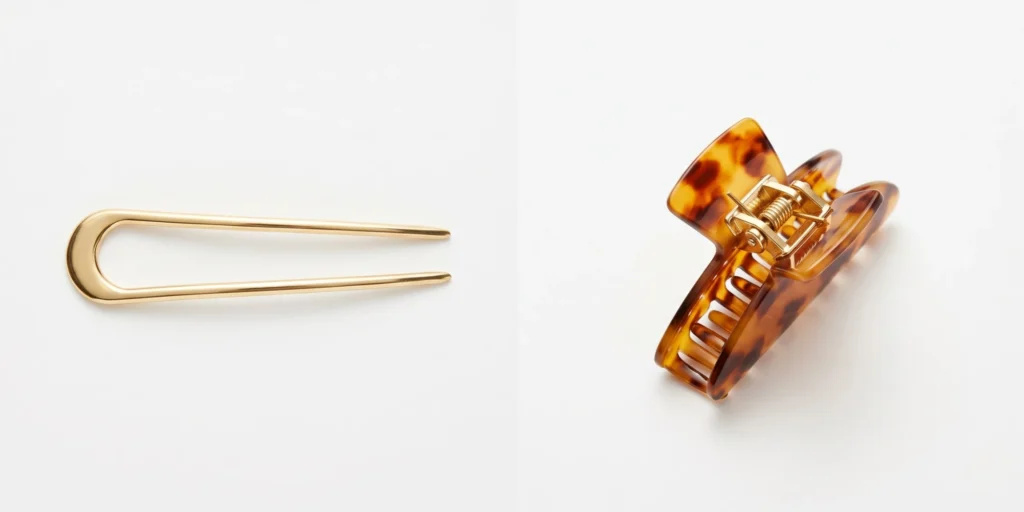
A French hair pin is a two-pronged metal pin designed to anchor gathered or twisted hair by threading through the hair section in a weaving motion, holding the style in place through friction and the pin’s structural resistance to withdrawal. A claw clip is a spring-loaded accessory with two hinged jaw halves that grip a gathered hair section through spring tension and interlocking teeth. Both secure updo and gathered hair styles, but through fundamentally different mechanisms — and the difference in mechanism is the difference in which styles each holds, which hair types each suits, and what skill level each requires.
This guide compares French hair pins and claw clips across hold mechanism, styling function, hair type suitability, skill requirement, hair health profile, and sourcing context — providing a complete basis for choosing between them or understanding how to use both together.
A French hair pin — also called a hair fork, hair stick pin, or two-pronged updo pin — is a metal pin with two parallel prongs joined at a decorative or plain head. The prongs are typically 6 cm to 10 cm in length, slightly wavy or straight, and are inserted into a gathered or twisted hair section in a weaving motion: the pin enters the hair at one angle, passes through the section, and exits at another angle, with the resistance of the hair shaft against the prongs creating the frictional hold that keeps the pin in place.
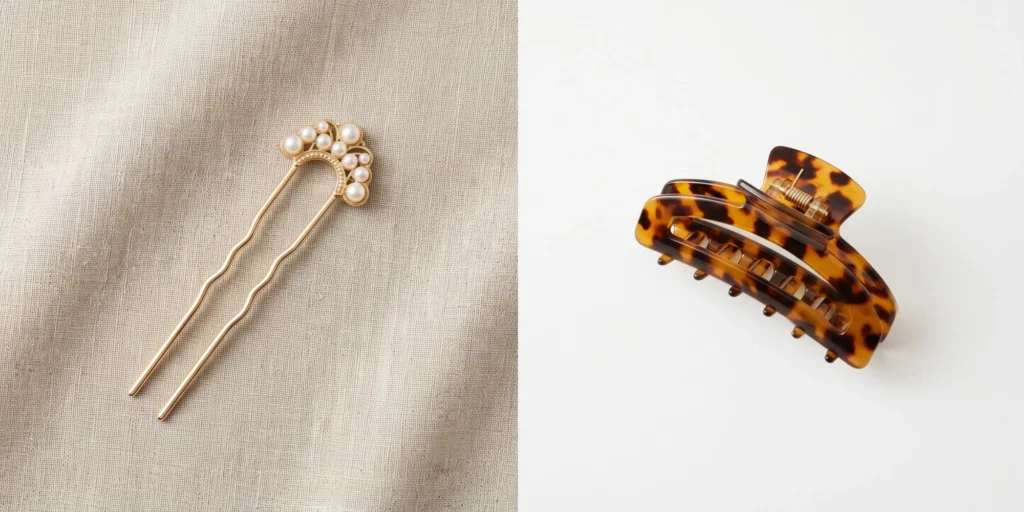
French hair pins are produced in a range of materials — steel, brass, and zinc alloy are most common — with surface finishes including gold-tone, silver-tone, and rose gold plating. Decorative heads range from simple flat discs to ornate pearl, crystal, or enamel embellishments. The types of French hair pins available span functional everyday formats through bridal and occasion-wear styles, with the decorative head visible above the hair serving as the primary aesthetic element when worn.
Unlike bobby pins — which hold a small section flat against the scalp through prong friction — French hair pins are designed for larger gathered sections in updo and bun styles. For a comparison of hair pins vs bobby pins, the functional distinction is significant: bobby pins work close to the scalp for precision anchoring, while French hair pins work through the body of a bun or twist.
A claw clip is a spring-loaded hair fastening accessory constructed from two hinged jaw halves with interlocking teeth, which grip a gathered hair section through the tension of an internal torsion spring. The user presses the clip open by squeezing the outer arms, positions the open jaw around the gathered section, and releases — the spring closes the jaw and the teeth grip the hair from both sides simultaneously. The clip remains closed until actively pressed open again.
Claw clips are produced in ABS plastic, cellulose acetate, and nylon across a size range from 4 cm (mini, for accent sections) to 13 cm (oversized, for thick and very long hair). The spring mechanism provides a consistent, non-loosening hold that does not require technique variation to maintain — once the clip is correctly applied and closed, it holds without adjustment. For a broader comparison between clip formats, the distinction between bobby pins vs hair clips further illustrates how different pin and clip mechanisms address different styling functions.
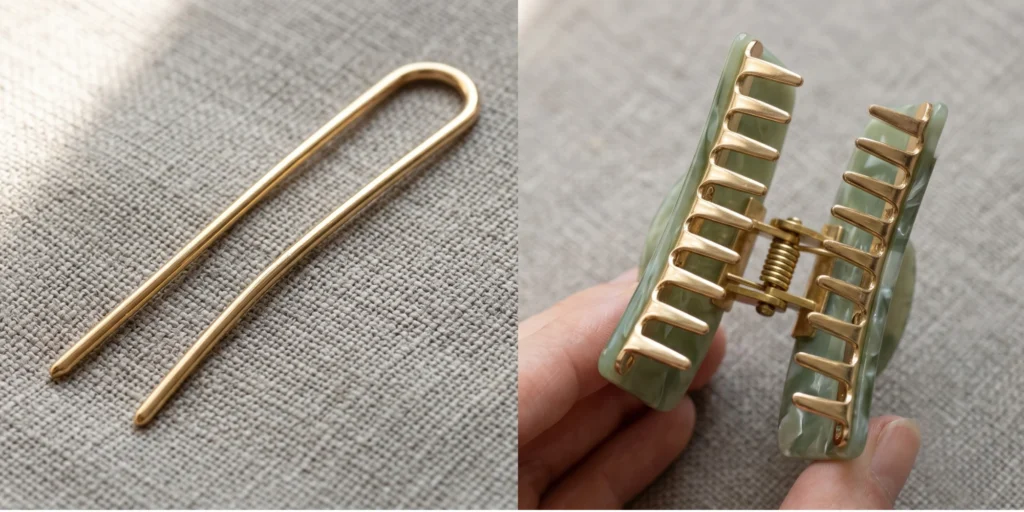
A French hair pin holds hair through friction and structural resistance. As the pin is threaded through a gathered or twisted hair section using a weaving motion, the prongs pass through multiple layers of hair at different depths. The resistance of the compressed hair against the prongs — combined with the slight wave in the prong profile, which increases the effective grip surface — creates a frictional anchor that prevents the pin from withdrawing. The style holds not because anything is clamped shut, but because the hair’s own mass and density resist the pin’s movement in any direction.
This means that French hair pin hold strength is directly dependent on the density and texture of the hair, the technique used to insert the pin, and the architecture of the twisted or gathered style being secured. A correctly inserted French pin in a well-constructed twisted bun can hold for hours without adjustment. An incorrectly inserted pin — too shallow, at the wrong angle, or in insufficient hair density — will slide out quickly. Understanding how to use a French hair pin correctly is therefore a prerequisite for reliable hold.
A claw clip holds hair through spring tension applied by a mechanical spring mechanism — a hold that is independent of technique once the clip is correctly sized and applied. The spring closes the jaw to a fixed tension level regardless of the hair’s density or texture; the teeth grip the hair from both sides of the jaw simultaneously; and the held position is maintained as long as the spring is intact and the clip is correctly sized for the hair volume. No weaving, no technique variation, and no hair density requirement beyond the clip’s size range.
The consequence is that claw clip hold is more reliable for the general consumer — it does not require the skill development that French hair pin insertion requires, and it does not depend on the hair’s texture providing sufficient frictional resistance to hold the pin in place.
This is the most practically significant difference between the two accessories for most consumers.
A claw clip requires no technique — gather the hair, twist, press the clip open, clip through the bun, release. The entire process takes ten to fifteen seconds and produces consistent results from the first attempt. The only variable that matters is clip size: the correct clip for the hair volume will hold reliably; the wrong size will not. Technique is not a variable.
A French hair pin requires technique. The pin must be inserted at the correct angle, threaded through the correct depth of hair, and anchored in the correct orientation relative to the bun structure. A beginner’s first several attempts with a French pin will typically produce either a loose hold that releases within minutes or a visible pin orientation that does not reflect the intended aesthetic. The learning curve is real and takes repeated practice to overcome — typically five to ten uses before the technique becomes reliable.
For consumers who are willing to invest in that learning curve, the payoff is a hold and aesthetic that a claw clip cannot replicate. For consumers who need reliable hold without technique investment, the claw clip is the correct choice.
| Hair Type | French Hair Pin | Claw Clip |
|---|---|---|
| Fine, straight hair | Good — weaving motion grips well in twisted sections | Good — small to medium clip suits fine hair volume |
| Medium density hair | Very good — sufficient density for reliable friction hold | Very good — medium clip covers this segment well |
| Thick hair | Moderate — multiple pins needed; single pin may slip | Excellent — large/oversized clip with reinforced spring |
| Very long hair | Moderate — weight can overcome pin friction over time | Good — oversized clip with tail-tucking technique |
| Curly hair | Good — curl texture increases pin friction hold | Good — large clip accommodates curl volume |
| Coily hair | Very good — tight coil texture grips pin prongs strongly | Good — oversized clip needed for high volume |
| Color-treated hair | Good — smooth prongs generate low friction on cuticle | Good — smooth tooth finish essential |
| Short hair (above chin) | Poor — insufficient length to build twist for pin to anchor | Moderate — small clip for accent sections only |
The French hair pin’s aesthetic is defined by the decorative head — the only element visible above the hair surface when the pin is correctly inserted. The pin body disappears into the hair; what remains is the head, positioned at or within the updo like a piece of jewellery. A pearl-headed French pin in a chignon reads as bridal or formal; a simple gold-disc-headed pin in a twisted bun reads as refined everyday elegance. The aesthetic is subtle, precise, and jewellery-adjacent in a way that no clip format replicates.
The claw clip’s aesthetic is defined by the entire clip body — the three-dimensional jaw structure that projects above the hair is fully visible and is the design element. A large tortoiseshell acetate claw clip at the crown of the head is not a subtle accessory; it is an expressive fashion statement. The claw clip’s aesthetic language is bold and casual in a way that suits everyday, streetwear, and social media-driven fashion styling contexts. It is not the right aesthetic for bridal, formal updo, or professional settings where understated accessories are expected.
Both French hair pins and claw clips present lower hair damage risk than elastic-based hair ties when used correctly. The relevant comparison is between pin insertion mechanics and clip tooth contact.
French hair pins generate very low friction against the hair cuticle — the smooth metal prong surface slides through the hair with minimal abrasion. The weaving motion passes the prong through the hair section rather than dragging across it, which generates lower friction than the application and removal of a snap clip or elastic. The primary risk with French pins is withdrawal at the wrong angle — pulling a deeply inserted pin straight out rather than reversing the weaving motion can catch and break individual strands.
Claw clips generate friction at the tooth contact points on application and removal. Well-finished smooth teeth on premium acetate or ABS clips present very low snagging risk; poorly finished teeth with burrs or rough edges snag strands and cause breakage. Neither format wraps around the hair shaft, and neither generates the tension crease that elastic-based ties produce.
According to research on hair shaft mechanical stress and cuticle damage, the surface finish of the accessory at the point of contact with the hair is the primary determinant of friction-related damage — a finding that supports the low-damage profile of both smooth-prong French pins and smooth-tooth claw clips relative to elastics and poorly finished alternatives.
| Variable | French Hair Pin | Claw Clip |
|---|---|---|
| Hold mechanism | Frictional — hair’s own density anchors the pin | Mechanical — spring tension closes jaw on hair |
| Skill required | Medium to high — technique-dependent | Low — size-dependent, not technique-dependent |
| Hold consistency | Variable — depends on technique and hair texture | Consistent — spring provides fixed tension |
| Application speed | Slow — 2–5 minutes to build style and insert pin | Fast — 10–15 seconds |
| Best for thick hair | Moderate — multiple pins needed | Excellent — correct size and spring spec |
| Best for formal styling | Excellent — jewellery-adjacent, low profile | Moderate — casual aesthetic |
| Best for everyday use | Moderate — technique investment required | Excellent — quick and reliable |
| Visible profile when worn | Very low — only decorative head visible | High — full clip body visible |
| Hair damage risk | Low — smooth prongs, no wrapping | Low — smooth teeth, no wrapping |
| Bridal / occasion suitability | Very high | Low to moderate |
| Retail price range | $5–$30 per pin depending on material | $5–$35 per clip depending on size and material |
| OEM MOQ | 300–1,000 units per style/colour | 300–500 units per style/colour |
📹 视频嵌入 — Practical Comparison 段落下方
YouTube 搜索:French hair pin vs claw clip updo comparison which is better
复制视频ID后替换下方 VIDEO_ID:
<iframe width=”560″ height=”315″ src=”https://www.youtube.com/embed/VIDEO_ID” title=”French Hair Pin vs Claw Clip Comparison” frameborder=”0″ allow=”accelerometer; autoplay; clipboard-write; encrypted-media; gyroscope; picture-in-picture” allowfullscreen></iframe>
French hair pins and claw clips are not mutually exclusive — many consumers use both within the same style or for different styling contexts throughout the week. Some common combined-use scenarios:
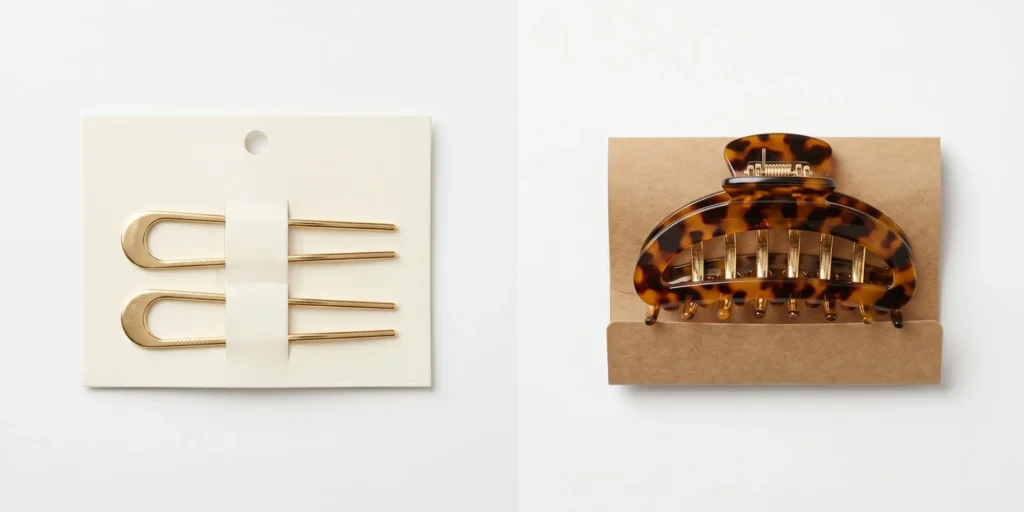
French hair pins are metal products requiring wire forming, prong finishing, and decorative head attachment — either cast, stamped, or assembled depending on the head design. Production lead times are moderate; MOQs typically begin at 300–1,000 units per style per finish depending on the complexity of the decorative head. Plain metal heads carry lower MOQs; ornate heads with cast elements, enamel work, or stone setting carry higher minimums reflecting the additional assembly steps. Key quality control variables are prong tip finish (tips must be smooth and rounded, not sharp — sharp tips snag hair on insertion), prong straightness consistency, and plating adhesion.
Claw clips require injection moulding tooling for the upper jaw, lower jaw, hinge, and spring housing. Standard MOQs begin at 300–500 units per style per colour for standard constructions with existing mould tooling. Spring tension specification is a key sourcing variable — buyers should specify standard, medium, or heavy spring gauge explicitly rather than accepting production defaults. Tooth surface finishing — smooth and burr-free — should be verified by sample removal testing before production commitment. Brands sourcing both French pins and claw clips in a combined range should work with an OEM hair pin manufacturer that produces both metal pin formats and injection-moulded clip formats within a single production relationship, enabling consolidated quality management and blended MOQ negotiation.
Q: Is a French hair pin or a claw clip better for an updo?
The answer depends on the type of updo and the styling context. For formal updos — chignons, French twists, and structured coiled styles — a French hair pin is better because its low profile conceals the mechanism within the style and the decorative head provides a jewellery-adjacent finishing element. For everyday casual updos — messy buns, half-up styles, and quick gathered styles — a claw clip is better because it provides reliable mechanical hold without the technique investment required by a French pin. For thick or voluminous hair in any updo context, a large claw clip with a reinforced spring provides more secure hold than a single French pin can generate through friction alone.
Q: Are French hair pins hard to use?
French hair pins have a moderate to high technique requirement compared to claw clips, which require no technique beyond size selection. The pin must be inserted at the correct angle, threaded through the correct depth of hair using a weaving motion, and anchored in the correct orientation relative to the bun structure. Most consumers require five to ten practice uses before the insertion technique becomes reliable. For detailed technique guidance, the step-by-step explanation of how to use a French hair pin covers the weaving motion and common insertion errors in full.
Q: Can French hair pins hold thick hair?
French hair pins can hold thick hair, but typically require two to three pins rather than a single pin. A single French pin holds through friction between its prongs and the hair section — on very thick hair, the outward pressure of the dense hair section can overcome a single pin’s frictional hold over time. Using two to three pins inserted from different directions distributes the hold across multiple anchor points and produces a more stable result. For consumers who prefer single-accessory hold on thick hair, a large claw clip with a reinforced spring specification provides more reliable hold without technique variation.
Q: What is the difference between a French hair pin and a bobby pin?
A French hair pin is a two-pronged metal pin with prongs typically 6–10 cm long, designed to anchor large gathered or twisted hair sections in updo styles through a weaving insertion technique. A bobby pin is a shorter, two-pronged pin (4.5–6.5 cm) with one straight and one ridged prong, designed to grip small sections of hair flat against the scalp through friction between the two prongs. French hair pins work through the body of a bun or twist; bobby pins work close to the scalp for precision anchoring of small sections. A full comparison of hair pins vs bobby pins covers this distinction in detail.
Q: What are the different types of French hair pins?
French hair pins vary primarily in prong length, prong profile (straight vs wavy), and decorative head design. Head designs range from simple flat discs and ball tips through pearl clusters, crystal droplets, enamel florals, and sculptural metal elements. Prong length affects how deeply the pin can be inserted and therefore how large a hair section it can anchor; wavy prong profiles increase friction and hold more securely than straight prongs. A detailed breakdown of the types of French hair pins and their specific applications covers the full format range.
Q: What is the MOQ for sourcing French hair pins or claw clips from an OEM manufacturer?
Standard MOQs for French hair pins from factory-direct OEM suppliers typically begin at 300–500 units per style per finish for plain or simple decorative heads, and 500–1,000 units for more complex ornate heads requiring cast components or stone setting. Standard MOQs for claw clips begin at 300–500 units per style per colour for standard constructions using existing mould tooling. Buyers sourcing both formats within a single order can typically negotiate blended minimum requirements with manufacturing partners that produce both metal hair pin and injection-moulded clip formats.
French hair pins and claw clips are complementary rather than competing accessories — each is better than the other in specific contexts, and neither is universally superior. French hair pins excel at formal, occasion, and bridal styling where a low-profile, jewellery-adjacent aesthetic and technique-enabled hold are the priorities. Claw clips excel at everyday, casual, and thick-hair styling where reliable mechanical hold, quick application, and a visible fashion statement are the priorities.
For B2B buyers, a range that includes both French hair pins and claw clips across appropriate size and finish options covers the full consumer hair accessory need spectrum — from bridal through everyday — within a single coherent product category. Manufacturers such as JunYi Beauty, which produces both metal hair pin formats and acetate and ABS claw clips across the full size range at its Dongguan facility under ISO 9001:2015 and amfori BSCI certification, represent the type of factory-direct OEM partner suited to brands building this combined range within a single supplier relationship.
👉 Searching for Hair Accessories ? Your brand deserves the best.