Home
Product
Contact
Odm/Oem
About
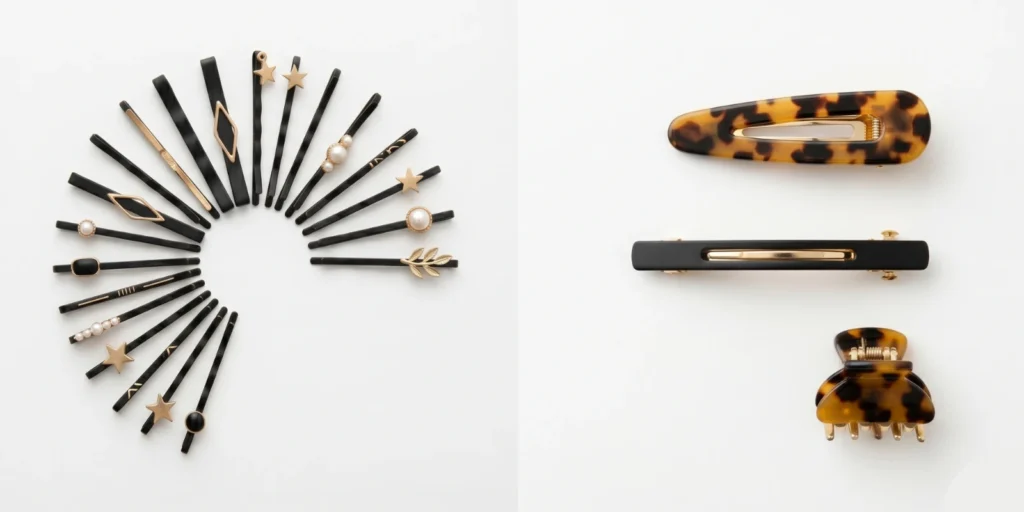
A bobby pin is a narrow, two-pronged metal fastening accessory with one straight prong and one ridged or wavy prong, designed to grip small sections of hair close to the scalp through the friction and tension created between the two prongs. A hair clip is a broader category of fastening accessory that encompasses spring-loaded, hinged, or sliding mechanisms in a wide range of sizes and materials, used to gather, secure, or style hair at varying distances from the scalp. While both serve a hair-fastening function, their construction, application, and suitability differ substantially across hair types, styling contexts, and product positioning.
This guide examines both accessory types across design, functionality, material, and B2B sourcing considerations to support buyers building or extending a hair accessories range.
A bobby pin is a two-pronged metal clip typically measuring 4.5 cm to 6.5 cm in length, consisting of a flat outer prong and a ridged or corrugated inner prong joined at a rounded tip. The user slides the open end through a section of hair; the inner ridging grips the hair shaft while the spring tension between the two prongs holds the pin in place.
Key structural characteristics:
Common bobby pin variants:
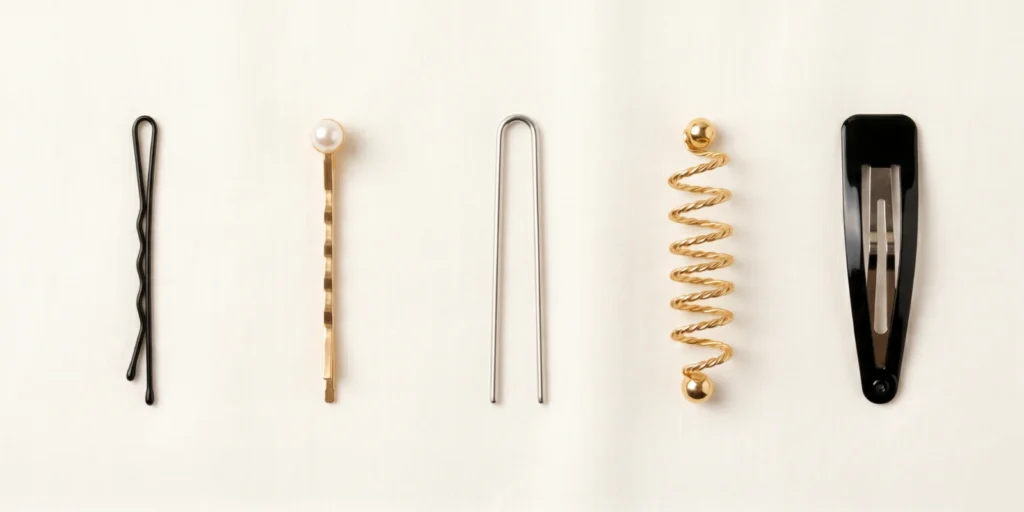
A hair clip is a broad category of spring-loaded or hinged accessory used to fasten gathered sections of hair. Unlike bobby pins, which work by sliding through hair close to the scalp, hair clips operate through a jaw or lever mechanism that closes around a gathered hair section. The category includes numerous distinct product types that vary in size, mechanism, and styling function.
Primary hair clip types relevant to this comparison:
Brands sourcing across multiple clip formats should work with a custom hair clip manufacturer that carries tooling for both decorative barrette formats and functional spring-clip mechanisms within the same supplier relationship.
The fundamental distinction between bobby pins and hair clips lies in their hold mechanism and the styling function each performs. Bobby pins work by sliding into hair and holding a small section flat against the scalp through friction — they are invisible when correctly placed and suited for detail styling. Hair clips work by closing around a gathered section of hair from the outside — they are visible as a styling element and function as both a fastening tool and a visible fashion accessory.
The following table outlines the primary differences across key criteria:
| Criteria | Bobby Pin | Hair Clip |
|---|---|---|
| Hold mechanism | Friction between two prongs | Spring or hinge closure |
| Scalp proximity | Close to scalp | At or away from scalp |
| Hair volume handled | Very small sections | Small to large sections |
| Visibility when worn | Invisible (intended) | Visible (design element) |
| Primary function | Detail fastening / updo anchoring | Section securing / styling |
| Typical hair types | All — used for sections | Fine to thick depending on clip type |
| Decorative potential | Limited (tip embellishment only) | High — surface is the design canvas |
| Typical unit price tier | Low to mid | Low to premium |
| Retail format | Multi-pack standard | Single or multi-pack |
| Professional salon use | High (styling tool) | High (sectioning tool) |
According to hair accessories market growth and product segmentation data, the broader hair care accessories segment has demonstrated consistent year-on-year growth across both mass-market and premium retail channels — reinforcing the commercial case for stocking both bobby pins and hair clips within a single brand range.
[IMAGE 3] File name: bobby-pin-styling-updo-application.jpg Alt: “Bobby pins arranged in a criss-cross pattern on a hair section showing updo anchoring technique” Prompt: Close-up flat lay product photography, wide 2:1 banner 2000x1000px, several matte black bobby pins in a criss-cross X pattern against a smooth neutral fabric surface suggesting hair texture, clean minimal composition, soft directional studio lighting from upper left, no faces, no people, no text, no logo, no watermark, professional beauty product photography
Bobby pins are the primary tool for securing small sections with precision — pinning a single strand away from the face, anchoring a decorative piece in place, or securing the edge of a braid against the head. No hair clip format performs this function at the same scale and precision.
Complex updo styles rely on multiple bobby pins inserted in a criss-cross pattern to distribute hold and prevent slippage. The pins anchor structure without being visible from the outside of the hairstyle.
Bobby pins are used to pin individual curls flat against the scalp while they set, either air-drying or under a hooded dryer. This is a foundational technique in both vintage and contemporary roller-set and wave styling.
Single or paired bobby pins secure loose strands at the temple, nape, or hairline without adding visual weight to the style. This is a common everyday use case across all hair types.
Bobby pins are used to anchor wigs, extensions, and hairpieces to the natural hair underneath, providing a flat, low-profile fastening that does not create visible bulk under the hairpiece.
Standard snap clips, barrettes, and claw clips are the primary tools for everyday hair fastening — pulling hair back from the face, creating a half-up style, or securing a loose updo for casual or work settings. Their ease of use and removability make them the dominant category for consumer everyday styling.
Decorative barrettes, embellished snap clips, and acetate claw clips function as visible fashion accessories — chosen for their aesthetic as much as their functional hold. This is the primary growth driver in the premium hair accessories segment. For brands developing fashion-forward accessory lines, an acetate claw clip manufacturer with in-house material selection and surface finishing capability is better positioned to support premium design briefs than a general accessories supplier.
Alligator clips and duckbill clips are industry-standard salon tools used to section hair during cutting, colouring, and blow-drying services. The salon channel represents a distinct B2B buyer segment with different specification requirements than the retail consumer channel.
Hair clips — particularly claw clips and French barrettes — handle hair volumes and lengths that bobby pins cannot manage. A single oversized claw clip can secure a full head of thick, long hair; achieving the same result with bobby pins would require ten or more pins and considerable technique.
Bobby pins are manufactured almost exclusively in metal — steel for mass-market production, brass for higher-quality variants. Surface treatments include matte lacquer coating (standard for classic black bobby pins), metallic plating (gold-tone, silver-tone, rose gold), coloured enamel on the outer prong, and anti-slip rubber tips at the closed end. The inner prong ridging is a critical functional specification — the number, depth, and spacing of ridges directly affect grip performance.
Hair clips are produced across a wider range of materials: cellulose acetate for premium decorative barrettes and claw clips, ABS plastic for mass-market injection-moulded formats, zinc alloy or brass for metal barrettes and French clips, and nylon where higher comb flexibility is required. For brands positioning on sustainability, suppliers producing accessories from certified recycled materials should be able to provide documentation aligned with Global Recycled Standard certification requirements.
The following table summarises material differences across both product types:
| Material | Used In | Key Properties | Price Tier |
|---|---|---|---|
| Steel | Bobby pins | Durable, springy, cost-efficient | Low |
| Brass | Premium bobby pins | Better plating adhesion, heavier feel | Mid |
| Cellulose acetate | Decorative clips, claw clips | Premium finish, plant-based | High |
| ABS plastic | Most clip types | Versatile, mass-market | Low to mid |
| Zinc alloy | Metal barrettes, French clips | Castable, plating-friendly | Mid |
| Nylon | Alligator clips, claw clips | Flexible, durable | Mid |
Bobby pins are high-volume, low-complexity products from a manufacturing standpoint. MOQs for standard bobby pins typically begin at 1,000 to 5,000 units per style per colour, reflecting the lower per-unit cost and the expectation of multi-pack retail formats. Decorative bobby pins with attached charms or crystal elements carry lower MOQs, typically beginning at 300–500 units per SKU.
Hair clip sourcing requires more tooling investment than bobby pins, as each clip format requires dedicated mould components for the jaw, hinge, spring, and decorative surface elements. Buyers engaging OEM hair accessories manufacturing partners should request spring tension specifications in writing for all spring-loaded clip formats, as spring performance directly affects end-user hold satisfaction and return rates.
Both product types destined for regulated retail markets should be sourced from manufacturers holding ISO 9001:2015 quality management certification. For bobby pins specifically, nickel content compliance is a regulatory consideration in EU markets — buyers sourcing for EU distribution should confirm that metal bobby pins meet EN 1811 nickel release testing requirements.
Q: What is the main difference between a bobby pin and a hair clip?
A bobby pin is a two-pronged metal fastener that slides into hair close to the scalp and holds small sections through friction between its prongs — it is designed to be invisible when worn. A hair clip is a broader category of spring-loaded or hinged accessory that closes around gathered hair from the outside and functions as both a fastening tool and a visible styling element.
Q: Can bobby pins damage hair?
Bobby pins can cause hair damage when used incorrectly — common causes include forcing a pin open too wide, using pins with exposed metal tips where protective coating has worn away, and repeatedly securing pins in the same location. Pins with rubber-coated tips and smooth prong finishes carry a lower damage risk. For fragile or chemically treated hair, decorative clips or fabric-covered alternatives that distribute tension more evenly are generally preferable for everyday use.
Q: What hair types are bobby pins best suited for?
Bobby pins perform well across all hair types for their intended use — securing small sections. However, they are most effective on fine to medium-texture hair, where the prong friction is sufficient to grip individual strands. On very thick or coarse hair, standard bobby pins may not grip securely and may require using multiple pins in a criss-cross pattern to achieve effective hold.
Q: What is the typical MOQ for sourcing bobby pins from an OEM manufacturer?
Standard MOQs for basic bobby pins from factory-direct OEM suppliers typically begin at 1,000 to 5,000 units per style per colour, reflecting the high-volume, low-cost nature of the product. Decorative bobby pins with attached embellishments carry lower MOQs, typically beginning at 300–500 units per SKU — comparable to decorative hair clip minimums. Buyers sourcing bobby pins alongside hair clips within a single purchase order may be able to negotiate combined minimum requirements.
Q: Are bobby pins and hair clips sold differently at retail?
Bobby pins are typically sold in multi-pack formats — standard retail packaging contains 30 to 100 pins — reflecting their disposable-use positioning and relatively low per-unit cost. Hair clips are more commonly sold individually or in small multi-packs of two to six pieces, with per-unit retail pricing that reflects their decorative value and material cost. This difference in retail packaging format affects both unit economics and shelf space planning for B2B buyers.
Q: What certifications should buyers look for when sourcing bobby pins for EU markets?
For EU distribution, the most important compliance consideration specific to bobby pins is nickel release — metal accessories that contact skin are regulated under the EU Nickel Directive, which requires that nickel release does not exceed 0.5 micrograms per square centimetre per week. Buyers should request EN 1811 test reports from suppliers to confirm compliance. ISO 9001:2015 quality management certification and amfori BSCI social compliance certification are relevant for both bobby pins and hair clips across all regulated markets.
Bobby pins and hair clips are complementary rather than competing categories — each addresses a distinct styling function that the other cannot effectively replicate. Bobby pins perform precision, low-profile fastening at the scalp level; hair clips manage larger hair sections and function as visible fashion accessories. For B2B buyers building a complete hair accessories range, stocking both categories covers the full spectrum of consumer fastening needs across everyday, professional, and occasion-wear styling contexts.
Manufacturers such as JunYi Beauty, which produces both metal hair pins and a broad range of plastic and acetate clip formats at its Dongguan facility under ISO 9001:2015 and amfori BSCI certification, represent the type of vertically integrated supplier suited to brands looking to consolidate bobby pin and hair clip sourcing without managing multiple factory relationships.
👉 Searching for Hair Accessories ? Your brand deserves the best.