Home
Product
Contact
Odm/Oem
About
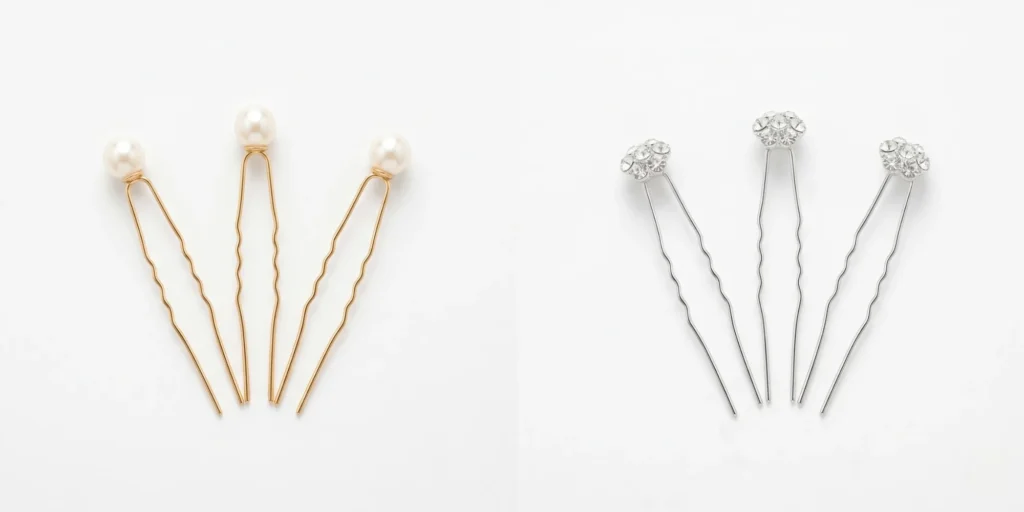
Pearl hair pins and crystal hair pins are both established bridal hair accessories, but they create different looks, suit different dress aesthetics, and photograph differently under wedding lighting conditions. Choosing between them is not simply a matter of personal taste — it is a decision that interacts with the wedding dress fabric, the overall styling aesthetic, the venue lighting, and the hair colour and texture of the person wearing them.
This guide compares pearl and crystal wedding hair pins across every relevant dimension to help brides, bridal stylists, and B2B buyers sourcing bridal accessory ranges make a well-informed decision.
The difference between pearl and crystal hair pins begins with how each material interacts with light — which is the primary variable that determines how each reads in photographs, in different venue lighting, and against different dress fabrics.
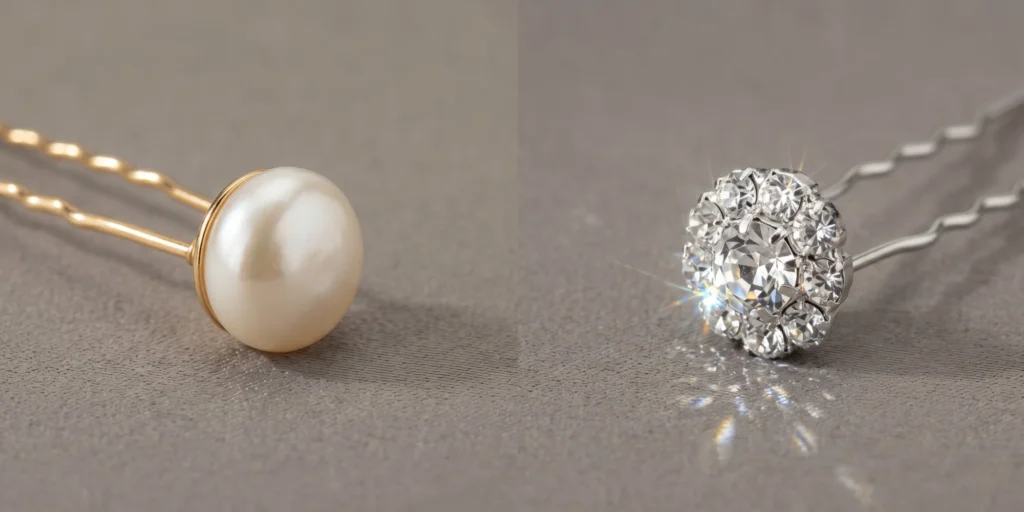
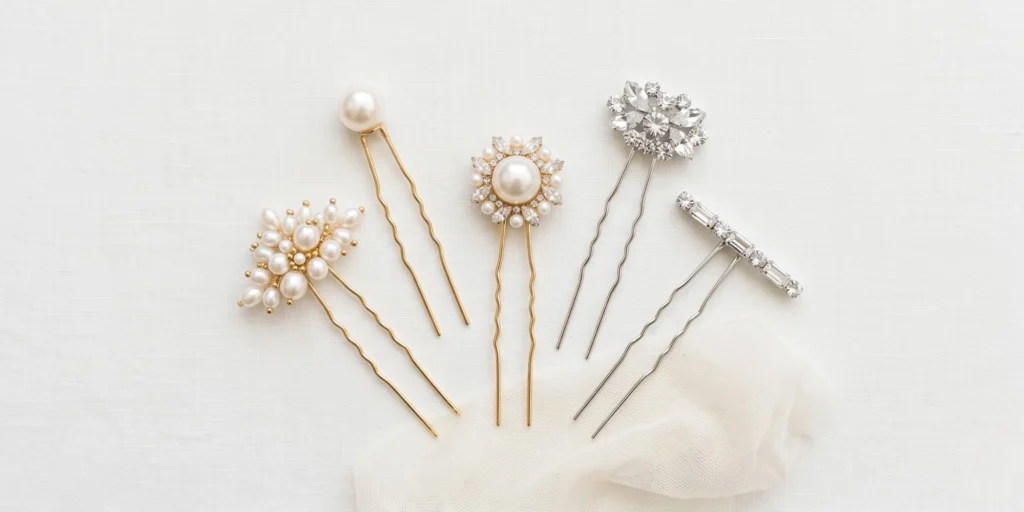
Pearls reflect light with a soft, diffused luminosity — the characteristic “lustre” of a pearl surface scatters light rather than refracting it into directional sparkle. The visual effect is subtle and warm: a pearl glows quietly against the hair, contributing an organic, soft richness to the overall look. The colour of the pearl — white, ivory, champagne, or blush — interacts with the hair colour and the dress tone to create a coordinated or complementary effect.
Crystals refract light into defined sparkle — each facet of a cut crystal or rhinestone redirects light into a visible point of brilliance. The visual effect is active and directional: crystals catch the light and throw it back as defined flashes of brightness. Under certain lighting conditions — candlelight, spotlighting, flash photography — this sparkle is dramatic and visible from across a room. Under diffuse natural light, the same crystals may appear relatively flat and understated compared to their performance under directed light.
Everything else that distinguishes pearl from crystal hair pins in a bridal context — the aesthetic register, the dress pairings, the styling formality — flows from this fundamental difference in how the two materials handle light.
Pearl hair pins carry a specific aesthetic register: classic, romantic, and timeless. Pearls have been associated with bridal styling across multiple centuries and cultures — they are the default bridal accessory material in a way that no other single material is. This heritage means that pearl hair pins read as both traditional and universally appropriate in a bridal context, even when the rest of the styling choices are contemporary. They are the least aesthetically risky choice for a bride who wants her accessories to feel polished and intentional without taking a strong stylistic position.
The softness of pearl lustre also harmonises with a wider range of wedding dress fabrics and styles than crystal. Pearl pins work with lace, chiffon, satin, silk, and organza — the soft diffused reflection complements each fabric’s own light interaction without competing with it. Against heavily embellished or beaded dress fabrics, pearl pins provide accent without adding to the visual density of the embellishment.
Bridal hair pins use several pearl types at different price and quality points. Freshwater pearls — the most commonly used in accessible bridal accessories — are nucleated freshwater mollusc pearls with a natural lustre that varies with quality grade. Akoya pearls are saltwater pearls known for particularly high lustre and round uniformity, used in premium bridal accessories. Baroque pearls are irregularly shaped pearls increasingly used in contemporary and non-traditional bridal styling for their organic, sculptural character. Glass pearl — also called faux pearl or imitation pearl — is a glass bead with a pearlescent coating used in most accessible price point bridal accessories; quality varies significantly with coating thickness and finish consistency.
Crystal hair pins read as glamorous, modern, and dramatic. The directional sparkle of cut crystal or rhinestone — particularly under venue lighting designed for evening events — creates a high-impact visual effect that pearl cannot produce. Crystal pins are the choice when the bride wants her accessories to be visible across the room, to photograph with drama under flash, or to add sparkle to a look that might otherwise be understated.
Crystal hair pins also coordinate more naturally with embellished or beaded dress fabrics — rhinestone beading on the dress and crystal pins in the hair create a coordinated sparkle language that reads as intentional and complete. A pearl pin against a heavily crystal-embellished dress may feel disconnected; a crystal pin in the same context feels curated.
Bridal hair pins use several crystal and crystal-equivalent materials. Austrian crystal — most famously associated with Swarovski — is precision-cut leaded glass with exceptionally high light refraction and clarity; it is the premium crystal standard in bridal accessories. Czech crystal is similarly high-quality precision-cut crystal glass at slightly more accessible price points. Rhinestone refers to faceted glass or acrylic stones with a metallic foil backing that amplifies light reflection — rhinestone quality varies enormously depending on the precision of the cut and the quality of the foil. Cubic zirconia (CZ) is a synthetic crystalline material that closely approximates the visual properties of diamond and is used in premium crystal bridal accessories positioned as fine jewellery alternatives.
| Consideration | Pearl Hair Pins | Crystal Hair Pins |
|---|---|---|
| Light effect | Soft, diffused lustre — warm glow | Directional sparkle — defined brilliance |
| Daytime / outdoor venues | Excellent — consistent under diffuse light | Moderate — may appear flat under natural light |
| Evening / indoor venues | Good — warm and romantic | Excellent — sparkle maximised under venue lighting |
| Flash photography | Soft, warm glow in photos | High sparkle — reads dramatically under flash |
| Lace and chiffon dresses | Excellent — soft harmony | Good — use small stones for balance |
| Satin and silk dresses | Good — elegant contrast | Excellent — coordinated high-glamour |
| Beaded / embellished dresses | Moderate — may feel disconnected | Excellent — continues sparkle language |
| Ivory / warm dress tones | Excellent — direct colour coordination | Good — silver-tone may cool warm dress tones |
| White / cool dress tones | Good — use white pearl for coordination | Excellent — silver and crystal complement cool tones |
| Traditional aesthetic | Excellent — the heritage bridal choice | Moderate — more contemporary connotations |
| Modern / contemporary aesthetic | Good — works in minimalist contexts | Excellent — suits non-traditional styling |
| Romantic / garden aesthetic | Excellent — organic softness | Moderate — sparkle can feel mismatched outdoors |
| Price range (retail) | $8–$45 per set depending on pearl type | $10–$60 per set depending on crystal type |
Hair colour is a frequently overlooked variable in bridal hair pin selection. Both pearl and crystal interact differently with different hair colours, and accounting for this can significantly sharpen the decision.
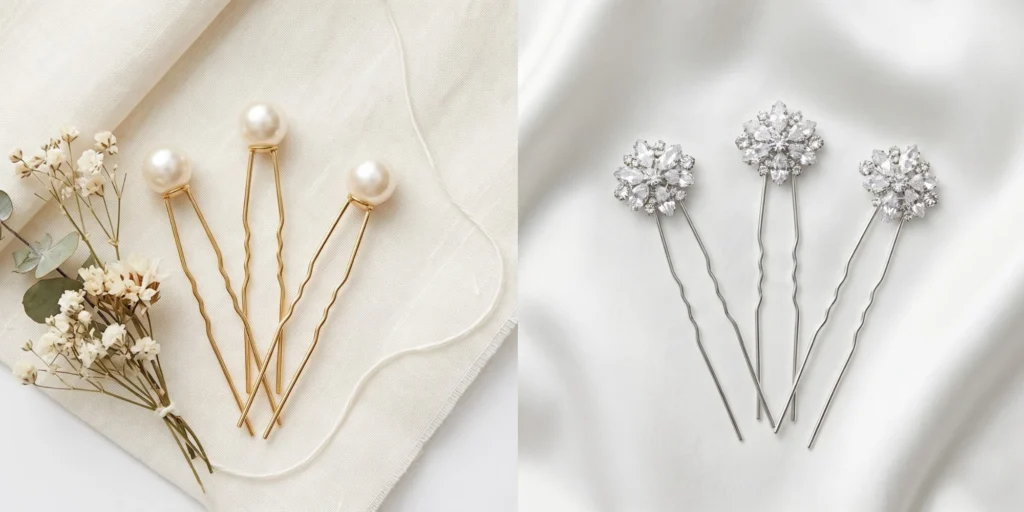
Ivory and white pearls stand out most clearly against dark hair — the contrast between the light pearl head and the dark hair creates a visible, photogenic effect. Against blonde or light hair, ivory pearls blend more subtly; champagne or blush pearls provide better contrast on very light hair. Against red or warm-toned hair, gold-tone metal settings and ivory or champagne pearls create a harmonious warm palette. Against grey hair — increasingly embraced in contemporary bridal styling — white or silver pearls create an elegant tonal effect.
Clear crystal rhinestones in silver-tone settings provide the highest contrast and sparkle against dark hair, where each pin head is clearly visible and catches the light individually. Against blonde hair, clear crystals may blend slightly; AB (aurora borealis) crystals — which have a subtle iridescent coating that creates multicolour light effects — tend to read more distinctly on light hair. Gold-tone crystal or champagne-coloured rhinestones in gold settings complement warm hair tones; silver-tone settings create a cool contrast against warm hair that some brides seek deliberately and others prefer to avoid.
Many contemporary brides choose to mix pearl and crystal pins within the same hairstyle rather than committing entirely to one material. This approach — scattering a combination of pearl and crystal pins through an updo — creates a more complex, layered light effect: the soft lustre of pearl provides a warm base tone while crystal pins punctuate the style with moments of directed sparkle.
Mixed approaches work best when the pearl and crystal pins share the same metal tone (both gold-tone or both silver-tone) and when the scale of the pearl heads and crystal clusters is coordinated. Mixing metal tones or significantly different pin scales within the same style tends to read as uncoordinated rather than intentionally layered.
The following decision framework synthesises the comparisons above into a practical checklist for brides choosing between pearl and crystal pins:
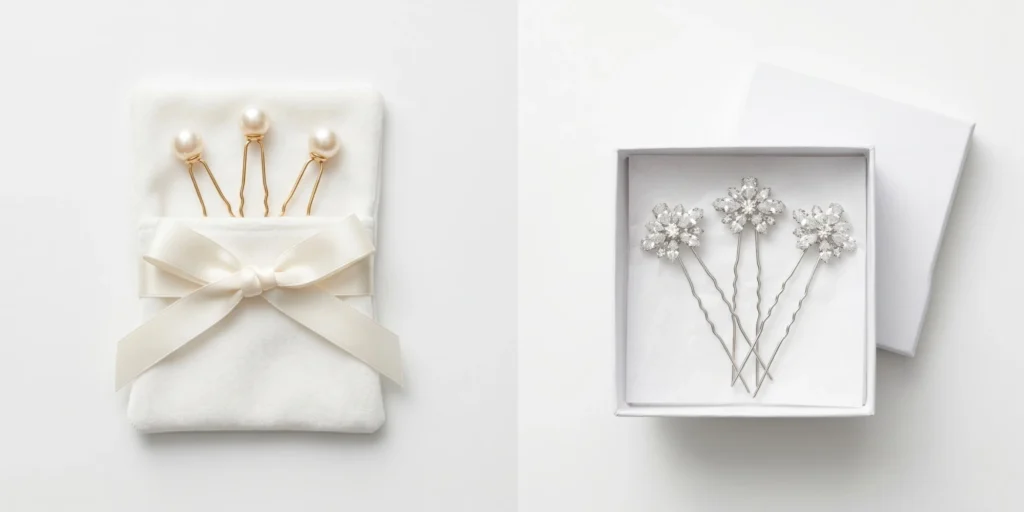
For B2B buyers developing bridal hair accessory ranges, the pearl vs crystal decision at the sourcing level mirrors the consumer decision at the styling level — with the addition of production, quality, and pricing variables.
The primary sourcing variable for pearl hair pins is pearl type and quality. Freshwater pearls in accessory-grade and AA grades are the most commercially viable specification for accessible bridal price points — they provide genuine pearl lustre at price points that support retail margins in the $15–$35 range. Glass pearl (faux pearl) at consistent coating thickness and high surface finish quality is viable for entry price points; the quality differential from freshwater pearl is visible in direct comparison but less apparent in photographs. Key sourcing specifications are pearl grade (size and lustre consistency), head-setting security (the pearl should not rotate or detach from the pin under wear), and prong tip finishing (smooth and rounded, not sharp).
The primary sourcing variable for crystal hair pins is stone type and cut precision. Austrian or Czech crystal produces visibly superior light refraction compared to standard glass rhinestone — the difference is apparent under venue lighting and in photographs. For premium bridal positioning, specifying Austrian or Czech crystal stones is the quality signal that supports higher retail price points. For accessible bridal positioning, high-quality rhinestone with precision-cut facets and consistent foil backing produces acceptable sparkle at lower stone cost. Key sourcing specifications are stone clarity (absence of cloudiness or inclusions), cut precision (facet symmetry determines sparkle quality), foil backing thickness (thicker foil produces more consistent light reflection), and setting security (stones should not rotate or detach under wear or photography conditions).
The metal quality and finish of the pin body affects both durability and the perceived quality of the finished accessory. Nickel-free metal specifications are important for bridal accessories that will be in close contact with scalp skin for extended periods — nickel allergies affect a significant proportion of consumers, and bridal accessory buyers sourcing for regulated markets should confirm nickel-free or EN 1811-compliant metal specifications with their manufacturing partner. Gold-tone plating thickness should be specified to a minimum micron thickness to ensure the plating does not wear during the wedding day or storage period before the event.
Brands sourcing bridal hair pins — whether pearl, crystal, or mixed — should work with an OEM hair pin manufacturer that can specify pearl grade, crystal stone type, metal composition, plating thickness, and tip finishing as explicit production requirements rather than accepting category defaults. The bridal consumer is the most detail-attentive buyer in the hair accessories market — quality variables that would be acceptable in an everyday accessory become unacceptable return and complaint drivers in a bridal context.
Q: Are pearl or crystal hair pins better for a wedding?
Neither is universally better — the choice depends on the wedding aesthetic, venue, dress fabric, and lighting conditions. Pearl hair pins are the stronger choice for daytime weddings, outdoor venues, romantic or traditional aesthetics, lace and chiffon dresses, and ivory or warm-toned dress colours. Crystal hair pins are the stronger choice for evening weddings, glamorous or contemporary aesthetics, beaded or embellished dresses, and venues with directed lighting that amplifies crystal sparkle. When in doubt, mixing a small number of both within the same hairstyle creates a layered light effect that suits most wedding contexts.
Q: Do pearl hair pins look better in wedding photos than crystal?
It depends on the photography style and lighting conditions rather than one being categorically better. Pearl hair pins photograph with soft, warm luminosity that reads beautifully in natural light and film photography — they contribute to the overall warmth and romance of the image without competing for visual attention. Crystal hair pins photograph with defined sparkle under flash photography and directed artificial lighting, creating a more dramatic, high-impact visual effect. For outdoor daytime ceremonies with natural light photography, pearl pins tend to photograph more consistently. For evening receptions with flash photography and venue lighting, crystal pins tend to create more photogenic sparkle.
Q: How many hair pins do I need for a bridal updo?
The number of decorative pins needed for a bridal updo depends on the style and pin size. Minimalist updos — a single chignon or a simple coil — typically use three to five pins placed strategically. Fuller or more complex styles — a bun with deliberately scattered pins, or a style with multiple twisted sections — may use eight to fifteen pins. Mini pins (single pearl or single stone heads) are typically used in clusters of ten to twenty scattered throughout the style. As a general starting point, purchasing a set of twelve to fifteen pins gives the stylist sufficient quantity to work with while allowing for final placement decisions on the day.
Q: What is the difference between freshwater pearl and glass pearl hair pins?
Freshwater pearls are genuine organic pearls produced by freshwater molluscs — they have a natural lustre that varies across the surface of each pearl and a subtle depth that glass cannot fully replicate. Glass pearl (faux pearl) is a glass bead with a pearlescent coating applied to simulate pearl lustre — the coating is uniform and consistent but lacks the depth and natural surface variation of a genuine pearl. At close range and in direct comparison, the difference is apparent; in photographs and at typical viewing distances, high-quality glass pearl is a credible alternative. For brides who prioritise genuine material origin, freshwater pearl is the appropriate specification; for those prioritising budget, high-quality glass pearl at consistent coating thickness is a practical option.
Q: Should pearl hair pins be gold-tone or silver-tone for a wedding?
The metal tone should be coordinated with the other jewellery being worn and the overall warm or cool tonal balance of the look. Gold-tone settings complement ivory and warm-toned dresses, warm skin tones, and warm jewellery metal choices (yellow gold wedding bands, pearl stud earrings in gold settings). Silver-tone settings complement pure white dresses, cool skin tones, and cool jewellery choices (white gold or platinum wedding bands, diamond stud earrings). Rose gold settings work across warm and neutral tonal contexts. The most important rule is consistency: mixing gold-tone and silver-tone in the same bridal look typically reads as uncoordinated rather than intentionally mixed.
Q: What is the typical MOQ for sourcing bridal pearl or crystal hair pins from an OEM manufacturer?
Standard MOQs for bridal hair pins from factory-direct OEM suppliers typically begin at 300–500 units per style per metal finish for standard constructions with freshwater pearl or rhinestone heads. Pins specifying premium Austrian or Czech crystal stones, genuine akoya pearl heads, or complex multi-component decorative heads may carry higher minimums of 500–1,000 units per style. Buyers sourcing both pearl and crystal styles within a combined bridal range order can often negotiate blended minimum requirements with manufacturing partners that produce both formats.
Pearl and crystal wedding hair pins serve the same styling function — anchoring a bridal updo while adding a decorative element — but create distinct visual effects that suit different weddings, different dresses, and different lighting conditions. Pearls offer soft, warm lustre that reads consistently across lighting conditions, harmonises naturally with romantic and traditional aesthetics, and coordinates with ivory and warm dress tones. Crystals offer directional sparkle that reaches its maximum effect under evening and directed lighting, coordinates with embellished and contemporary dress aesthetics, and photographs dramatically under flash. Neither is universally superior — the correct choice is the one that is most coherent with the specific wedding context, and for many brides, a considered mix of both provides the most nuanced and complete result.
For B2B buyers developing bridal hair accessory ranges, stocking both pearl and crystal formats — across gold-tone and silver-tone metal finishes, in single-stone and cluster head styles — covers the full range of bridal consumer needs within the hair pin category. Manufacturers such as JunYi Beauty, which produces bridal hair pins in both pearl and crystal head formats across multiple metal finishes at its Dongguan facility under ISO 9001:2015 and amfori BSCI certification, represent the type of factory-direct OEM partner suited to brands building a complete bridal hair accessories range.
👉 Searching for Hair Accessories ? Your brand deserves the best.