Home
Product
Contact
Odm/Oem
About
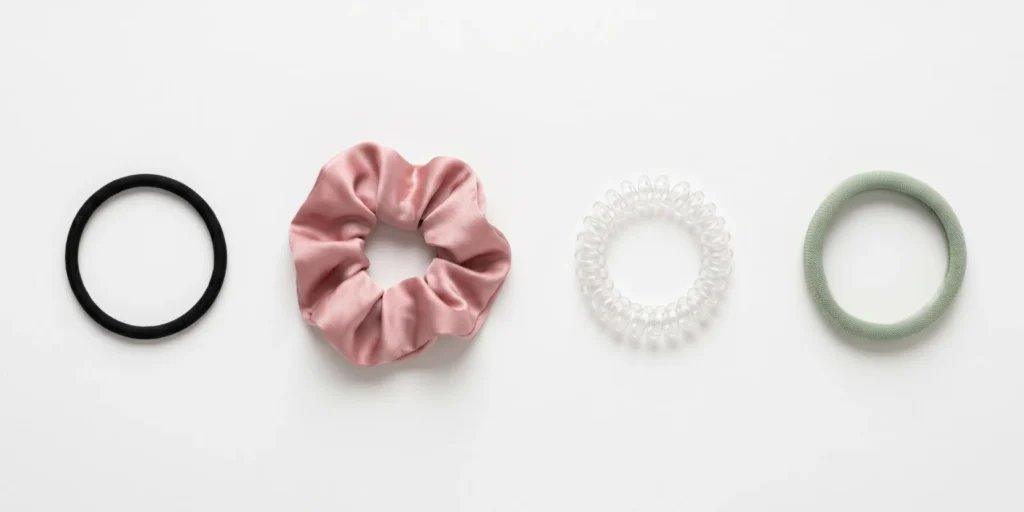
A hair tie is a fastening accessory used to gather and secure sections of hair, typically constructed from an elastic core covered with fabric, nylon, or left exposed. Hair breakage is the physical fracturing of the hair shaft — distinct from hair loss at the root — caused by mechanical stress, friction, or repeated tension applied to the same point on the hair. Whether hair ties cause breakage is a question with a precise answer: the material, construction, and wearing habits associated with specific hair tie formats determine whether breakage occurs, not the act of using a hair tie per se.
This guide examines the mechanics of hair tie-related breakage, identifies which product formats present the highest and lowest risk, and outlines the alternative and complementary products that address breakage concerns — with sourcing context for B2B buyers developing hair accessories ranges.
Hair breakage caused by hair ties occurs through three primary mechanisms, each of which is influenced by the construction of the tie itself.
Every time a hair tie is wrapped around a ponytail or bun, it applies compressive and tensile forces to the hair shaft at the point of contact. On straight bare elastic — the classic utility hair band — these forces are concentrated at a narrow band of contact, generating high localised stress. Over repeated daily application and removal cycles, this stress accumulates and eventually exceeds the tensile strength of the hair shaft, resulting in breakage.
Removing a hair tie — particularly from tangled or fine hair — applies friction to the cuticle layer of individual strands. Bare elastic and metal-jointed elastics generate the highest friction on removal. The metal crimp or join found on standard drugstore elastics is the single highest-risk element in conventional hair tie construction: it catches on individual strands during removal, causing tearing rather than smooth release.
Wearing a hair tie in the same position for extended periods creates a sustained tension crease — a weak point in the hair shaft that is more susceptible to breakage from subsequent styling, brushing, or environmental stress. This is particularly relevant for everyday ponytail wearers who tie their hair at the same height and tightness consistently.
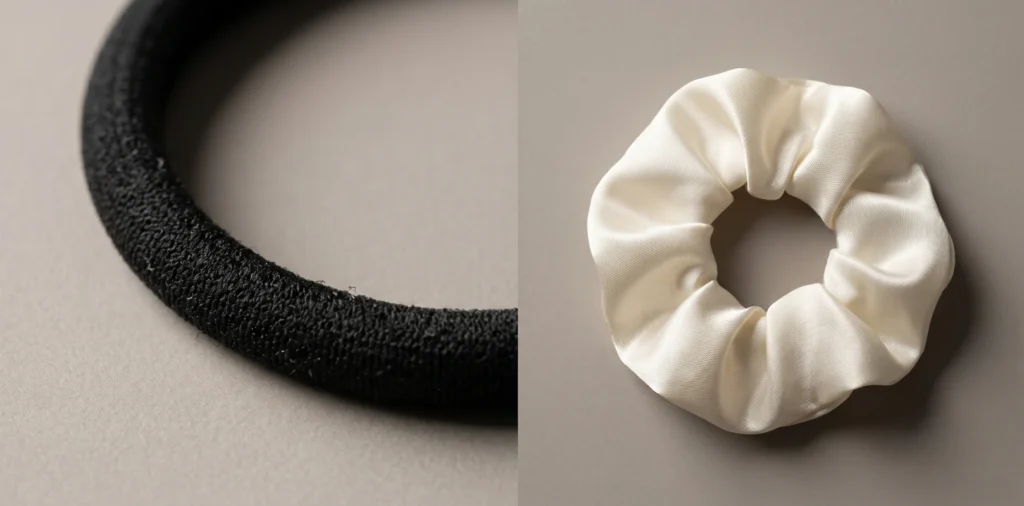
Not all hair ties present equal breakage risk. The following table rates common hair tie formats across the three primary breakage mechanisms:
| Hair Tie Format | Mechanical Stress | Friction on Removal | Tension Crease Risk | Overall Breakage Risk |
|---|---|---|---|---|
| Bare elastic band (no fabric) | High | High | High | Very high |
| Metal-jointed elastic (crimp join) | High | Very high | High | Very high |
| Fabric-covered elastic (thin) | Medium | Medium | Medium | Medium |
| Scrunchie (fabric + elastic) | Low | Very low | Low | Low |
| Spiral / coil hair tie | Low | Very low | Very low | Very low |
| Satin ribbon tie | Very low | Very low | Very low | Very low |
| Seamless silicone band | Medium | Low | Medium | Low to medium |
According to research on hair cuticle friction and mechanical damage, the outer cuticle layer of the hair shaft is particularly vulnerable to abrasive contact — and the surface texture of the material in contact with the hair is the primary determinant of friction-related damage. This finding directly supports the observed performance difference between bare elastic and fabric-covered alternatives.
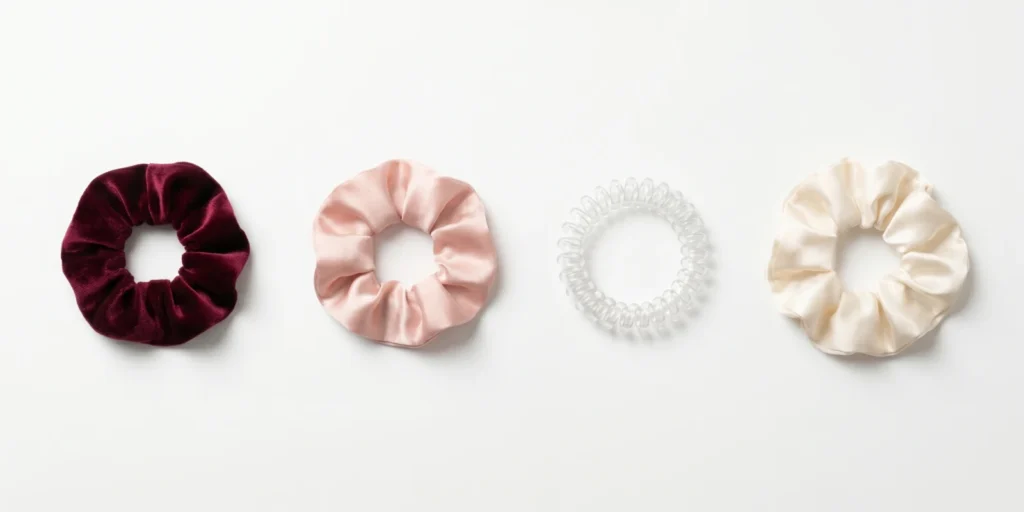
A scrunchie is a fabric-covered elastic hair tie in which the elastic core is encased within a sewn fabric tube, creating a gathered, voluminous exterior. The fabric covering — which may be satin, velvet, cotton, or silk — serves two functional roles: it distributes the elastic’s compressive force across a wider contact area, and it provides a lower-friction surface between the tie and the hair shaft.
Satin scrunchies are particularly effective for fragile, chemically treated, or curly hair because the smooth weave surface generates minimal friction during both application and removal. Velvet scrunchies offer stronger hold due to the pile’s grip effect, making them better suited to fine or slippery hair types. Brands sourcing hair accessories for the premium or wellness market should work with a custom hair scrunchie manufacturer to specify fabric type, elastic tension, and seam construction to match target hair type requirements.
Spiral coil hair ties — also called phone cord ties or tornado ties — are constructed from a coiled plastic or resin filament that wraps around the hair in a helical pattern rather than applying a circumferential band of pressure. The coil distributes tension evenly along its length and leaves no crease in the hair, making it the lowest-crease format currently available in mass retail.
The coil’s smooth surface also generates very low friction on removal. The primary limitation of spiral coil ties is hold strength on very fine or silky hair, where the coil may slip without sufficient grip. For this reason, they are best positioned as a daytime styling accessory rather than a high-hold athletic or professional option.
Satin ribbon ties are strips of woven or knit fabric — typically 60 cm to 120 cm in length — that are tied directly around the hair to form a bow or knot. With no elastic component, the hold relies entirely on the knot and the friction of the fabric against the hair. Surface friction is the lowest of any hair tie format, making ribbon ties the gentlest option for overnight wear, protective styling, or fragile hair management.
The trade-off is ease of use and hold reliability: ribbon ties require manual tying and are less secure than elastic-based formats for active or extended wear. They are most effectively positioned in the premium, bridal, or gift-set channel.
Seamless silicone bands are moulded from a single piece of silicone without a join or crimp, eliminating the highest-risk element of conventional elastic construction. The smooth, seamless surface reduces snagging on removal relative to metal-jointed elastics. However, the silicone material still generates moderate friction relative to fabric-covered alternatives, and the compressive force is less distributed than in a scrunchie format.
Seamless silicone bands occupy a middle position in the breakage risk spectrum — significantly safer than conventional elastics, but not equivalent to scrunchies or coil ties in terms of breakage reduction.
Beyond product format, wearing habits significantly affect breakage outcomes. The following practices are associated with elevated breakage risk regardless of the hair tie format used:
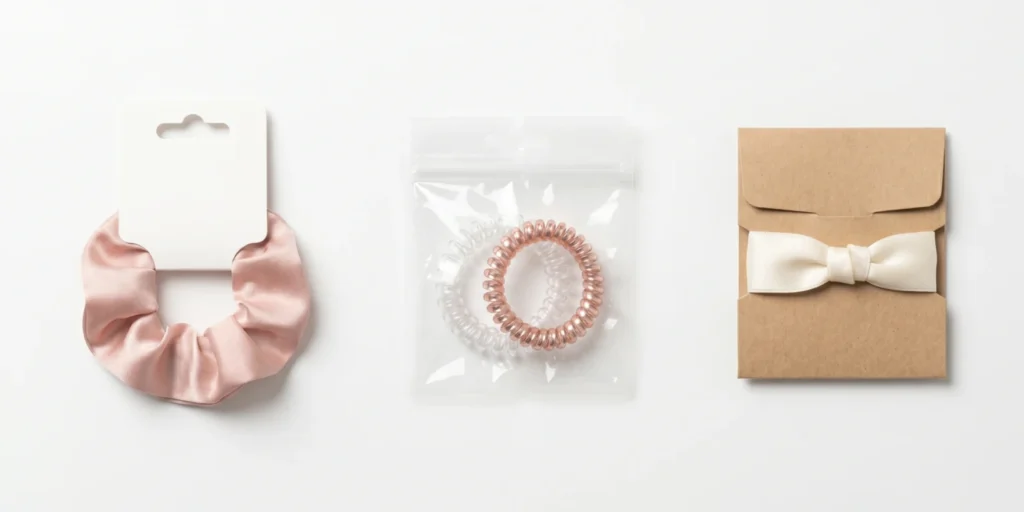
For private label brands, e-commerce operators, and salon retail buyers evaluating hair tie categories, the shift in consumer awareness around breakage has created a meaningful commercial opportunity in the low-breakage segment. Understanding the sourcing variables specific to each format supports more precise product brief development.
The primary specification variables for scrunchies are fabric type and weight, elastic tension, finished diameter, seam construction method, and packaging format. Fabric selection is the most consequential variable for breakage performance: satin and silk-finish fabrics offer the lowest friction, velvet and cotton offer higher grip. Elastic tension should be calibrated to the target hair volume — lower tension for fine hair, higher for thick or high-volume hair. Standard MOQs from factory-direct suppliers typically begin at 300–500 units per style per colour.
Spiral coil hair ties are typically produced from TPU (thermoplastic polyurethane) or acrylic resin. Key specification variables include coil diameter (which affects how many wraps the tie makes around a given ponytail diameter), filament thickness (which affects hold strength), and coil pitch (which affects the distribution of tension along the hair section). MOQs are generally higher than for scrunchies, reflecting the injection moulding tooling involved in coil production.
Hair ties that contact the skin and hair directly should be sourced from manufacturers holding ISO 9001:2015 quality management certification. For products destined for EU markets, material safety compliance — including testing for restricted substances under REACH regulation — is a relevant sourcing consideration for both elastic and plastic coil formats. Buyers developing sustainability-positioned ranges should look for suppliers producing scrunchie fabric from Global Recycled Standard certified recycled polyester, an increasingly requested credential in the premium hair accessories segment.
Buyers evaluating OEM hair accessories manufacturing partners for hair tie development should request material safety data sheets alongside production samples to confirm compliance before committing to a full production run.
The following table provides a sourcing and positioning reference for buyers planning a hair tie range that addresses breakage concerns across different consumer segments:
| Format | Breakage Risk | Target Consumer | Retail Price Tier | Typical MOQ | Channel Fit |
|---|---|---|---|---|---|
| Satin scrunchie | Low | Curly, treated, fragile hair | Mid to premium | 300–500 pcs | Retail, e-commerce, salon |
| Velvet scrunchie | Low | Fine, straight, thick hair | Mid to premium | 300–500 pcs | Retail, e-commerce, gift |
| Spiral coil tie | Very low | All hair types, crease-averse | Mid | 500–1,000 pcs | Retail, e-commerce, sport |
| Satin ribbon tie | Very low | Fragile, protective styling | Mid to premium | 300–500 pcs | Premium retail, bridal, gift |
| Seamless silicone band | Low to medium | Active, everyday wear | Low to mid | 500–1,000 pcs | Mass market, sport, pharmacy |
| Fabric-covered elastic | Medium | General consumer | Low | 500–1,000 pcs | Mass market, multi-pack |
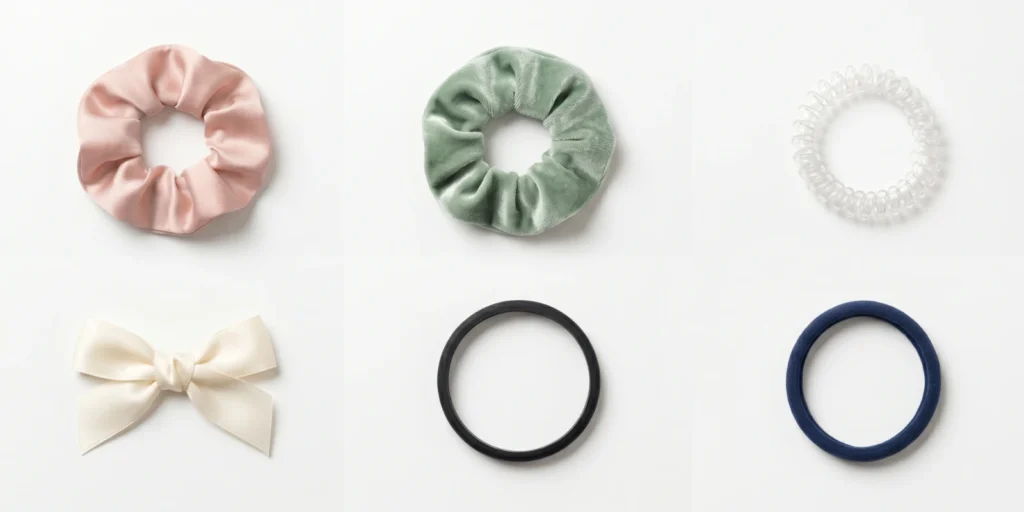
Not all hair ties cause meaningful breakage. Bare elastic bands and metal-jointed elastics present the highest breakage risk due to their narrow contact area, high friction surface, and the snagging effect of the metal crimp join. Scrunchies, spiral coil ties, and satin ribbon ties present significantly lower breakage risk because they distribute tension more broadly, provide lower-friction surfaces, and remove without snagging on individual strands. The format, material, and wearing habits associated with a hair tie collectively determine whether breakage occurs.
Bare elastic bands concentrate compressive and tensile force in a narrow band at the wrap point, generating high localised mechanical stress on the hair shaft. Scrunchies distribute the same holding force across a wider fabric-covered surface, reducing stress concentration. Additionally, the smooth fabric exterior of a scrunchie generates lower friction against the hair cuticle during application and removal than the rubber surface of a bare elastic, reducing abrasive damage to the outer hair shaft layer.
Satin scrunchies and satin ribbon ties are the most suitable formats for damaged or chemically treated hair. The smooth, low-friction satin surface minimises mechanical abrasion against the already-compromised cuticle layer, while the wider contact area of a scrunchie reduces concentrated stress at the wrap point. Spiral coil ties are also a strong option, as they distribute tension along a helical path rather than at a single circumferential band and leave no crease in the hair. Bare elastic bands and metal-jointed elastics should be avoided for this hair type.
Sleeping with a conventional elastic hair tie in place is associated with elevated breakage risk because sustained overnight friction — from both the tie itself and pillow contact — creates cumulative mechanical damage at the wrap point. If securing hair for sleep is preferred, a loose satin scrunchie or satin ribbon tie at low tension presents considerably lower risk than an elastic band. These formats are specifically marketed in the hair care and protective styling segment for overnight use.
Standard MOQs for scrunchies from factory-direct OEM suppliers typically begin at 300–500 units per style per colour for standard fabric and elastic specifications. Spiral coil hair ties typically carry higher MOQs of 500–1,000 units per style, reflecting the injection moulding tooling involved in production. Buyers sourcing multiple hair tie formats within a single order may be able to negotiate blended MOQ arrangements with established manufacturing partners.
Hair ties occupy a foundational position in any hair accessories range and benefit from segmentation by hair type and use context rather than being presented as a single undifferentiated category. A well-structured range typically includes a low-breakage premium tier (satin scrunchies, ribbon ties) targeting fragile or treated hair consumers, a mid-market everyday tier (velvet scrunchies, seamless silicone bands) for general styling, and a functional tier (fabric-covered elastics, coil ties) for active or crease-free wear. This segmentation supports upselling from commodity elastics to higher-margin scrunchie and ribbon formats.
Hair ties do cause breakage — but the extent of that damage is almost entirely determined by the format and material of the tie, and the habits with which it is used. Bare elastic bands and metal-jointed elastics present significant breakage risk through concentrated mechanical stress, high surface friction, and snagging on removal. Scrunchies, spiral coil ties, and satin ribbon ties address each of these mechanisms through wider force distribution, lower-friction surfaces, and seamless or fabric-covered construction.
For B2B buyers, the growing consumer awareness around hair tie-related breakage represents a commercial opportunity to expand beyond commodity elastic formats into higher-margin, differentiated products that are positioned on functional performance rather than price. Manufacturers such as JunYi Beauty, which produces scrunchies across satin, velvet, and cotton fabric specifications alongside a broader hair accessories range at its Dongguan production facility under ISO 9001:2015 and amfori BSCI certification, represent the type of factory-direct OEM partner suited to brands looking to develop or extend a low-breakage hair tie offer.
👉 Searching for Hair Accessories ? Your brand deserves the best.