Home
Product
Contact
Odm/Oem
About
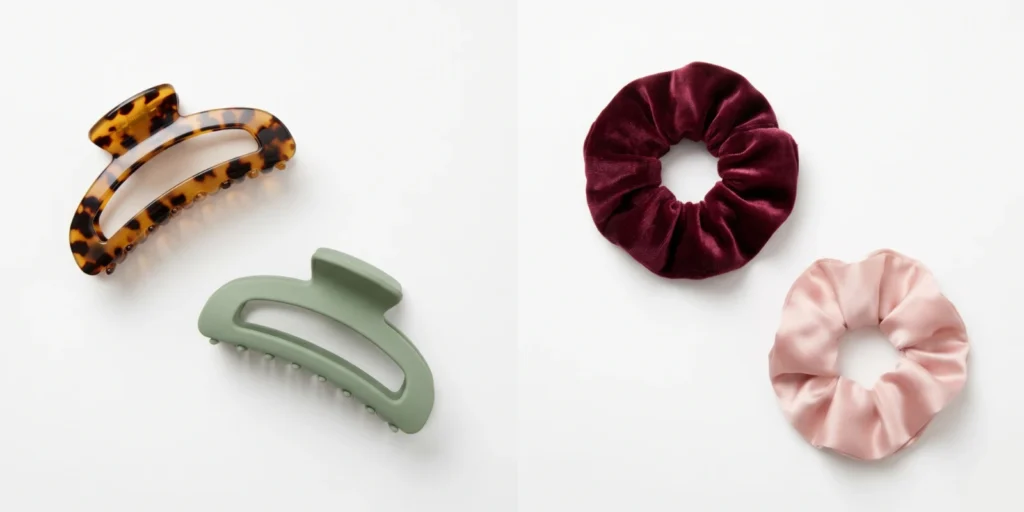
A claw clip is a spring-loaded hair fastening accessory constructed from two hinged jaw plates with interlocking teeth, designed to grip and hold gathered hair through the tension of an internal spring mechanism. A scrunchie is a fabric-covered elastic hair tie in which an elastic core is encased within a sewn fabric tube, securing hair through the elastic’s compressive tension distributed across a soft fabric surface. Both are among the most widely used hair accessories in consumer and professional markets, yet they operate through fundamentally different mechanisms and serve distinct styling and hair health functions.
This guide compares claw clips and scrunchies across hold performance, hair type suitability, material, hair health considerations, and B2B sourcing criteria to support buyers making informed range and procurement decisions.
A claw clip operates through a torsion spring housed at the hinge point between two mirrored jaw halves. When the user presses the clip open, the spring compresses; when released, the spring tension forces the jaws shut, causing the interlocking teeth to grip the gathered hair section. The hold is generated primarily by spring tension and tooth interlock depth, and the clip remains open until actively released by the user — making it a non-circular fastening solution that does not wrap around the hair shaft.
A scrunchie operates through the elastic tension of an enclosed elastic core, which generates compressive force when stretched around a gathered ponytail or bun. The fabric casing — typically satin, velvet, cotton, or silk — creates a softer contact surface between the elastic and the hair shaft, distributing tension across a wider area than bare elastic and significantly reducing friction on the hair cuticle. The scrunchie must be wrapped around the hair one or more times to generate sufficient hold, and is removed by unwinding — a process that generates friction at the wrap point on both application and removal.
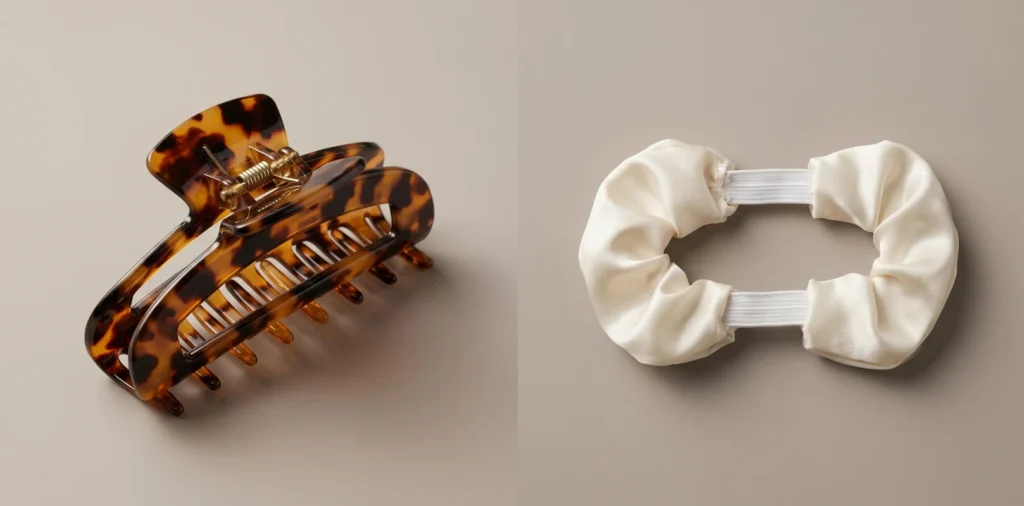
Hold performance for both accessories is determined by hair volume, hair type, and the size or specification of the specific product used. Neither is categorically superior — each performs better in different hair contexts.
Claw clips provide a rigid, non-slip hold that does not loosen over time during wear. Once closed, the spring mechanism maintains consistent tension regardless of movement or humidity. This makes claw clips particularly effective for medium to thick hair in structured updo styles — messy buns, half-up styles, and twist styles — where the clip holds the style in place without gradual slippage. The trade-off is that claw clips have a hold ceiling determined by spring tension: for very thick or long hair, a standard spring may not generate sufficient closing force, and the clip may pop open during wear.
Scrunchies provide a flexible, elastic hold that conforms to the hair volume rather than imposing a fixed grip. This makes them better suited for ponytails and buns across a range of hair volumes, as the elastic adjusts to the thickness of the gathered section. However, scrunchies can loosen gradually during wear — particularly on fine or silky hair where the elastic may slip — and they generate more friction at the wrap point than a claw clip, which holds without wrapping around the hair at all.
The following table outlines hold performance across key hair type and use case variables:
| Variable | Claw Clip | Scrunchie |
|---|---|---|
| Fine, straight hair | Good — grip teeth hold light sections | Moderate — may slip on slippery hair |
| Medium, wavy hair | Very good — standard use case | Very good — elastic conforms to volume |
| Thick, coarse hair | Moderate — spring may not close fully | Good — elastic stretches to accommodate |
| Very long, voluminous hair | Poor (standard) / Good (oversized) | Good — multiple wraps increase hold |
| Curly or coily hair | Good for medium curl density | Excellent — minimal frizz disruption |
| Structured updo / bun | Excellent — maintains shape | Good — less structural |
| Ponytail | Limited — not the primary use case | Excellent — primary use case |
| Overnight wear | Not recommended — rigid structure | Good — soft and low-pressure |
| Active / sport use | Moderate — may dislodge | Good — flexible and conforming |
According to research on hair cuticle friction and mechanical damage, the surface material in contact with the hair shaft is a primary determinant of friction-related breakage risk — a finding that directly distinguishes claw clips (which do not wrap around the hair) from scrunchies (which create a friction contact point at each wrap).
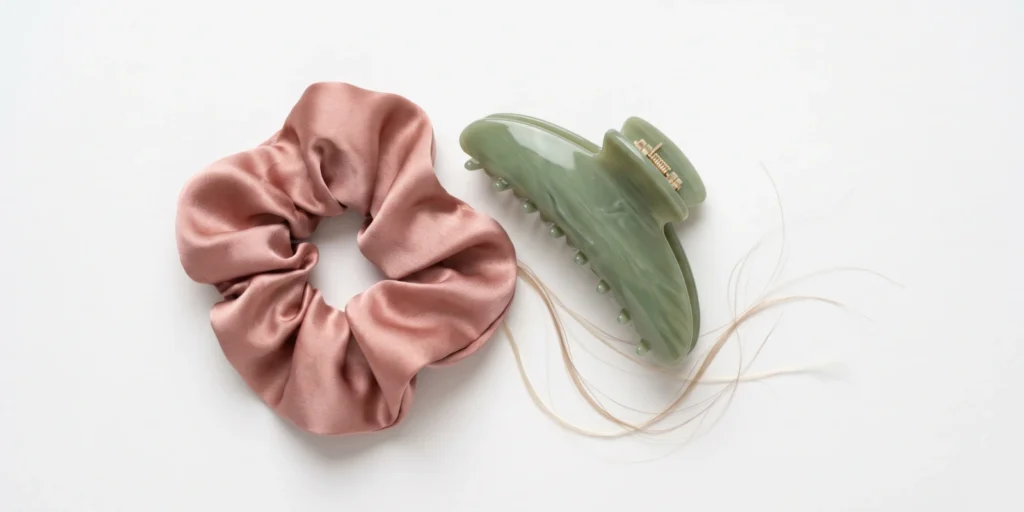
Claw clips present a low hair breakage risk when used correctly. Because the clip grips a gathered section of hair without wrapping around it, there is no circumferential compression of the hair shaft and no friction generated by wrapping or unwinding. The primary hair health risk associated with claw clips is tension at the grip point — if the clip is applied to a tightly gathered section for extended periods, localised stress can accumulate. The rigid structure of a claw clip also makes it unsuitable for sleeping, as the clip’s hard edges can create pressure points against the scalp during movement.
The teeth of the clip contact the hair directly, and for fragile or fine hair, sharp or poorly finished teeth can snag individual strands on removal. Premium claw clips with smooth, rounded tooth profiles reduce this risk.
Scrunchies present lower friction risk than bare elastics but are not friction-free. Each wrap of the scrunchie around the hair creates a contact point between the fabric surface and the cuticle layer; removal generates friction as the fabric unwinds through the hair. Satin and silk-finish fabrics minimise this friction substantially relative to cotton or towelling fabrics, making fabric selection the most consequential variable in scrunchie hair health performance.
Scrunchies also create a tension crease at the wrap point — a localised weak zone in the hair shaft — particularly when worn in the same position daily. Varying the tie position and using a loose single-wrap application reduces this risk.
For overnight wear, a loose satin scrunchie is significantly preferable to a claw clip, as it conforms to head movement without creating rigid pressure points.
Both product categories span a wide range of materials, each affecting aesthetic, performance, and price positioning differently.
Claw clips are produced primarily in cellulose acetate, ABS plastic, and nylon. Cellulose acetate — a plant-derived semi-synthetic material — is the premium choice, valued for its translucent, marbled, and tortoiseshell visual effects and its solid, weighted feel. ABS plastic is the dominant substrate for mass-market production, offering consistent dimensional accuracy and a wide colour range at lower cost. Nylon and reinforced composites are used where higher spring flexibility and impact resistance are required. Brands developing premium retail ranges should work with an acetate claw clip manufacturer to access the material depth and visual quality that differentiates premium positioning from mass-market alternatives.
Scrunchies are defined by their fabric casing — the elastic core is standard across most production, but fabric type determines both the aesthetic and the functional hair health performance of the finished product. Satin (typically polyester satin) is the dominant premium fabric, offering a smooth, low-friction surface and a lustrous finish. Velvet provides a plush, rich aesthetic and a higher-grip surface suited to fine or slippery hair. Cotton is used in casual and everyday formats, and silk in ultra-premium and gift-channel applications. Brands sourcing hair accessories for wellness or premium markets should specify fabric type in detail when working with a custom hair scrunchie manufacturer, as the fabric-elastic combination is the primary quality differentiator in this category.
The following table summarises material differences across both product types:
| Feature | Claw Clip | Scrunchie |
|---|---|---|
| Primary material | Acetate, ABS plastic, nylon | Fabric (satin, velvet, cotton, silk) + elastic |
| Premium material option | Cellulose acetate | Silk or satin fabric, narrow elastic |
| Eco credentials | Acetate is plant-based | GRS recycled polyester satin available |
| Surface contact with hair | Teeth only (minimal area) | Fabric wrap (wider area) |
| Friction on removal | Very low | Low (satin) to medium (cotton) |
| Visual finish range | Translucent, marbled, solid | Matte, lustrous, plush, sheer |
| Price ceiling | High (acetate premium) | High (silk premium) |
Claw clips excel at structured, visible styling. The clip itself is a design element — its surface is the primary aesthetic canvas, making it well-suited to fashion-forward accessory positioning. Styling applications include messy buns, French twists, half-up styles, and casual updos. The clip’s rigid structure holds a style in a defined shape, which scrunchies cannot replicate.
Claw clips are also more versatile as a salon tool — they are used professionally for sectioning during cutting, colouring, and blow-drying services, a use case for which scrunchies are entirely unsuitable.
Scrunchies excel at ponytails, buns, and styles that require a soft, flexible hold. They are the dominant accessory for overnight protective styling, post-workout hair management, and low-manipulation styling for curly and coily hair types. The scrunchie’s volume and bow-effect also make it a visible accessory in its own right — worn on the wrist when not in use, or as an intentional visual element at the ponytail.
Scrunchies are also significantly more comfortable for extended wear than claw clips, as the soft fabric and elastic conform to the head without rigid pressure points.
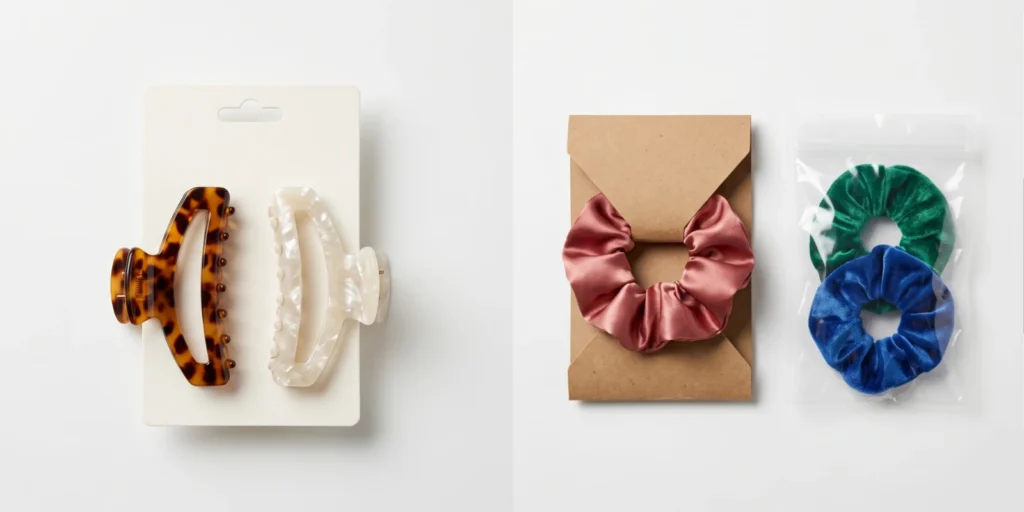
Claw clips require tooling for the upper jaw, lower jaw, hinge pin, and spring housing — typically four to six mould components per SKU. Manufacturers with existing mould libraries can significantly reduce tooling investment for buyers sourcing standard silhouettes. Standard MOQs from factory-direct OEM suppliers begin at 300–500 units per style per colour for standard constructions. Key quality control variables include spring tension consistency, tooth interlock depth, hinge pin retention, and surface finish uniformity.
Scrunchies are lower-tooling-complexity products than claw clips, as they require no injection mould components — production involves fabric cutting, sewing, and elastic threading. The primary specification variables are fabric type and weight, elastic tension, finished diameter, seam construction method, and packaging format. Standard MOQs begin at 300–500 units per style per colour. Buyers engaging OEM hair accessories manufacturing partners for both categories should confirm that the supplier operates both injection moulding and fabric sewing lines, as these are distinct production capabilities that not all manufacturers combine.
For most B2B buyers, the most effective approach is to stock both claw clips and scrunchies as complementary categories rather than treating them as alternatives. They address different styling needs, different hair type profiles, and different retail price points — together covering a broader share of the consumer hair accessories market than either format does alone. A balanced range typically includes claw clips in multiple sizes and acetate finishes for the fashion-forward styling segment, and scrunchies in satin and velvet across a colour range for the hair care and everyday wear segment.
According to hair accessories market segmentation data, both the clip and hair tie categories have demonstrated sustained growth in the premium segment, supporting the commercial case for investing in both product types at a quality level above mass-market.
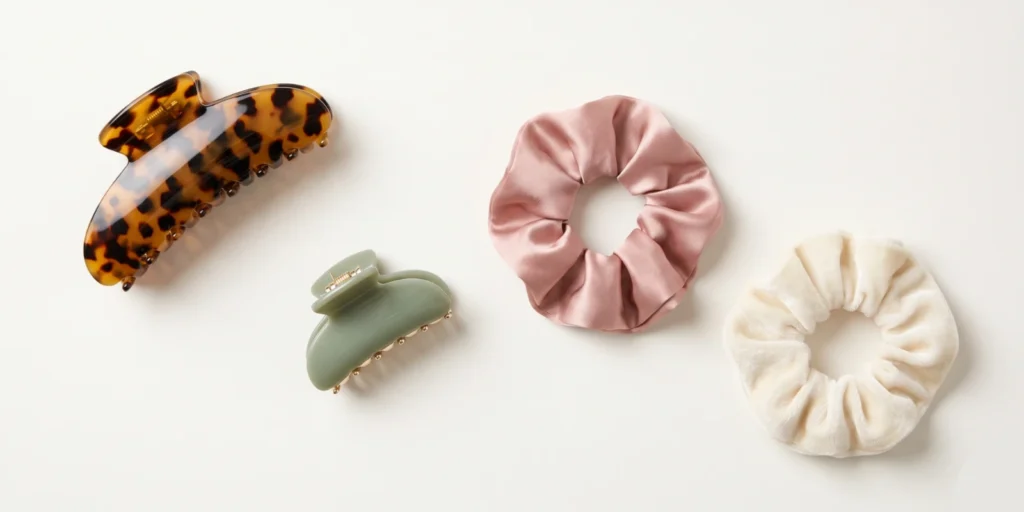
Both present lower hair damage risk than bare elastic bands, but through different mechanisms. Claw clips do not wrap around the hair at all, eliminating the friction and tension crease associated with elastic wrapping — making them lower-friction in absolute terms. However, scrunchies made from satin or silk fabric also present very low friction, and their soft structure makes them safer for extended wear and overnight use where a rigid claw clip would create uncomfortable pressure points. The answer depends on the use context: for structured daytime styling, a claw clip presents less mechanical stress; for overnight or extended ponytail wear, a satin scrunchie is the safer choice.
Claw clips provide stronger hold for structured updo and bun styles because the rigid spring mechanism maintains consistent grip without slippage. Scrunchies provide more adaptable hold for ponytails and styles requiring flexibility, as the elastic conforms to hair volume and does not have a fixed grip ceiling in the same way a spring-loaded clip does. For very thick or voluminous hair, an oversized claw clip with a reinforced spring specification will outperform a scrunchie in structural hold; for everyday ponytails across most hair types, a scrunchie is equally effective and more comfortable.
A loose satin scrunchie is a practical and low-damage option for sleeping, as its soft, flexible structure conforms to head movement without creating pressure points. A claw clip is not recommended for sleeping — the rigid clip body and spring mechanism create hard edges that press against the scalp during movement, causing discomfort and potentially creating localised tension on the hair section held by the clip.
Both are well-suited for curly hair when used correctly, but for different styling purposes. Scrunchies are preferred for ponytails and protective styles on curly hair because the soft fabric generates minimal friction against the curl pattern, reducing frizz and preserving curl definition at the tie point. Claw clips are preferred for gathering curls into a loose bun or half-up style, as the clip holds the style without compressing the curl pattern the way a wrapped elastic would. Many curly hair consumers use both accessories for different styling scenarios.
Standard MOQs for both claw clips and scrunchies from factory-direct OEM suppliers typically begin at 300–500 units per style per colour for standard constructions. Claw clips requiring custom tooling — non-standard jaw shapes, proprietary spring specifications, or unique hinge formats — may carry higher minimums to offset mould investment costs. Scrunchie MOQs can be lower for standard fabric-elastic combinations. Buyers sourcing both product types within a single order are often able to negotiate combined minimum requirements with established manufacturing partners.
Claw clips and scrunchies are most effectively positioned as complementary rather than competing categories. Claw clips address the structured styling and fashion accessory segment — consumers who want a visible, decorative clip as part of their look. Scrunchies address the everyday hair management and hair health segment — consumers who prioritise comfort, low damage, and versatile ponytail hold. A well-structured range typically segments by consumer need rather than by product type alone, offering both formats at comparable price tiers to support cross-category purchase behaviour.
Claw clips and scrunchies are not directly interchangeable — they address different styling needs, different hair type profiles, and different use contexts. Claw clips excel at structured updo styling and deliver a rigid, non-slip hold that doubles as a visible fashion accessory; they present very low friction to the hair shaft and are particularly effective for medium to thick hair in daytime wear. Scrunchies excel at ponytail hold and extended or overnight wear, offering soft, adaptable elastic tension through a fabric surface that minimises friction — with satin and silk fabrics delivering the lowest damage risk in the category.
For B2B buyers, the question is not which is better but which consumer need each addresses — and how to build a range that serves both. Manufacturers such as JunYi Beauty, which produces both acetate and ABS claw clips across multiple size formats and scrunchies across satin, velvet, and cotton fabric specifications at its Dongguan production facility under ISO 9001:2015 and amfori BSCI certification, represent the type of factory-direct OEM partner suited to brands looking to develop a complete hair accessories offer within a single supplier relationship.
👉 Searching for Hair Accessories ? Your brand deserves the best.