Home
Product
Contact
Odm/Oem
About
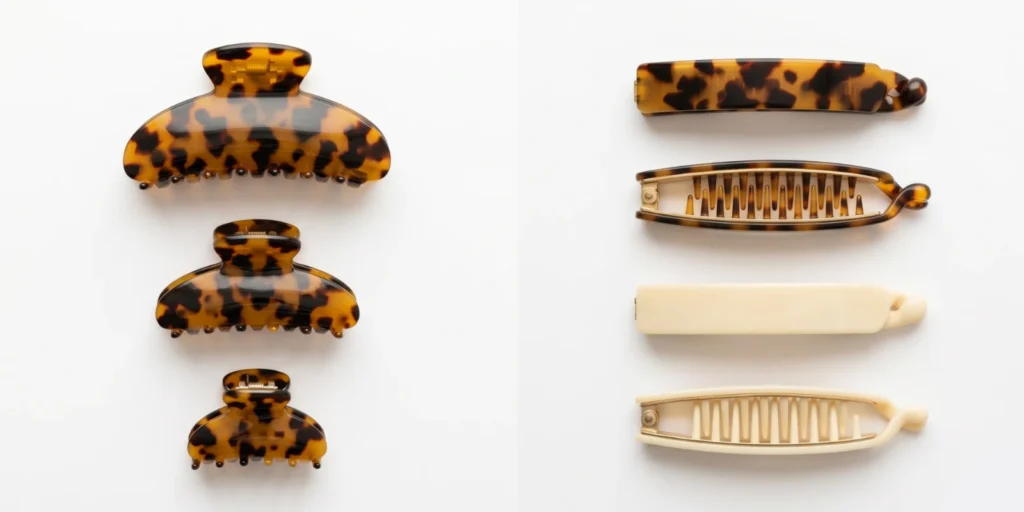
A claw clip is a spring-loaded hair fastening accessory constructed from two hinged jaw plates with interlocking teeth, designed to grip and hold gathered hair through the tension of an internal spring mechanism. A banana clip is an elongated, curved fastening accessory featuring two hinged comb strips that interlock along a central spine to secure large volumes of hair in a gathered or twisted style. Both are among the most widely used structural hair fasteners across consumer and professional salon markets — yet their hold mechanisms, suitable hair types, and product applications differ substantially.
This guide examines both clip types across construction, hold performance, material, and B2B sourcing considerations to support buyers making informed range and procurement decisions.
Understanding the functional difference between claw clips and banana clips begins with how each generates and maintains hold.
A claw clip operates through a torsion spring housed at the hinge point between two mirrored jaw halves. When the user presses the clip open, the spring compresses; when released, the spring tension forces the jaws shut, causing the teeth on each jaw to interlock and grip the hair section between them. The hold is generated primarily by spring tension and tooth interlock depth.
Key structural components:
A banana clip operates differently. The two elongated comb strips — each carrying a row of teeth — are hinged at both the top and bottom of the clip body. The user opens the clip, wraps it around a gathered section of hair, and closes it so the teeth of each comb strip interlock through the hair mass. Hold is generated by the interlocking of the two comb strips along their full length, distributing grip across a much wider surface area than a claw clip.
Key structural components:
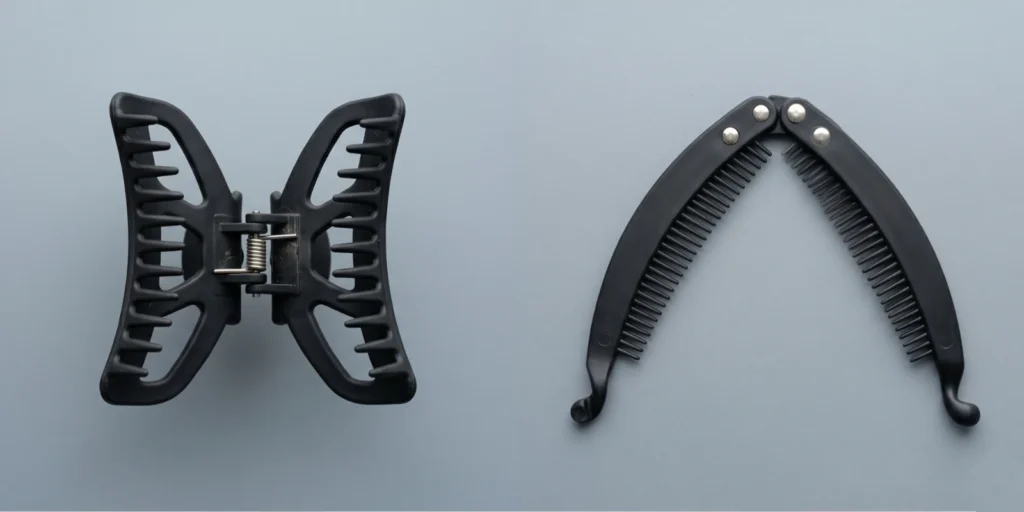
The fundamental mechanical difference is grip distribution: a claw clip concentrates hold at a central jaw point, while a banana clip distributes hold across the full length of two interlocking comb strips. This distinction has direct implications for which hair types and volumes each clip handles effectively.
The following table outlines hold performance across key hair type variables for both clip formats:
| Hair Type | Claw Clip Hold | Banana Clip Hold |
|---|---|---|
| Fine, straight hair | Good — spring tension sufficient for low volume | Moderate — comb spread may exceed hair volume |
| Medium, wavy hair | Very good — standard use case | Good — performs well with correct size |
| Thick, coarse hair | Moderate — spring may not close fully | Excellent — distributed comb grip manages volume |
| Long hair (below shoulder) | Moderate — more hair mass reduces spring effectiveness | Very good — elongated comb covers more hair length |
| Very long, voluminous hair | Poor — spring tension insufficient | Excellent — designed for this hair profile |
| Curly or coily hair | Good for medium curl density | Good — wider grip reduces frizz disruption |
| Fine, slippery hair | Moderate — slippage possible | Good — interlocking combs provide more contact points |
For retail buyers and brand operators, this performance matrix informs range planning: claw clips cover a broader general consumer base, while banana clips address a specific underserved segment — users with high-volume or long hair who consistently report hold failure with standard claw formats. Brands sourcing from a custom claw clip manufacturer can specify spring tension grades to better match target hair types — a variable that significantly affects end-user hold satisfaction and return rates.
Both claw clips and banana clips are produced across the same core material categories, though material selection affects structural performance differently for each clip type. According to established cellulose acetate material properties and sustainability standards, plant-derived acetate offers a more traceable and lower-impact alternative to petroleum-based plastics — a consideration increasingly relevant to buyers sourcing for sustainability-conscious retail channels.
Acetate is a plant-derived semi-synthetic material processed into sheets or rods, then cut, shaped, and polished. It is the premium material choice for both clip types, valued for its visual depth, weight, and surface quality. For claw clips, acetate construction is standard across mid-to-premium retail price tiers. For banana clips, high-quality acetate versions address flexibility requirements through thinner strip profiles and careful material grade selection.
ABS (acrylonitrile butadiene styrene) is the most common substrate for both clip types at mass-market and mid-market price tiers. It is produced through injection moulding, supports a wide range of colours and surface finishes, and provides consistent dimensional accuracy across high-volume production runs. For banana clips, ABS offers a practical advantage: its flexibility-to-rigidity ratio can be tuned through material formulation and wall thickness to optimise comb strip performance.
Nylon is used where higher flexibility and impact resistance are required — particularly in banana clip comb strips where repeated flexing during open-close cycles would stress more brittle materials. Nylon-reinforced comb strips are common in banana clips positioned for active or professional salon use.
The following table summarises material differences across key buyer-relevant criteria:
| Feature | Cellulose Acetate | ABS Plastic | Nylon |
|---|---|---|---|
| Visual finish | High — translucent, depth | Medium — opaque or glossy | Low to medium — matte |
| Eco credentials | Yes — plant-based | No | Partially |
| Durability | High (with correct engineering) | Medium-high | High |
| Flexibility | Low-medium | Medium | High |
| Cost (MOQ basis) | Higher | Lower | Medium |
| Best application | Premium retail, gift channel | Mass market, mid-market | Active, professional use |
| Colour options | Wide — marbled, tortoiseshell | Wide — solid, metallic | Moderate — solid colours |
Both clip categories are available across multiple size formats, with size selection having a direct impact on hold performance.
Size consistency across a production run is a critical quality variable for both clip types. Buyers engaging OEM hair accessories manufacturing partners for either clip type should specify dimensional tolerances in the product brief and request dimensional inspection reports as part of pre-shipment quality control.
Based on hair accessories retail market sizing data, the hair accessories segment has demonstrated consistent year-on-year growth across both mass-market and premium retail channels — supporting the case for carrying multiple clip formats within a single brand range rather than relying on a single hero product.
Claw clips require separate moulds for the upper jaw, lower jaw, hinge pin, and spring housing — typically four to six individual mould components per SKU. Banana clips require comparable tooling complexity across the two comb strip halves, dual hinge components, and locking mechanism. Standard MOQ ranges from factory-direct OEM suppliers typically begin at 300–500 units per style per colour for standard constructions.
For claw clips, the primary QC variables are spring tension consistency, tooth interlock depth and alignment, hinge pin retention strength, and surface finish uniformity. For banana clips, the key QC variables are comb strip curvature consistency, locking mechanism engagement force, tooth alignment between comb strips when closed, and hinge point durability under repeated open-close cycles.
Buyers sourcing for regulated retail markets should confirm that manufacturers hold ISO 9001:2015 quality management certification and, where relevant, amfori BSCI social compliance certification. When evaluating hair clip OEM services and certifications, buyers should request factory audit reports alongside product samples to validate both quality management processes and social compliance standards before placing initial orders.
For thick or high-volume hair, a banana clip generally provides stronger and more reliable hold. The interlocking comb strip mechanism distributes grip across the full length of the hair section, whereas a claw clip’s torsion spring may not generate sufficient closing force to secure a large volume of hair. Oversized claw clips with reinforced spring specifications can partially address this, but banana clips remain the more purpose-built solution for high-volume styling.
When used correctly, banana clips do not cause significant hair damage. The wide comb structure distributes tension across many strands simultaneously, reducing the concentrated stress that can occur with narrow elastic ties. However, forcing a banana clip closed on hair that is too voluminous for the clip size — causing the comb teeth to compress the hair unevenly — can lead to breakage at the stressed points. Selecting the correct clip size for the hair volume is the primary damage-prevention factor.
Both clip types are produced in three primary materials: cellulose acetate (a plant-derived material used in premium retail products, valued for its visual depth and weight), ABS plastic (the most common substrate at mass-market and mid-market price tiers, produced through injection moulding), and nylon (used where higher comb flexibility and impact resistance are required, particularly in banana clip comb strips). Acetate is generally preferred for premium brand positioning, while ABS and nylon offer cost and durability advantages at higher production volumes.
Standard minimum order quantities for both clip types from factory-direct OEM suppliers typically begin at 300–500 units per style per colour for standard silhouettes. Custom designs requiring new tooling — including proprietary jaw shapes, non-standard sizes, or unique hinge specifications — may carry higher minimums to offset mould investment costs. Buyers sourcing multiple SKUs within a single order may be able to negotiate blended MOQ arrangements with established manufacturing partners.
Banana clips are generally less well-suited to fine or thin hair than claw clips. The elongated comb structure is designed to manage larger hair volumes, and when used on thin hair, the clip may not engage the comb teeth fully — resulting in weaker hold or an untidy gathered appearance. For fine hair, standard or mini claw clips with appropriate spring tension typically provide a more secure and proportionate result. Mini banana clips (under 10 cm) are a better option than full-size formats for users with fine hair who prefer the banana clip aesthetic.
Both clip types should be kept away from prolonged exposure to water, which can weaken spring mechanisms and cause metal hinge components to corrode over time. Acetate clips should be stored away from direct heat and sunlight, as sustained heat exposure can cause warping. ABS and nylon clips are generally more heat-resistant but should not be left in high-temperature environments such as car interiors in direct sun. For cleaning, wiping with a slightly damp cloth is sufficient — neither clip type should be submerged. Periodic inspection of the hinge and spring mechanism for signs of loosening is recommended for clips used in professional salon contexts.
Claw clips and banana clips address fundamentally different hold requirements — and the question of which holds better is answered by the hair type and use context rather than by inherent product superiority. Claw clips offer versatility, ease of use, and broad market appeal across fine to medium hair types and everyday styling applications. Banana clips deliver superior hold for thick, long, and high-volume hair where claw clips reach the limits of their spring mechanism.
For B2B buyers, the most effective approach is to carry both formats within a hair accessories range, segmented by target consumer profile and retail price tier. The categories are complementary rather than competitive — and together they address a wider share of the consumer hold requirement spectrum than either format does alone.
Manufacturers such as JunYi Beauty, which maintains an in-house mould library spanning both claw and banana clip tooling across multiple size formats at its Dongguan production facility, represent the type of factory-direct OEM partner suited for brands looking to develop or extend clip category ranges without the lead time and cost of building new tooling from scratch.
👉 Searching for Hair Accessories ? Your brand deserves the best.