Home
Product
Contact
Odm/Oem
About
A hair accessory is a functional or decorative item used to style, secure, or embellish hair — ranging from structural fastening tools to purely ornamental adornments worn as part of a broader fashion look. While claw clips and basic scrunchies remain category staples, the hair accessories market entering 2026 is being reshaped by a broader set of silhouettes, materials, and styling functions that reflect evolving consumer preferences and retail trend cycles.
For B2B buyers — including private label brand owners, salon procurement managers, and e-commerce operators — understanding which accessory categories are gaining traction supports more strategic range planning and sourcing decisions ahead of peak retail seasons.
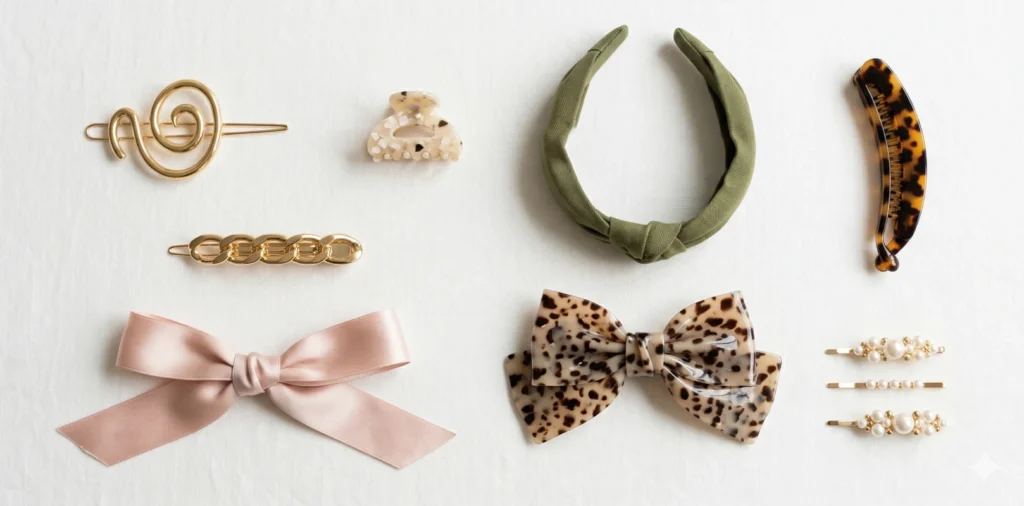
This article identifies eight hair accessory types gaining significant visibility in 2026, with an overview of their design characteristics, material composition, and sourcing considerations for brand buyers.
Ribbon hair ties are fabric-based fastening accessories constructed from long strips of woven or satin-finish ribbon, tied directly around the hair to form a bow or knot at the nape or ponytail base. Unlike conventional elastic-based ties, ribbon hair ties rely on the friction of the knot rather than tension to hold the hair in place.
The appeal of ribbon ties in 2026 is driven by their dual function: they serve as both a functional hair fastener and a visible fashion accessory, extending beyond the hairline into the overall outfit aesthetic. Grosgrain, satin, velvet, and organza are the most common ribbon constructions used in production.
Key product specifications relevant to buyers:
nsert sentence: Ribbon ties are typically produced alongside scrunchie lines by factory-direct suppliers offering custom hair scrunchie and tie manufacturing, as both categories share fabric sourcing and sewing infrastructure.
Sculptural hair pins are decorative fastening accessories featuring three-dimensional formed elements — geometric shapes, abstract motifs, organic forms such as leaves or petals — attached to a functional pin base. In 2026, this category is being driven by the crossover between fine jewellery aesthetics and everyday hair accessory design.
Construction typically involves a metal base pin (brass, zinc alloy, or stainless steel) with an attached decorative element produced through casting, stamping, or resin moulding. Surface finishes include gold plating, silver plating, antique brass, and enamel colour fills.
The category spans a wide price and complexity range — from simple stamped metal charms on U-pins to multi-component sculptural pieces with semi-precious stone accents. For B2B buyers, the key sourcing variables are:
While the claw clip as a category is well established, the 2026 trend is not the standard mid-size format but rather the two extremes: micro claw clips (under 4 cm) used as sectioning or accent pieces, and oversized maxi claws (10 cm and above) designed to hold full-volume hair with a single clip.
The micro format has gained traction as a multi-piece styling approach — consumers using four to eight small clips to pin sections of hair in place, creating structured half-up styles. The maxi format appeals to users with thick or long hair who require a more substantial fastening solution than standard claw clips provide.
Both formats are available in acetate, ABS plastic, and nylon constructions. Acetate remains the preferred material for premium retail positioning due to its visual depth, weight, and perceived quality relative to injection-moulded plastics.
The following table outlines the key differences between micro and maxi claw clip specifications:
| Specification | Micro Claw Clip | Standard Claw Clip | Maxi Claw Clip |
|---|---|---|---|
| Length | Under 4 cm | 5–8 cm | 10 cm and above |
| Teeth count | 8–14 | 16–24 | 28–40 |
| Typical material | ABS, acetate | ABS, acetate, nylon | Acetate, reinforced nylon |
| Hair volume suited | Fine to medium | Medium | Thick, long, voluminous |
| Usage pattern | Multi-piece accent | Single-piece hold | Single-piece hold |
| Retail price tier | Low to mid | Mid | Mid to premium |
Insert sentence: Buyers sourcing acetate claw clip manufacturing across multiple size formats should confirm that their supplier operates separate mould libraries for micro and maxi specifications, as these require distinct tooling.
Structured fabric headbands in 2026 are moving away from the thin plastic-core utility format toward wider, padded, and shaped constructions that function as a visible style element rather than a background accessory. Widths of 6 cm to 12 cm, combined with quilted, pleated, or knotted surface treatments, position these headbands as standalone statement pieces within an outfit.
Common construction methods include:
For B2B buyers, structured headbands present a higher per-unit cost than basic elastic headbands, but also support stronger retail price positioning — particularly in the salon retail and gift-set channel.
Chain-link hair accessories incorporate visible metal chain components — drawn from fine jewellery and fashion accessory conventions — as a primary design feature rather than a purely structural one. In 2026, this includes chain-link barrettes, chain-drop bobby pins, and decorative chain connectors worn between two separate hair clips.
The category intersects with the broader Y2K aesthetic revival that has sustained momentum in Western fashion markets since 2022. Chain constructions used in hair accessories include:
Metal finish options include gold-tone, silver-tone, rose gold, and oxidised/blackened finishes. The primary production consideration is the connection method between the chain component and the hair-securing element — secure soldering or crimping is essential to prevent chain separation during use.
A banana clip is an elongated, curved hair fastening accessory with two hinged combs that interlock to grip and hold large volumes of hair, typically securing a gathered style at the back of the head. The banana clip was a dominant accessory category in the 1980s and 1990s and is experiencing a documented resurgence in 2026, driven by social media styling content and the broader nostalgia trend cycle in fashion accessories.
Functionally, banana clips offer a distinct advantage over claw clips for users with very thick or long hair: the elongated comb structure distributes grip across a larger hair section, reducing stress concentration and providing a more secure hold. This makes them particularly relevant for the professional salon channel, where clients require long-lasting styles.
Production materials include:
The key manufacturing consideration for banana clips is the hinge mechanism — the pivot point between the two comb halves must withstand repeated open-close cycles without loosening or fracturing.
Pearl embellishment — using faux pearl beads, resin pearl cabochons, or pearl-finish coatings — is appearing across multiple hair accessory categories in 2026, including bobby pins, barrettes, claw clips, and headbands. Rather than constituting a standalone product type, pearl detailing functions as a material and finish strategy that elevates mid-market accessories into a premium or gift-ready positioning.
From a manufacturing standpoint, pearl embellishment is applied through several methods:
For B2B buyers, pearl embellishment adds per-unit cost but meaningfully expands retail price ceiling and perceived value — particularly relevant for brands operating in the bridal, occasion-wear, or premium gifting channel.
Bow-shaped barrettes are structured hair clips in which the primary visual element is a rigid or semi-rigid bow form — distinct from fabric-tied bows — produced in acetate, resin, metal, or moulded plastic. The bow silhouette in 2026 is trending toward oversized and architectural interpretations: asymmetric proportions, exaggerated loops, and tonal or marbled material finishes that read as a design object rather than a conventional hair fastener.
The bow barrette differs from a fabric bow in that the form is fixed and pre-shaped, requiring no tying or adjustment by the wearer. The securing element is typically a French barrette mechanism or a crocodile-clip base on the reverse.
Key production considerations for bow barrettes:
The clip mechanism attachment — whether glued, riveted, or mechanically fastened — is a key quality variable, as separation between the bow form and the clip base is the most common failure point in this category.
Insert sentence: Brands developing bow barrette lines should work with a custom hair clip manufacturer that has in-house acetate cutting and heat-forming capability, as outsourcing these processes to separate vendors introduces quality control complexity.
The hair accessories landscape in 2026 extends well beyond the claw clip into a broader range of silhouettes, materials, and functional categories — each presenting distinct sourcing, manufacturing, and retail positioning considerations. Ribbon ties and bow barrettes address the fashion-forward styling segment; sculptural pins and chain-link accessories target the jewellery-adjacent consumer; banana clips and oversized claw formats serve functional hold requirements for high-volume hair. Pearl embellishment and structured headbands, meanwhile, represent cross-category strategies for elevating retail price positioning.
For B2B buyers building or refreshing a hair accessories range, the categories outlined above represent areas where product development investment is likely to be supported by sustained consumer demand through 2026 and beyond. Manufacturers such as JunYi Beauty, which maintains an in-house mould library of over 2,000 active tooling sets across clip, pin, band, and claw categories at its Dongguan production facility, represent the type of factory-direct OEM partner capable of supporting multi-category sourcing within a single supplier relationship.
👉 Searching for Hair Accessories ? Your brand deserves the best.