Home
Product
Contact
Odm/Oem
About
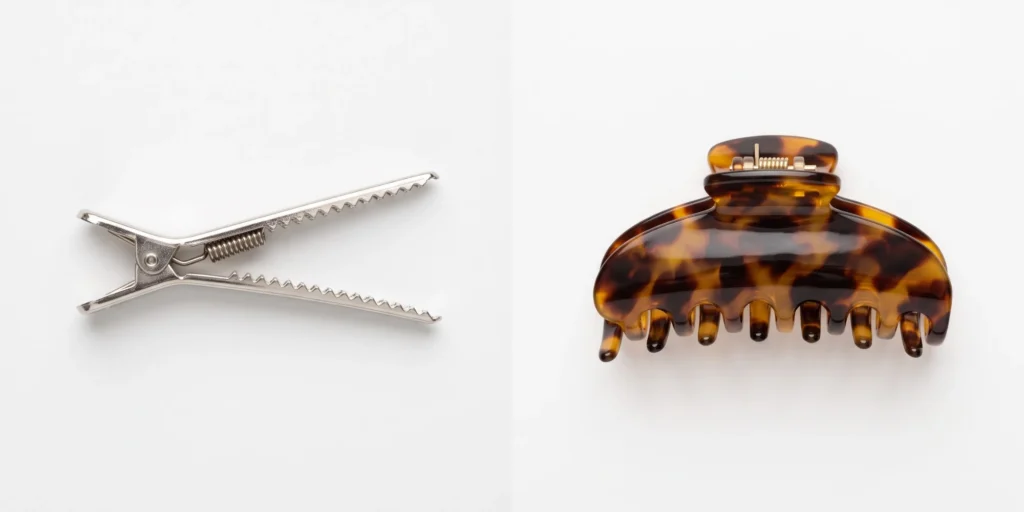
An alligator clip is a spring-loaded, flat-jaw hair fastening tool characterised by its serrated or ribbed inner teeth, metal or plastic construction, and a hinge-and-spring mechanism that generates consistent clamping pressure across its full jaw length — designed primarily for salon sectioning, blow-dry preparation, and professional hair application contexts. A claw clip is a multi-pronged, spring-hinged jaw clip available in a wide range of sizes and materials, designed to gather and secure hair at various volumes and lengths for everyday styling use. While both clip types use a spring-tension closing mechanism, they differ substantially in jaw geometry, tooth configuration, target hair volume, and the contexts in which each performs reliably.
This guide examines both clip types across construction, hold mechanism, material, application, and B2B sourcing considerations to help buyers make informed range and specification decisions.
An alligator clip — also referred to as a crocodile clip, sectioning clip, or duckbill clip depending on the specific variant — is a flat-jaw spring clip whose inner surfaces feature interlocking serrated teeth or ribbed ridges running the length of the jaw. When the clip closes, the teeth interlock or press firmly against the hair section, generating grip through a combination of spring pressure and mechanical tooth engagement. This tooth configuration is the defining functional characteristic of the alligator clip and is what distinguishes it from the smooth-jaw or prong-based mechanism of a claw clip.
Key structural characteristics of alligator clips:
Common alligator clip variants:
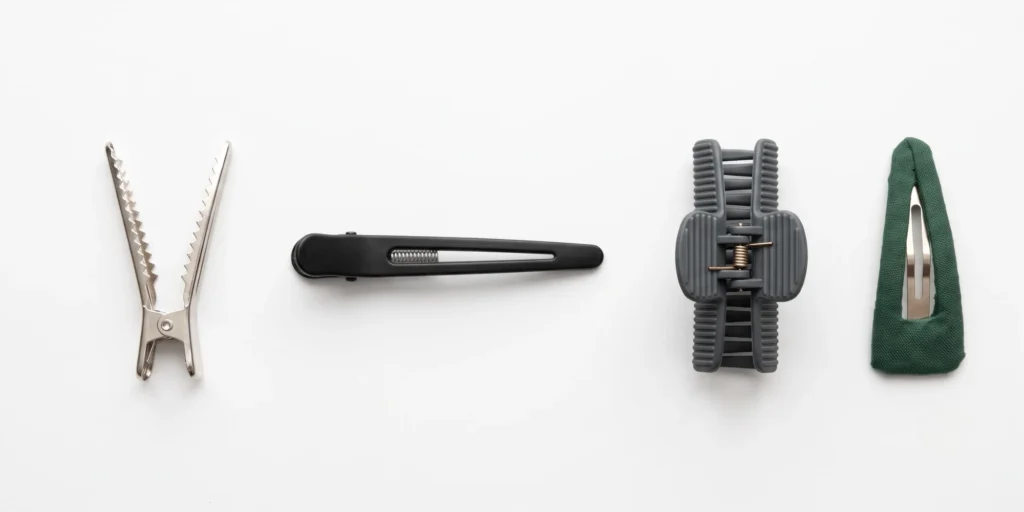
A claw clip is a two-part, spring-hinged jaw clip in which each half of the jaw carries a row of interlocking prongs or teeth that, when closed, interlock to grip a gathered section of hair. Unlike the flat-jaw geometry of an alligator clip, a claw clip’s jaw is typically curved or arched, allowing it to wrap around a larger volume of gathered hair rather than pressing it flat. Claw clips are available in a significantly wider range of sizes — from mini clips designed for small accent sections to oversized formats capable of securing full-volume, long hair in a single clip.
Key structural characteristics of claw clips:
For brands developing a tiered claw clip range, an acetate claw clip manufacturer with in-house mould libraries across multiple size formats reduces tooling lead time and allows consistent spring tension specification across the range.
The hold performance of both clip types is determined by three interacting variables: jaw geometry, tooth or prong configuration, and spring tension. The comparison below summarises how each clip type generates hold and where each mechanism performs more or less reliably.
| Criteria | Alligator Clip | Claw Clip |
|---|---|---|
| Jaw geometry | Flat, elongated | Curved, arched |
| Grip mechanism | Serrated teeth + spring pressure | Interlocking prongs + spring tension |
| Hair section type | Flat, layered sections | Gathered, rounded sections |
| Hair volume capacity | Low to medium (flat sections) | Medium to very high (gathered volume) |
| Hold strength on fine hair | High — teeth grip even fine sections firmly | Moderate — prongs may slip on fine hair |
| Hold strength on thick hair | Medium — flat jaw limited by volume | High — curved jaw accommodates volume |
| Hold duration | Extended — used for salon processing time | Short to medium — everyday styling duration |
| Hair damage risk | Higher — serrated teeth can snag or crease | Lower — prongs distribute tension more evenly |
| Typical use duration | Worn during styling process; removed after | Worn throughout the day |
According to hair accessory damage and tension research, the concentration of grip force at specific contact points — as occurs with serrated-tooth mechanisms — is a consistent risk factor for localised hair shaft stress, particularly in fine or chemically processed hair. Claw clips, by distributing tension across multiple prong contact points on a curved jaw, reduce this concentration effect during everyday wear.
Alligator clips are the professional standard for salon sectioning because their flat jaw and serrated teeth are specifically designed to hold flat, layered hair sections in place during chemical processing, colouring, and heat styling. The clip’s low profile keeps sections flat against the head, which is essential for precise colour application and clean section separation. In this specific context — holding a defined flat section in place under the conditions of a salon service — alligator clips outperform claw clips, which are not designed for flat-section hold.
Claw clips consistently outperform alligator clips for securing gathered hair volumes — ponytails, buns, half-up styles, and casual updos. The curved jaw geometry is designed to accommodate and wrap around a gathered section of hair, which a flat alligator jaw cannot do effectively at equivalent hair volumes. For everyday consumer use where the clip is worn throughout the day and needs to hold a meaningful volume of hair comfortably, a correctly sized claw clip significantly outperforms an alligator clip.
Claw clip hold performance is strongly dependent on matching clip size to hair volume. A common cause of claw clip failure — slipping or releasing during wear — is using a clip that is undersized for the hair volume being secured. The following size-to-hair-volume matching guide applies across most claw clip formats:
Professional salon-grade alligator clips are manufactured almost exclusively in metal — steel or zinc alloy for the jaw body, with a steel spring and metal hinge pin. The serrated teeth are formed directly in the metal jaw during the stamping or die-casting process. Consumer-grade alligator-style clips use ABS plastic bodies with a steel spring insert, which reduces material cost but also reduces the precision and durability of the tooth engagement.
Surface finishes for professional metal alligator clips include nickel plating, chrome plating, and matte black coating. For decorative consumer variants, fabric wrapping or enamel coating over a metal or plastic base is common.
Claw clips are produced across a wider material range than alligator clips. The primary material categories and their sourcing implications are:
The following table summarises material differences and their sourcing implications across both clip types:
| Material | Used In | Key Properties | Price Tier |
|---|---|---|---|
| Steel / zinc alloy | Professional alligator clips | Durable, precise tooth engagement, heavy | Mid to high |
| ABS plastic | Consumer alligator clips, claw clips | Lightweight, colour versatile, cost-efficient | Low to mid |
| Cellulose acetate | Premium claw clips | Premium finish, plant-based, heavier feel | High |
| Nylon | Large claw clips | Flexible, durable, spring-resistant | Mid |
Professional salon-grade alligator clips are a mature, standardised product category with well-established specifications. Buyers sourcing for professional salon distribution should specify metal jaw construction, spring tension rating, and tooth profile in the product brief. Consumer-grade alligator clips with plastic bodies are sourced from the same general hair clip supply base as other ABS plastic clip formats, with MOQs typically beginning at 500–1,000 units per style per colour.
Decorative alligator clips — fabric-covered or embellished consumer formats — share sourcing channels with snap barrettes and decorative hair clips. Buyers engaging custom hair clip manufacturers for decorative alligator clip development should confirm spring tension retention after fabric wrapping, as the additional material layer can reduce jaw opening width and affect usability.
Claw clips require dedicated tooling for each size format — the jaw body, prong structure, hinge, and spring are all size-specific components. Buyers building a multi-size claw clip range should confirm that the manufacturing partner holds existing tooling across the required size range, as commissioning new tooling for each size adds both cost and lead time to the development process.
Acetate claw clips carry higher tooling and material costs than ABS plastic variants but command correspondingly higher retail price points. For brands developing a tiered range — ABS plastic for everyday formats and acetate for premium or seasonal collections — sourcing both from a single OEM hair accessories manufacturer with capability across both material categories simplifies quality management and reduces logistics complexity.
Q: Which holds better overall — an alligator clip or a claw clip?
Neither clip type holds better in all contexts. Alligator clips hold flat, sectioned hair more securely due to their serrated-tooth jaw design — this is why they are the professional standard for salon sectioning. Claw clips hold gathered hair volumes more securely due to their curved jaw geometry and prong structure — this is why they are the dominant format for everyday consumer hair fastening. The correct answer depends on the specific use case: alligator clips for flat professional sectioning; claw clips for gathered everyday styling.
Q: Can a claw clip replace an alligator clip for salon sectioning?
Claw clips are not a functional substitute for alligator clips in professional salon sectioning contexts. The curved jaw of a claw clip does not hold flat hair sections against the head with the same precision or stability as the flat serrated jaw of an alligator clip, and the wider prong spacing allows sections to slip or separate during processing. Professional salon kits typically include alligator or duckbill clips specifically because no other consumer clip format replicates their flat-section hold performance.
Q: Why does my claw clip keep slipping out?
Claw clip slipping is most commonly caused by a mismatch between clip size and hair volume. Using a clip that is too small for the hair volume being secured means the prongs cannot fully engage around the gathered section, resulting in reduced grip and eventual release. The solution is typically to use a larger clip size. Secondary causes include worn or weakened spring tension in the clip, which reduces the clamping force the prongs can apply — this is more common in lower-quality plastic clips where the spring loses tension after repeated use.
Q: What is the difference between an alligator clip and a duckbill clip?
Both are flat-jaw spring clips used for professional hair sectioning, and the terms are sometimes used interchangeably. In standard industry usage, an alligator clip typically refers to a narrower, longer clip with fine interlocking teeth — used for precise sectioning. A duckbill clip refers to a wider, flatter clip with a broader jaw profile — used for holding larger flat sections in place during blow-dry styling. Both are metal-construction professional tools rather than consumer fashion accessories.
Q: What MOQ should buyers expect for OEM alligator and claw clip production?
For consumer-grade ABS plastic alligator clips and standard claw clips, factory-direct OEM production typically begins at 500–1,000 units per style per colour. For premium acetate claw clips, MOQs are typically 300–500 units per colour per size, reflecting the higher material cost. Professional metal alligator clips may carry higher MOQs due to the metal fabrication process — typically 1,000 units and above per specification. Buyers sourcing both clip types within a single order may be able to negotiate blended minimum arrangements.
Q: Are acetate claw clips stronger than ABS plastic claw clips?
Acetate and ABS plastic claw clips differ in material properties rather than hold strength directly. Acetate is denser and heavier than ABS, giving it a more substantial feel in use, but the hold performance of a claw clip is primarily determined by the spring tension specification and prong geometry rather than the jaw body material. A well-specified ABS plastic claw clip with a strong spring can outperform a poorly specified acetate clip. For B2B buyers, spring tension specification is the key quality variable to confirm with manufacturing partners regardless of the body material selected.
Alligator clips and claw clips address different hold requirements and should be evaluated as complementary rather than competing product categories. Alligator clips deliver precision flat-section hold under professional salon conditions — a function that claw clips are not designed to replicate. Claw clips deliver reliable gathered-volume hold for everyday consumer styling across a wide range of hair types and volumes — a function that alligator clips cannot perform at scale. For B2B buyers building a complete hair clip range, stocking both formats covers the full spectrum from professional salon tools to everyday consumer fastening, with the acetate claw clip segment offering the strongest premium retail positioning within the consumer channel. Manufacturers such as JunYi Beauty, which produces both professional-format sectioning clips and a full range of acetate and ABS claw clips at its Dongguan facility under ISO 9001:2015 and amfori BSCI certification, offer the multi-format production capability that supports comprehensive range development from a single supplier relationship.
👉 Searching for Hair Accessories ? Your brand deserves the best.