Home
Product
Contact
Odm/Oem
About
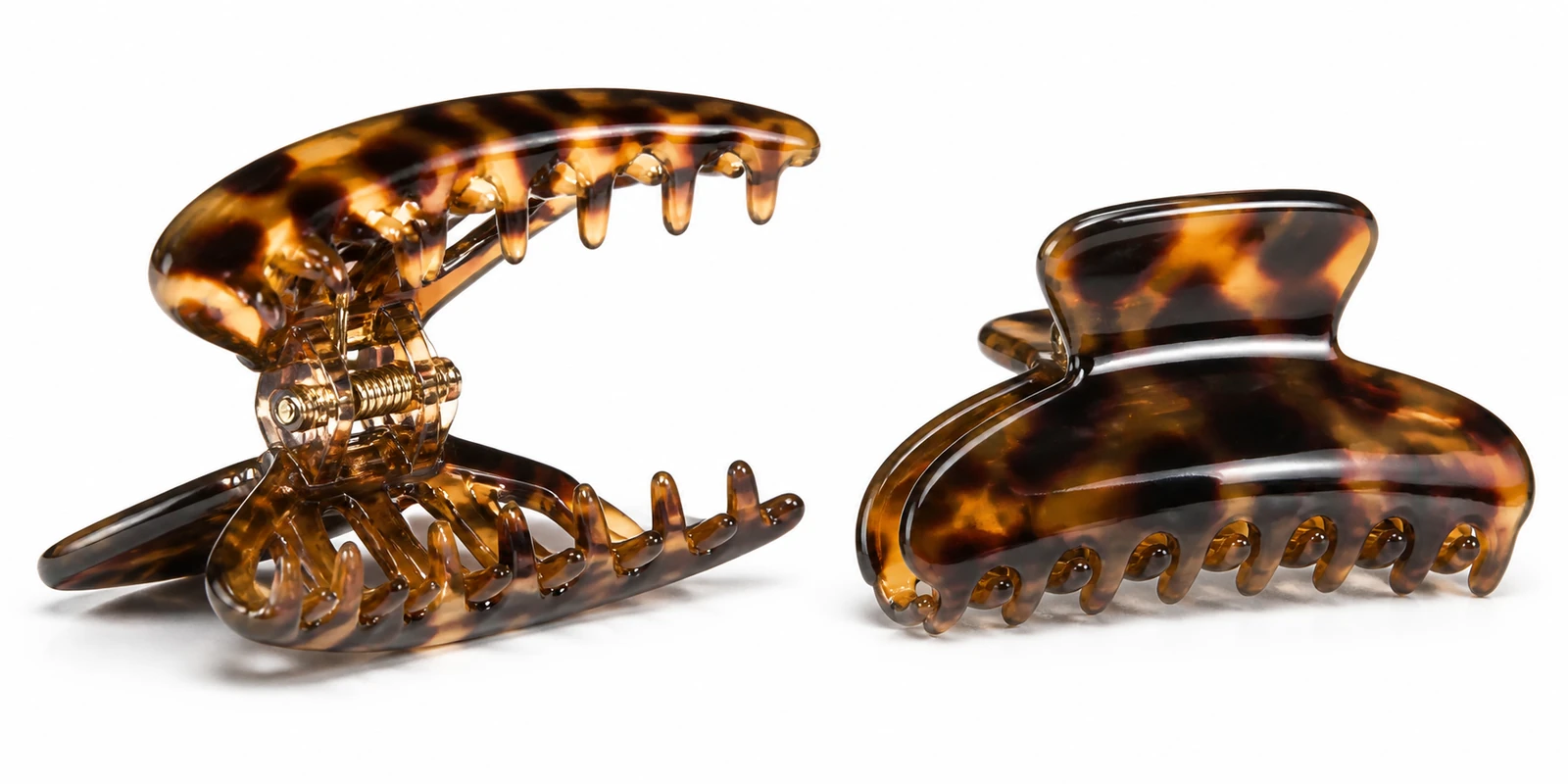
A jaw clip and a claw clip are the same hair accessory: a spring-loaded clip with two interlocking sets of teeth connected by a central hinge, which opens when squeezed and clamps shut over a gathered section of hair when released. The confusion is understandable, since the two names appear across different retail contexts as if they might describe different products, and buyers sourcing at volume sometimes worry they’re missing a category by searching only one term. This guide explains exactly why both names exist, where each term dominates, what genuinely does vary within this single product category, and how to avoid confusion when sourcing under either name.
“Claw clip” describes the visual appearance of the interlocking teeth, which resemble a claw closing over the hair. “Jaw clip” describes the mechanical motion instead, the two halves opening and closing like a jaw. Neither name is more technically correct than the other; they simply emphasise different aspects of the same mechanism, appearance versus motion, and both entered common usage independently rather than one being a rebrand of the other.
“Claw clip” is the dominant term in North American consumer retail and social media, where the product is most commonly discovered and purchased by end consumers. “Jaw clip” appears more frequently in UK and European product listings, and shows up consistently in professional salon supply catalogues and B2B manufacturing and trade contexts regardless of region. A smaller number of retailers also use “butterfly clip” for larger versions of the same mechanism, adding a third term into circulation for what remains structurally one product category. For buyers sourcing internationally, recognising that a supplier’s use of “jaw clip” in a quote or catalogue almost always refers to the identical product a domestic buyer would call a “claw clip” avoids unnecessary back-and-forth clarifying what should be a simple order.
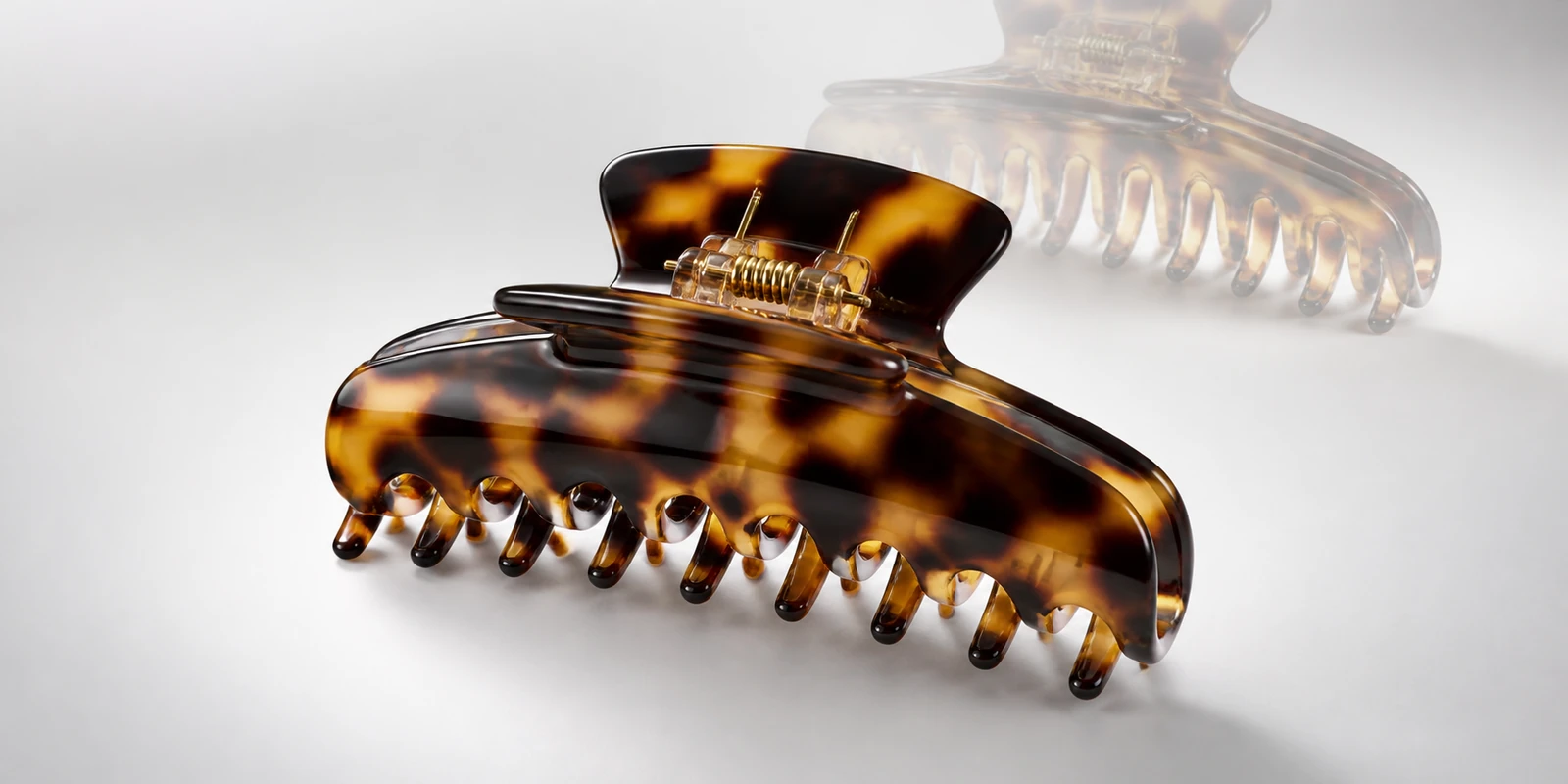
The mechanism traces back to 1986, when French businessman Christian Potut developed the design at his company CSP Diffusion, based in Oyonnax, France, a region with a long-standing plastics manufacturing tradition. Potut has described the idea coming from an offhand moment of crossing and uncrossing his fingers, which led him to combine two products his company already made, combs and clips, into a single accessory. By the mid-1990s the company was selling hundreds of thousands of units monthly, with the US and Japan among its strongest export markets. The design was never patented internationally, only protected within France, which is part of why the product spread quickly across global markets under whichever local name each market’s retailers and manufacturers settled on independently, with no single company controlling how the accessory would eventually be described worldwide.
Since jaw clip and claw clip describe the same mechanism, the real differences buyers should pay attention to sit inside the category rather than between two supposedly separate ones.
| Variable | What Changes | Why It Matters |
|---|---|---|
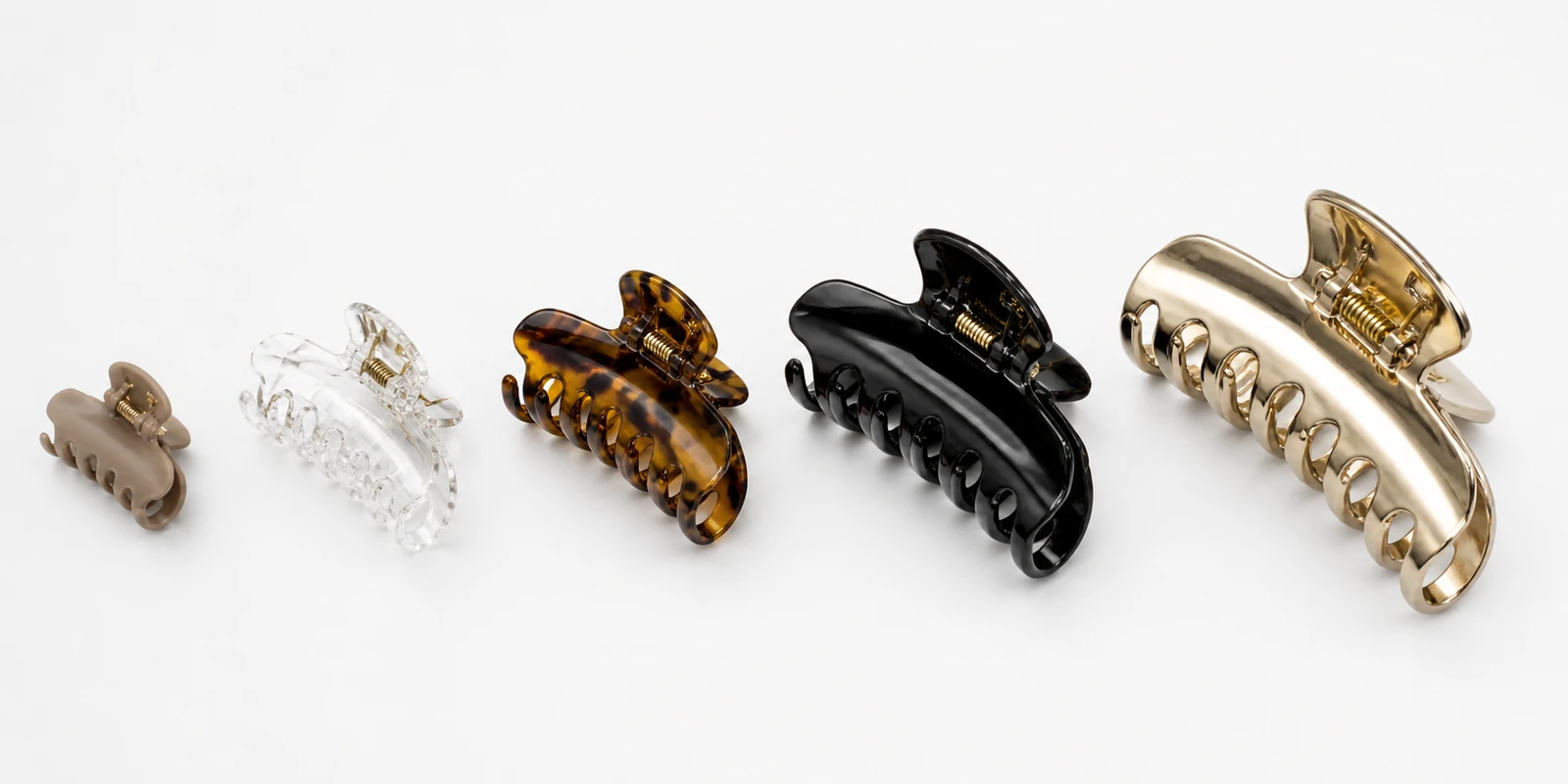
| Size | 4 cm to 13 cm+ jaw length | Determines hair volume and length the clip can hold |
| Material | Acetate, ABS plastic, metal alloy | Affects finish, weight, and spring durability |
| Jaw profile | Curved vs flat | Curved suits gathered sections; flat suits smoother, sectioned hold |
| Tooth spacing | Fine vs wide | Fine spacing suits thinner hair; wide spacing suits thick or coarse hair |
| Spring tension | Light vs firm | Firm tension holds heavier sections but requires more force to open |
These variables, not the jaw-versus-claw naming, are what actually distinguish one product from another within a supplier’s catalogue, and they’re the specifications worth focusing a sourcing conversation on regardless of which name the supplier uses.
While jaw clips and claw clips are the same product, two related accessories are worth distinguishing clearly, since confusing these does represent a real functional difference. A barrette uses a completely different mechanism, a flat clasp that snaps shut through a hinge without the multi-toothed jaw structure, and holds hair flat rather than gathering volume the way a claw or jaw clip does. An alligator clip uses a flat, serrated jaw designed for salon sectioning and blow-dry preparation rather than everyday styling, holding a flat section precisely against the head instead of gathering a rounded volume of hair. Both are legitimate separate categories from the claw or jaw clip, unlike the claw-versus-jaw naming split, which describes no functional difference at all.
A misconception that surfaces regularly is the assumption that jaw clips are somehow larger, stronger, or more “professional grade” than claw clips, likely because the term shows up more often in salon supply and B2B catalogues. This isn’t accurate: size and strength are functions of the specific product’s jaw length, material, and spring tension, not of which of the two interchangeable names appears on the listing. A small, lightweight jaw clip and a small, lightweight claw clip described the two same ways would be identical products. The reverse misconception, that claw clips are exclusively a casual or budget product because the term dominates mass-market retail, is equally inaccurate, since premium acetate and metal versions are marketed under the claw clip name just as often as under jaw clip.
Search volume and terminology preference genuinely differ by market in ways worth understanding for anyone naming products or writing product copy. Consumer-facing search in the US and Canada skews heavily toward “claw clip,” meaning product titles and on-page copy targeting that audience should lead with that term even if “jaw clip” also appears somewhere for coverage. B2B directories, salon supply platforms, and European retail search behave differently, where “jaw clip” often performs as well as or better than “claw clip” in the same content. Treating this as a search optimisation decision rather than a product categorisation decision is the more accurate way to think about which term to lead with in any given market.
For a seller building out a product catalogue across multiple regions, the practical takeaway is straightforward: pick a primary term based on the dominant market being targeted, then include the secondary term naturally within the description and metadata rather than duplicating listings under two separate product names. Duplicating listings by name alone creates unnecessary catalogue clutter and can dilute search ranking for both versions rather than concentrating relevance under one strong listing. This applies equally to B2B sourcing platforms, where using both terms in a company profile or product database improves the chance of being found by buyers who default to either term based on their own market’s convention.
Buyers building product listings across multiple regional markets benefit from including both terms in metadata and search-facing copy, since a shopper in the UK searching “jaw clip” and one in the US searching “claw clip” are looking for the identical product. Sourcing conversations with manufacturers should focus on the specifications that actually vary, jaw length, material, tooth spacing, and spring tension, rather than treating “jaw clip” and “claw clip” as separate line items requiring separate quotes. A supplier unfamiliar with one of the two terms, though rare in established B2B manufacturing relationships, is worth a quick clarifying question rather than assuming a miscommunication about product category. When requesting quotes, describing the product by its specifications rather than by name alone removes any ambiguity entirely, regardless of which term the supplier defaults to in their own catalogue.
Buyers developing a range under either name can specify jaw length, material, and tension directly through a custom claw clip manufacturer without needing to treat “jaw clip” as a separate sourcing category.
Yes. Both terms describe the identical spring-loaded, hinged hair clip with interlocking teeth. The naming difference reflects regional and context-based convention rather than any structural or functional distinction between the two.
North American consumer retail and social media predominantly use “claw clip,” while UK and European listings, along with professional salon supply and B2B trade contexts globally, more frequently use “jaw clip.” Both terms are understood in international sourcing regardless of a buyer’s home market.
In many markets, “butterfly clip” refers to a larger version of the same jaw or claw clip mechanism, though in other contexts it refers to a smaller, separate decorative clip with a different hinge structure. Confirming which product a supplier means by “butterfly clip” is worth doing explicitly given this term’s less consistent usage.
Jaw length, material, jaw curve profile, tooth spacing, and spring tension are the specifications that genuinely vary between products in this category. These, rather than the jaw-versus-claw name, are what buyers should specify and compare when sourcing.
No. An alligator clip has a flat, serrated jaw built for precise salon sectioning, while a claw or jaw clip has a curved, multi-toothed jaw built for gathering volume in everyday styling. These are genuinely different products, unlike the claw-versus-jaw naming split.
Yes. Including both “claw clip” and “jaw clip” in product titles, descriptions, and search metadata captures search intent across regions that otherwise use different default terminology for the identical product.
A jaw clip and a claw clip are the same product wearing two different names, one describing how the teeth look and the other describing how the mechanism moves. The naming split follows regional and B2B-versus-consumer retail convention rather than any real difference in construction or function. The specifications actually worth comparing when sourcing or shopping, jaw length, material, tooth spacing, and spring tension, sit inside the category regardless of which name a listing or supplier uses.
Manufacturers such as JunYi Beauty, which produces claw and jaw clips across acetate, plastic, and metal construction in a full range of sizes at its Dongguan facility under ISO 9001:2015 and amfori BSCI certification, work with buyers under either naming convention without any difference in the product being sourced.
👉 Searching for Hair Accessories ? Your brand deserves the best.