Home
Product
Contact
Odm/Oem
About
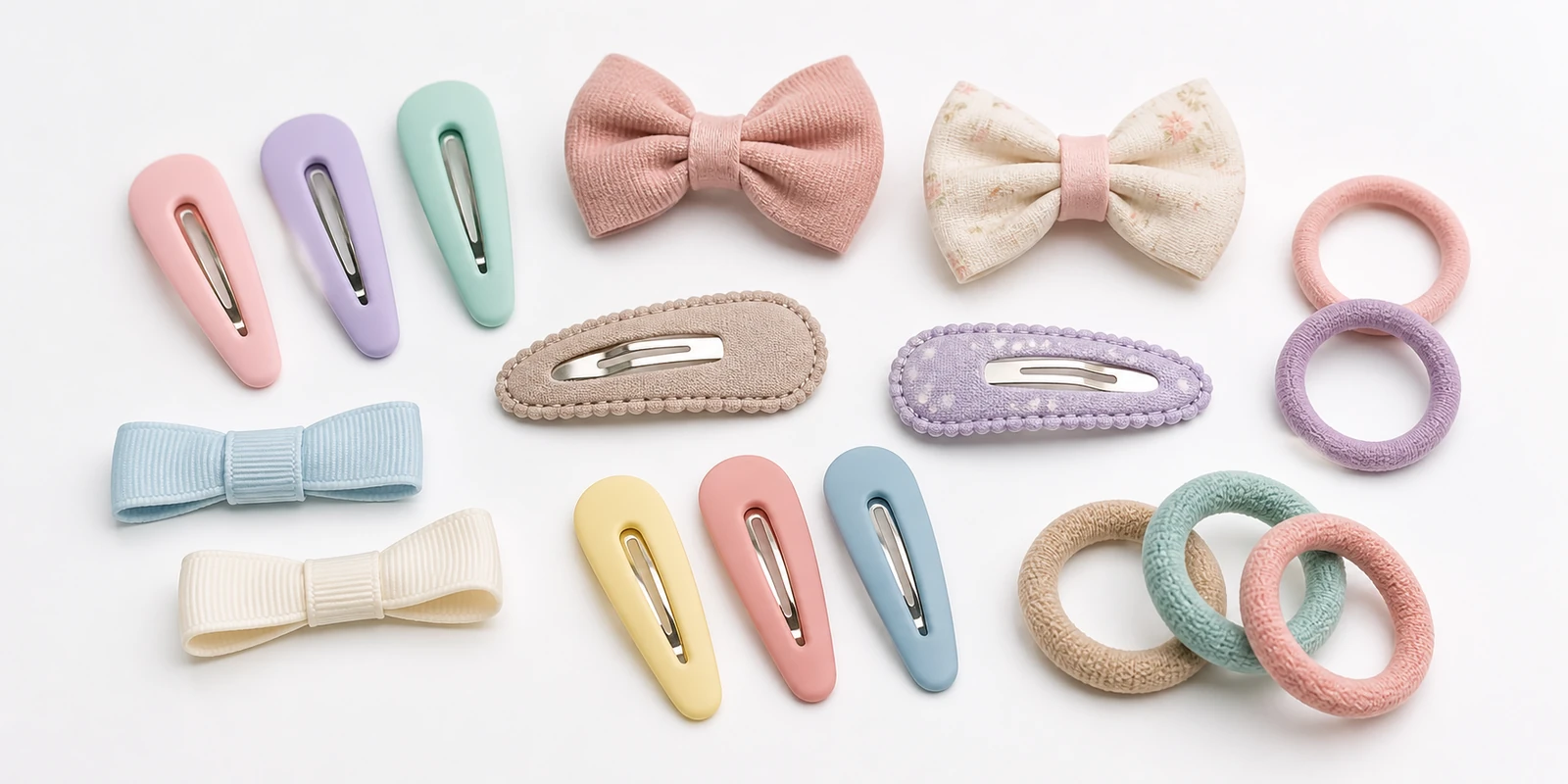
Safe hair accessories for kids are clips, bands, and ties designed and tested to meet applicable limits for lead, any applicable phthalate restrictions, and age-based small-parts requirements. A product that looks identical to an adult accessory can fail relevant children’s safety rules if the material sourcing was not handled with a child’s exposure risk in mind, and the consequences range from a failed customs inspection to an actual recall. This guide covers which materials and construction details to avoid, how current US and EU requirements apply, and how buyers should verify a supplier’s compliance claims before placing an order.
Lead risk in hair accessories concentrates in two places: the base material itself, particularly cheap metal alloys and PVC plastics, and any paint or similar surface coating applied afterward. Under the CPSIA, the US federal limit is 100 parts per million in accessible component materials, while a separate 90 parts per million limit applies to paint and similar surface coatings. A product can fail either measurement independently, so a compliant base material with non-compliant paint still fails overall, and painting over a non-compliant accessible substrate does not make the underlying material acceptable.
Phthalates are plasticisers used to keep PVC and similar plastics flexible, and they may appear in soft-touch clip coatings, elastic-adjacent components, and rubberised grips. The US federal restriction does not automatically apply to every children’s hair accessory: it applies when the product falls within the legal definition of a children’s toy or child care article. For products within that scope, eight specified phthalates, including DEHP, DBP, and BBP, may not exceed 0.1 percent by weight in an accessible plasticised component. The limit is evaluated for the relevant component rather than averaged across the entire product.
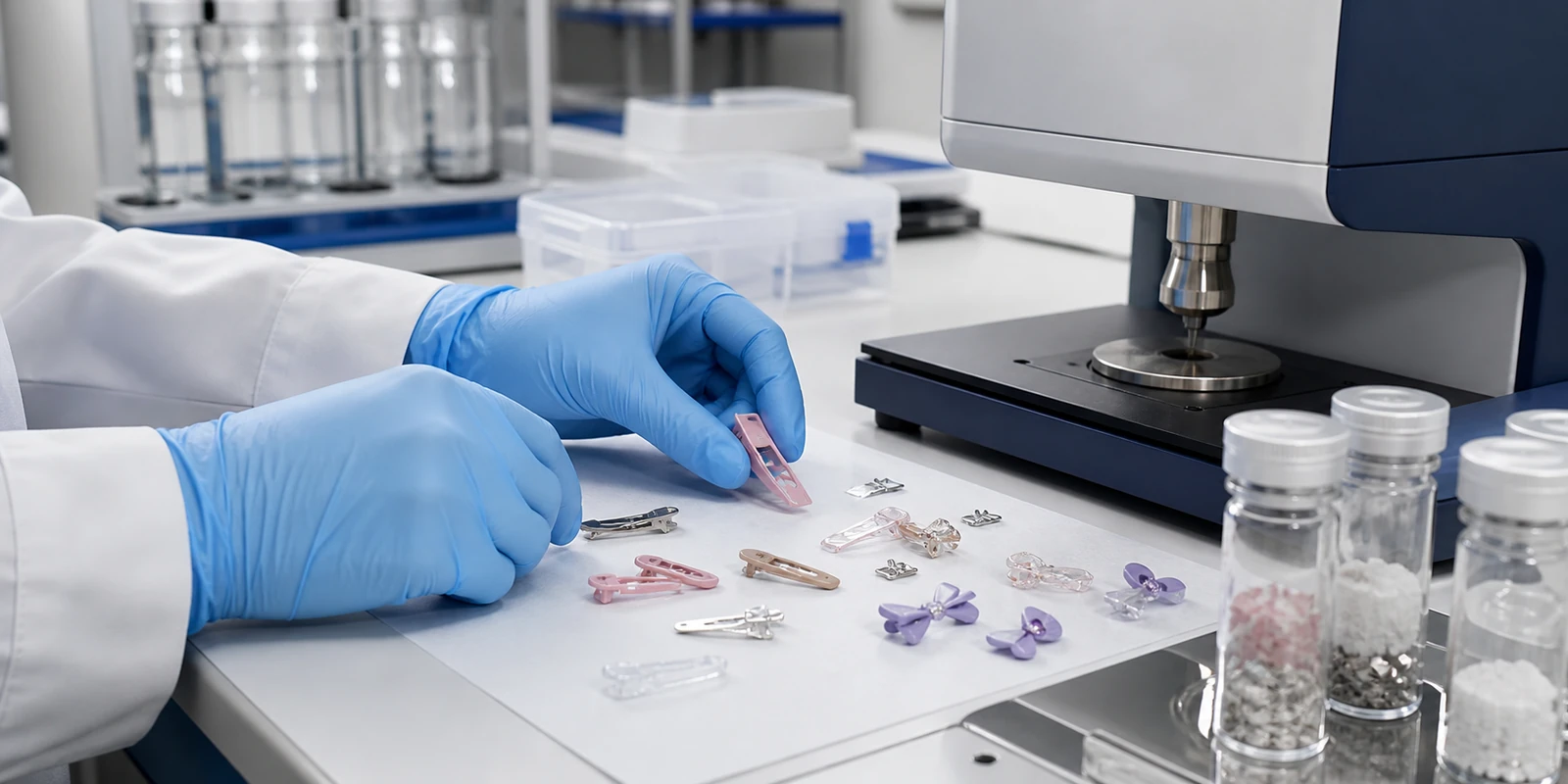
Metal springs, snap closures, and decorative hardware can create nickel exposure where metal comes into direct and prolonged contact with skin. In the EU, REACH Annex XVII Entry 27 limits nickel release from the relevant parts of such articles to 0.5 micrograms per square centimetre per week. A nickel-free specification or a carefully selected stainless-steel grade can reduce risk, but stainless steel may still contain nickel and coatings can wear, so release testing remains the reliable verification method wherever the restriction applies.
The relevant US rule differs depending on the product’s intended age range and classification. Products within the scope of 16 CFR Part 1501 that are intended for children under three are banned if the product or a component fits entirely inside the federal small-parts test cylinder, including a part released during applicable use-and-abuse testing. For toys and games intended for children aged three to under six that contain small parts as received by the consumer, 16 CFR Section 1500.19 requires a choking-hazard warning. That warning provision is not a universal alternative for every children’s product marketed to any age above three.
Rhinestones, small beads, and detachable decorative elements are the components most likely to create a small-parts issue in hair accessories. Adhesive-set decorations should be evaluated under the use-and-abuse procedures applicable to the product’s age grading and classification to determine whether they detach during foreseeable handling.
The table below summarises the principal risk areas and the rules that may govern them.
| Risk Area | Governing Standard | Key Limit or Rule |
|---|---|---|
| Lead in accessible components | CPSIA Section 101 / 15 USC 1278a | 100 ppm maximum |
| Lead in paint or similar surface coating | 16 CFR Part 1303 | 90 ppm maximum |
| Restricted phthalates | CPSIA Section 108 / 16 CFR Part 1307 | 0.1% (1000 ppm) maximum per listed phthalate when the product is a children’s toy or child care article |
| Small parts, under 3 | 16 CFR Part 1501 | In-scope products are banned if the article or a released component fits completely in the test cylinder |
| Small-parts warning | 16 CFR Section 1500.19 | Applies to toys and games intended for ages 3 to under 6 that contain small parts, plus separately specified products |
| Nickel release (EU) | REACH Annex XVII, Entry 27 | 0.5 micrograms/cm2 per week maximum for relevant parts in direct and prolonged skin contact |
Appropriately specified stainless steel or verified low-nickel-release alloys for metal components, ABS or polypropylene plastic without restricted additives, and cotton or polyester elastic without latex generally present lower starting risk profiles for this category. These material choices do not eliminate the need to determine which rules apply and to test the actual materials and construction used in production, but they help buyers avoid higher-risk substitutions such as unidentified alloys and flexible PVC formulations with incomplete chemical documentation.
Beyond formal testing, a few practical checks can catch obvious problems before a product reaches a child. A visual inspection for loose, poorly glued, or sharp-edged decorative elements can identify construction defects that a certificate may not reflect in every unit from a production run. Checking that spring-loaded clips close with light, even pressure rather than a hard snap provides a useful screen for excessive spring tension, although it is not a substitute for mechanical testing. For retailers stocking multiple SKUs, keeping reports organised by exact product and colourway prevents an outdated or mismatched report from being associated with a product it did not cover.
For a children’s product subject to applicable CPSC safety rules, the US manufacturer or importer, not the laboratory, issues the Children’s Product Certificate based on testing by a CPSC-accepted third-party laboratory, unless a specific exception applies. Buyers should request the certificate and underlying reports for every rule applicable to the exact product, materials, and colourway being ordered rather than relying on a general factory compliance statement. Importers should also confirm the current CPSC and US Customs certificate eFiling requirements that apply to their shipments.
For EU-bound orders, an ordinary children’s hair accessory is not automatically a toy. EN 71 testing and CE marking apply only when the product is legally classified within the toy regime or another CE-marked product category. Otherwise, the product remains subject to applicable chemical restrictions such as REACH and the General Product Safety Regulation; the EU expressly notes that products outside CE-marking legislation are still governed by general product-safety rules.
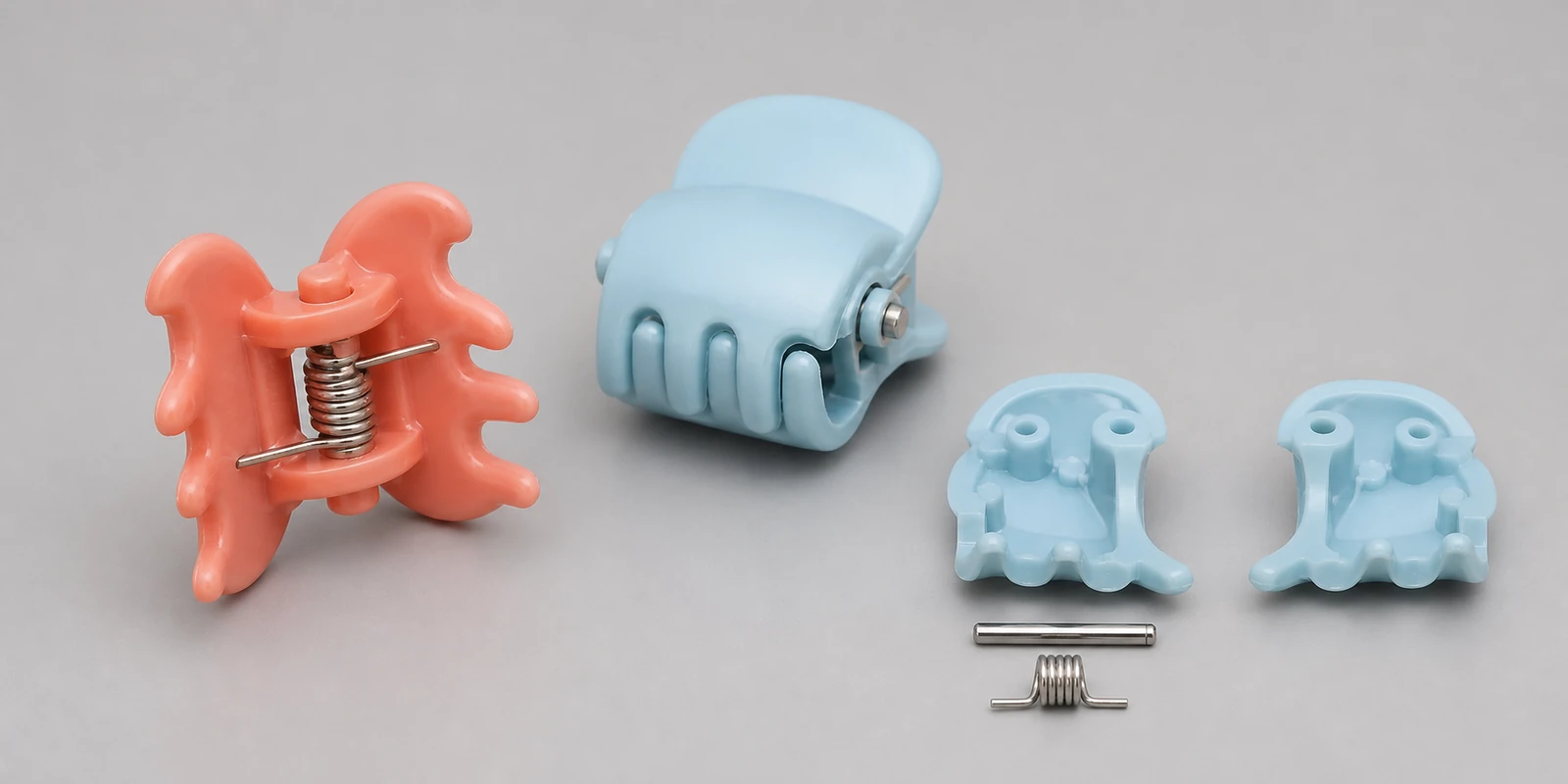
Material compliance alone does not cover every real risk in this category, and construction choices matter independently of what the accessory is made from. Spring tension on clips intended for toddlers should be evaluated for foreseeable pinch hazards involving a small child’s scalp or fingers. Elastic ties should avoid metal crimps or connectors that can snag fine hair or detach as a separate small part. Products marketed for infants and toddlers should avoid strings, ribbons, or cords long enough to create a strangulation hazard. Packaging deserves separate scrutiny because bags, fasteners, and closure components may introduce suffocation or small-parts risks that are not created by the accessory itself.
Age grading and product classification drive the applicable compliance path, so buyers should define the actual target user before finalising a specification. A product intended for children under three may be prohibited if it contains or releases a small part, regardless of a manufacturer’s preferred warning label. Buyers developing a children’s hair accessory range should specify material grades and prohibited substances in writing, request reports tied to the actual components and colourways, and confirm the mechanical tests and labelling rules applicable to the stated age range and product classification.
Material substitutions that can be difficult to see in a product photo, such as a cheaper PVC coating or an unspecified metal alloy, can change the applicable test result. A supplier with established experience in occasion and kids’ hair accessories, rather than a general adult hair-accessories factory extending into children’s products without adjusting material sourcing and age grading, is generally better positioned to document these requirements consistently.
Accessible component materials in children’s products are generally limited to 100 parts per million of total lead. Paint and similar surface coatings have a separate 90 parts per million limit, and the product must satisfy every applicable requirement.
They require careful age grading and attachment testing. An in-scope product intended for children under three cannot be or release a component that fits completely inside the federal small-parts cylinder. Warning requirements for older children depend on product classification and age range.
The US federal restriction covers eight specified phthalates at a maximum of 0.1 percent each in accessible plasticised components, but only when the product is legally classified as a children’s toy or child care article. Other federal, state, or destination-market rules may also apply.
It can be when metal parts come into direct and prolonged contact with skin. EU REACH limits nickel release from relevant parts to 0.5 micrograms per square centimetre per week. Material names alone are not proof of compliance, so release testing may be needed.
Buyers should request reports from laboratories qualified for every applicable rule and documentation tied to the exact product, components, and colourways. For regulated US children’s products, the manufacturer or importer is responsible for issuing the Children’s Product Certificate.
No. Products within the small-parts rule and intended for children under three cannot contain or release small parts. The federal warning for toys and games containing small parts applies to products intended for children aged three to under six and does not override the under-three ban.
Safety in children’s hair accessories comes down to verifiable specifics: lead limits that apply separately to accessible components and paint, phthalate restrictions whose scope depends on product classification, small-parts rules tied to intended age and product type, and nickel-release limits for relevant skin-contacting metal parts. None of these points can be confirmed from a product photo or a general supplier assurance, which is why correct classification, appropriate testing, traceable documentation, and accurate age grading matter throughout sourcing and production.
Manufacturers such as JunYi Beauty, which produces hair accessories including occasion and kids’ lines at its Dongguan facility under ISO 9001:2015 and amfori BSCI certification, offer the material specification control and documentation buyers need to verify requirements before committing to production.
👉 Searching for Hair Accessories ? Your brand deserves the best.