Home
Product
Contact
Odm/Oem
About
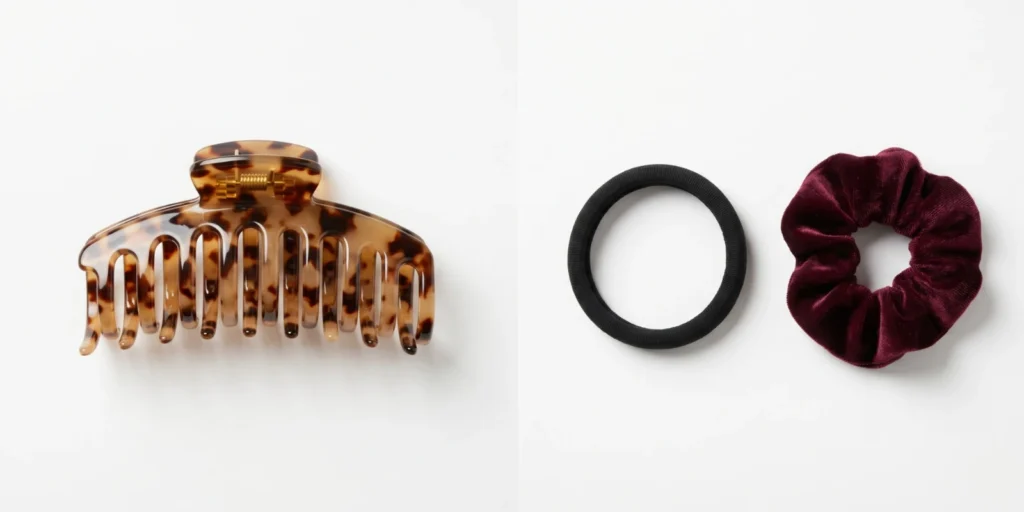
Thick hair presents a specific hold challenge that standard hair accessories frequently fail to address: the volume and weight of a large gathered hair section generates forces that exceed the design limits of accessories built for average hair density. A standard claw clip with a light-gauge spring may pop open under the weight of a thick bun; a standard hair tie may require three or more wraps to achieve sufficient hold, concentrating excessive tension and friction at the wrap point. Neither failure mode is acceptable for everyday wear.
This guide compares claw clips and hair ties specifically in the context of thick hair — examining hold mechanics, product specifications that determine performance, hair health considerations at high tension, and the sourcing criteria relevant to B2B buyers developing hair accessories ranges for thick-hair consumers.
Thick hair differs from average-density hair in two mechanical respects that directly affect accessory hold performance. First, the total cross-sectional volume of a gathered ponytail or bun is substantially greater — generating higher outward pressure against any fastening mechanism. Second, the cumulative weight of a thick hair section is greater — meaning that gravity applies more downward force on any clip or tie holding the style in place.
For claw clips, the relevant variable is spring closing force: the spring must generate sufficient tension to keep the jaws shut against the outward pressure of the gathered hair. For hair ties, the relevant variable is elastic tension per wrap: each wrap of the tie must generate sufficient compressive force to maintain the gathered section without the individual wraps cutting into the hair or the tie loosening over time.
Standard accessories are typically designed for the median hair volume — which means they systematically underperform on thick hair unless specifications are adjusted. The following sections examine how each product type performs when correctly specified for thick hair, and where each reaches its limits.
Claw clips can hold thick hair effectively when two conditions are met: the clip is large enough to accommodate the gathered hair section, and the spring is strong enough to maintain closing force against the outward pressure of the hair volume. Both conditions require deliberate product specification — a standard small or medium claw clip will fail on thick hair regardless of how well it is constructed.
Oversized claw clips — typically 10 cm to 12 cm in length — with reinforced torsion springs are the correct specification for thick hair. At this size, the jaw span is wide enough to accept a full thick ponytail or bun, and a reinforced spring maintains consistent closing force throughout the day. Many thick-hair consumers report that a single correctly-sized claw clip provides more reliable hold than multiple wraps of a standard elastic.
The hold mechanism of a claw clip is also inherently stable in a way that elastic is not: once the spring is released and the jaws close, the clip maintains constant tension without loosening over time. A hair tie, by contrast, can gradually slip or loosen as the elastic stretches under sustained load.
Standard-gauge springs — the type found in most retail claw clips — generate closing forces calibrated for average hair volumes. On thick hair, the outward pressure of the gathered section can exceed the spring’s closing force, causing the clip to partially open and the hair to slip. This failure is particularly common with mid-session movement: a clip that holds when first applied may open after an hour of wear as the hair settles and the spring fatigues under continuous load.
Very long thick hair also presents a weight challenge that even large claw clips may not overcome in certain styles. A heavy bun held at the crown of the head places significant downward torque on the clip’s hinge — a force vector that springs are less effective at resisting than circumferential compression. In these cases, multiple clips or the addition of a hair pin to anchor the bun may be necessary.
Hair ties — specifically thicker-gauge elastics, wide scrunchies, and heavy-duty fabric-covered bands — can hold thick hair effectively for ponytail and bun styles. The elastic mechanism conforms to the exact volume of the gathered section rather than imposing a fixed jaw span, meaning it self-adjusts to thick hair without a size specification issue. A scrunchie with a wide, high-tension elastic core wraps around a thick ponytail and generates compressive hold proportional to the hair volume without the risk of popping open that affects spring-mechanism clips.
For thick hair specifically, velvet scrunchies perform better than satin scrunchies in terms of hold — the pile of the velvet fabric grips individual strands more effectively, reducing slippage on coarse or heavy hair types. Brands sourcing hair accessories for the thick-hair segment should work with a custom hair scrunchie manufacturer to specify elastic tension and fabric type together, as these two variables interact directly to determine hold performance on high-volume hair.
Standard-gauge elastics — including most drugstore hair ties — require three or more wraps to achieve sufficient hold on thick hair. At three or more wraps, the cumulative tension at the wrap point is substantial, and the hair tie effectively applies a high-pressure band to the hair shaft. This is the primary cause of breakage and tension headaches associated with hair tie use on thick hair: the accessory is working correctly by its own design, but the force required to hold thick hair exceeds what can be applied without mechanical consequence.
Thin elastics and bare rubber bands are particularly damaging on thick hair because they concentrate high force in a narrow contact area. The correct specification for thick hair is a wider-gauge elastic — either a thick seamless band or a fabric-covered elastic with a reinforced core — that distributes force across a larger surface area while still generating sufficient total compressive force.
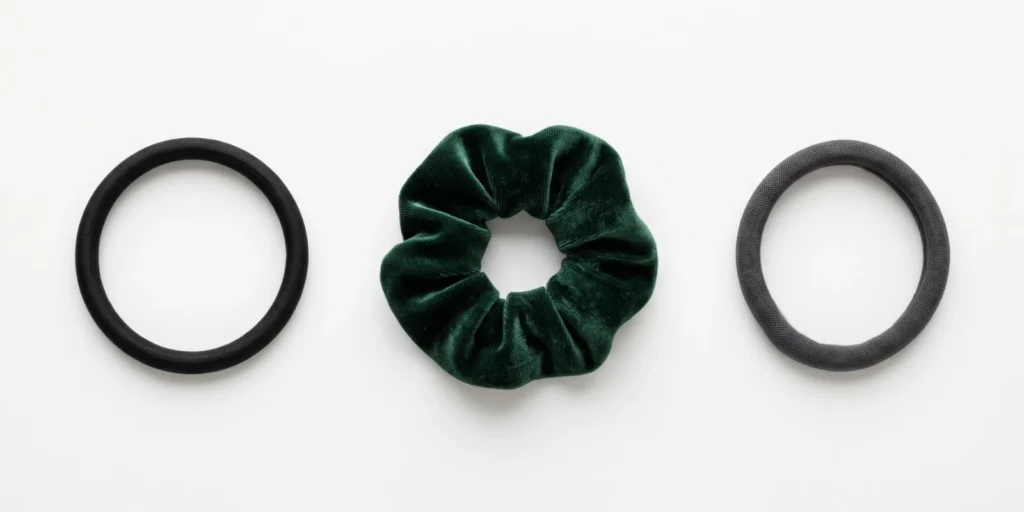
The following table compares claw clips and hair ties across the key variables that determine hold performance on thick hair:
| Variable | Claw Clip (oversized, reinforced spring) | Hair Tie (wide elastic / velvet scrunchie) |
|---|---|---|
| Hold mechanism | Spring tension — fixed, non-loosening | Elastic compression — self-adjusting |
| Hold for thick ponytail | Limited — not primary use case | Excellent — primary use case |
| Hold for thick bun / updo | Excellent — structured, shape-retaining | Good — less structural, may loosen |
| Risk of popping open | Moderate with standard spring; low with reinforced spring | None — elastic does not pop open |
| Risk of slipping over time | Low — spring tension is constant | Moderate — elastic may stretch and slip |
| Breakage risk at hold point | Low — no wrapping, no friction at wrap point | Medium — multiple wraps increase tension |
| Tension headache risk | Low — distributed grip across jaw | Medium — concentrated at wrap point |
| Ease of application | Easy — single action | Moderate — requires multiple wraps |
| Ease of removal | Very easy — press to open | Moderate — must unwind through hair |
| Suitable for very long thick hair | Moderate — weight may dislodge clip | Good — elastic accommodates any length |
| Overnight wear | Not recommended | Good — soft, conforms to movement |
| Active / sport use | Low — may dislodge with movement | Good — elastic maintains hold during movement |
According to research on hair shaft mechanical stress and breakage, repeated high-tension application of hair ties to the same point on the hair shaft is one of the primary causes of traction-related breakage — a finding that underscores the importance of correct elastic specification for thick hair, where the tension required to achieve hold is substantially higher than for fine or medium hair.
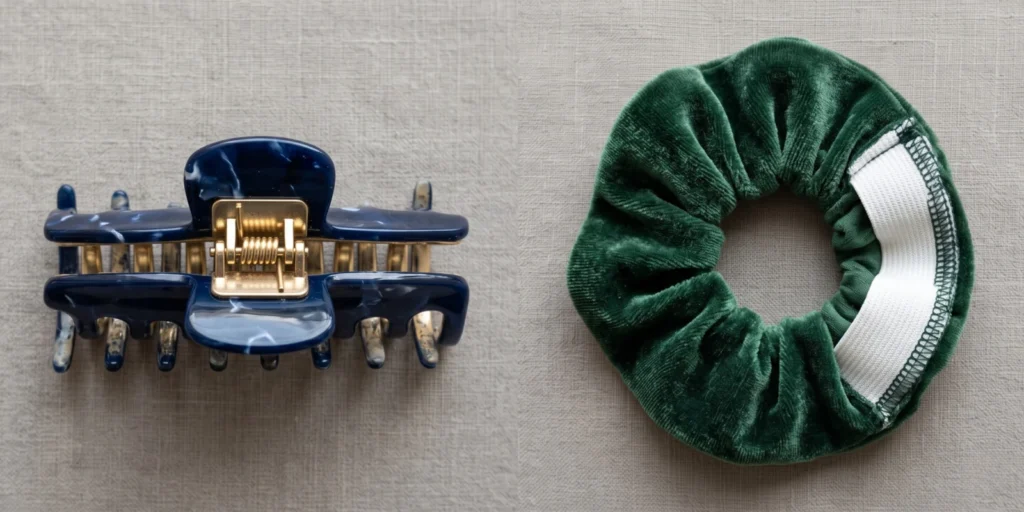
The three critical specifications for a claw clip to perform on thick hair are length, spring gauge, and tooth depth. Length should be 10 cm or greater — clips shorter than 9 cm will not span a full thick hair section and will fail to close properly. Spring gauge should be reinforced relative to standard production: factories typically offer standard, medium, and heavy spring options within their mould tooling, and buyers sourcing for the thick-hair segment should specify medium or heavy gauge. Tooth depth — the length of the interlocking teeth — affects how securely the teeth grip individual hair strands; longer, more deeply interlocking teeth provide more secure grip on high-volume hair.
Brands developing premium ranges for thick-hair consumers should work with an acetate claw clip manufacturer that offers spring tension specification as a variable in their production brief, rather than accepting the default spring weight used in standard production runs.
For scrunchies, the key specifications are elastic width, elastic tension, and fabric type. Wide elastic — 1.5 cm to 2 cm width — distributes compressive force across a larger surface area and generates higher total hold force per wrap than standard 0.5 cm elastic. Elastic tension should be specified higher than standard for thick-hair products; most OEM suppliers can offer a standard and high-tension variant within the same fabric construction. Fabric type affects grip: velvet generates significantly higher friction against coarse hair than satin, making it the preferred fabric for thick or coarse hair types where slippage is a concern.
For seamless silicone or wide rubber bands marketed to the thick-hair segment, the critical variable is band width and wall thickness — both of which determine the total compressive force generated per wrap. Buyers engaging OEM hair accessories manufacturing partners should request elastic tensile strength test data alongside production samples to verify that the specified elastic meets thick-hair performance requirements before committing to a full production run.
The thick-hair consumer segment is consistently underserved by standard hair accessories ranges. Most retail hair accessories are designed for median hair density — which means that consumers with thick hair routinely encounter accessories that fail or cause discomfort. This represents a commercial opportunity for brands that deliberately develop or source accessories specified for thick-hair performance.
The following table outlines a recommended range structure for a thick-hair focused hair accessories offering:
| Product | Specification for Thick Hair | Retail Price Tier | Primary Use Case |
|---|---|---|---|
| Oversized acetate claw clip | 10–12 cm, heavy spring, deep teeth | Mid to premium | Bun, updo, half-up styles |
| Oversized ABS claw clip | 10–12 cm, reinforced spring | Low to mid | Everyday bun, casual updo |
| Velvet scrunchie (wide elastic) | 1.5–2 cm elastic, high tension, velvet | Mid | Ponytail, bun, overnight |
| Wide seamless elastic band | Wide gauge, high wall thickness | Low to mid | Sport ponytail, active wear |
| Satin scrunchie (wide elastic) | 1.5 cm elastic, high tension, satin | Mid to premium | Low-damage ponytail, overnight |
According to hair accessories market segmentation data, premium hair accessories formats — including oversized acetate claw clips and fabric scrunchies — have shown consistent growth in the premium retail segment, supporting investment in higher-specification product development for defined consumer hair type segments.
Q: Do claw clips actually hold thick hair?
Yes — but only when correctly specified. A standard small or medium claw clip will fail on thick hair because the spring is not strong enough to close fully against the outward pressure of a large gathered hair section. An oversized claw clip (10–12 cm in length) with a reinforced or heavy-gauge spring can hold thick hair reliably for bun and updo styles. The key specification variables are clip length and spring tension — both of which must be specified above standard production defaults for thick-hair performance.
Q: Are hair ties or claw clips better for a thick hair ponytail?
Hair ties — specifically wide-elastic scrunchies or thick seamless bands — are generally more reliable than claw clips for ponytail styles on thick hair. The elastic’s self-adjusting compressive mechanism accommodates any hair volume, whereas a claw clip’s fixed jaw span and spring tension have an upper limit. For bun and updo styles, however, an oversized claw clip provides stronger structural hold than a hair tie.
Q: What type of hair tie is best for thick hair?
Velvet scrunchies with wide, high-tension elastic cores perform best for thick hair among fabric-covered formats — the velvet pile grips coarse or heavy hair more effectively than satin, reducing slippage. Wide seamless silicone or rubber bands are the most reliable option for active wear, as they generate high compressive force without the friction damage associated with repeated elastic wrapping. Standard thin elastics and bare rubber bands are not appropriate for thick hair — they require too many wraps and concentrate excessive tension at the contact point.
Q: Do hair ties cause more damage than claw clips on thick hair?
When incorrectly specified, hair ties generate more mechanical damage on thick hair than claw clips. Standard thin elastics require multiple wraps on thick hair, concentrating high tension and friction at the wrap point — which accumulates as breakage over repeated daily use. Claw clips do not wrap around the hair shaft, eliminating wrap-point tension and friction entirely. However, a correctly specified wide-elastic scrunchie or seamless band generates significantly less damage than a thin elastic — so the comparison depends on the specific product rather than the category as a whole.
Q: What size claw clip is needed for thick hair?
Thick hair typically requires a claw clip of at least 10 cm in length to span the full gathered hair section. Clips in the 10–12 cm range with reinforced spring tension are the standard specification for thick-hair consumers. Some very high-volume or long-and-thick hair may require clips at the upper end of this range or multiple clips used together. Mini and standard-size clips (under 8 cm) are not suitable for thick hair and will not close fully on a full gathered section.
Q: What is the MOQ for sourcing oversized claw clips or thick-hair scrunchies from an OEM manufacturer?
Standard MOQs for oversized claw clips from factory-direct OEM suppliers typically begin at 300–500 units per style per colour for standard constructions using existing mould tooling. Custom jaw lengths or spring tension specifications that require tooling modification may carry higher minimums. Wide-elastic scrunchies for thick hair typically begin at 300–500 units per style per colour, with higher-tension elastic specifications available within existing production lines at no tooling premium. Buyers sourcing both oversized clips and thick-hair scrunchies within a single order may negotiate combined minimum requirements.
For thick hair, neither claw clips nor hair ties are universally superior — each format wins in specific styling contexts when correctly specified. Oversized claw clips with reinforced springs are the most reliable option for thick-hair bun and updo styles, providing non-loosening structural hold without wrap-point friction. Wide-elastic hair ties and velvet scrunchies are the most reliable option for thick-hair ponytail styles and active or overnight wear, providing self-adjusting elastic hold that accommodates any hair volume.
The critical insight for B2B buyers is that thick hair requires deliberate specification rather than standard production defaults. Sourcing accessories for this segment without specifying spring gauge, elastic width, or fabric type will produce products that fail their intended users — and miss the commercial opportunity represented by a consumer group that is consistently underserved by standard retail hair accessories ranges. Manufacturers such as JunYi Beauty, which produces both oversized acetate and ABS claw clips and scrunchies across multiple elastic tension specifications at its Dongguan facility under ISO 9001:2015 and amfori BSCI certification, represent the type of factory-direct OEM partner suited to brands developing a deliberately specified thick-hair accessories range.
👉 Searching for Hair Accessories ? Your brand deserves the best.