Home
Product
Contact
Odm/Oem
About
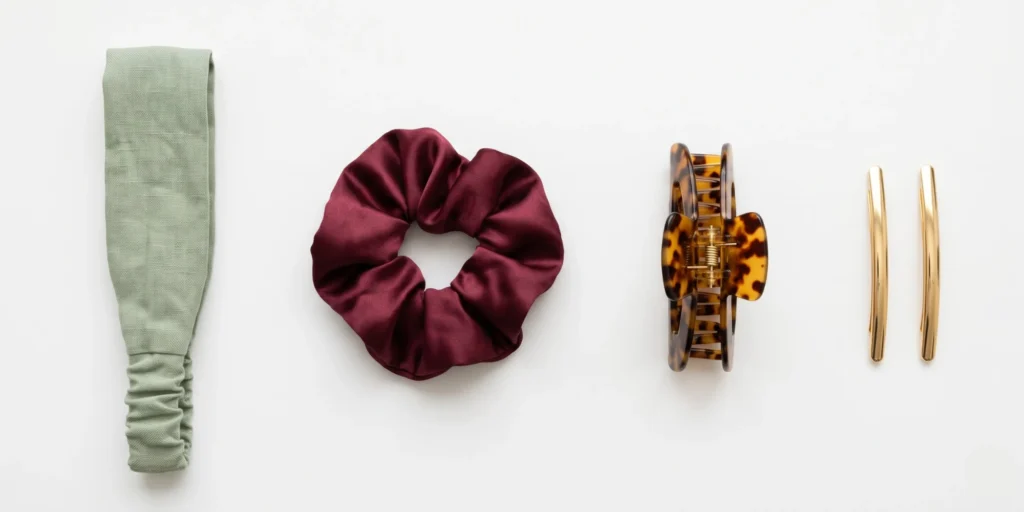
Curly hair presents a distinct set of hold and damage challenges that straight or wavy hair does not. The helical structure of a curl means that the hair shaft changes direction repeatedly along its length — creating a surface that is more voluminous per strand, more prone to tangling when disturbed, and more susceptible to frizz when the curl pattern is disrupted by friction or compression. An accessory that holds straight hair reliably may perform poorly on curly hair — sliding out because it cannot grip the irregular surface, or staying in place but generating friction that disrupts the curl pattern at the contact point.
This guide identifies the accessories that hold curly hair most effectively, explains why they work better than the alternatives, and provides practical guidance for consumers and B2B buyers developing ranges for the curly hair segment.
Three structural properties of curly hair directly affect which accessories work and which fail.
A section of curly hair occupies significantly more volume than the same number of strands of straight hair at the same length. The curl coils add three-dimensional bulk that straight hair lying flat does not generate. This means a claw clip or elastic that is correctly sized for straight medium-density hair may be undersized for curly hair of nominally the same length and strand count — the gathered section is simply larger, and an undersized clip will fail to close or an undersized elastic will require extra wraps.
The curling of the hair shaft creates an irregular, high-surface-area texture that behaves differently from the smooth, uniform surface of straight hair when an accessory contacts it. On one hand, this texture can increase friction between the hair and a grip surface — making some accessories hold better on curly hair than on fine straight hair. On the other hand, accessories that grip by catching on the hair surface — teeth with sharp edges, crimp joins on elastics — are more likely to snag on curly hair’s irregular texture, generating tangling and breakage on removal.
Curly hair’s cuticle layer is naturally more raised than that of straight hair, making it more susceptible to humidity and friction-induced frizz. Accessories that generate friction at the contact point — bare elastics, rough-surfaced plastics, tight metal headbands — can disturb the curl pattern and the cuticle alignment at the accessory contact zone, resulting in frizz that disrupts the curl definition the rest of the style has achieved.
Satin scrunchies are the most widely recommended hair tie for curly hair, and the recommendation is grounded in mechanics rather than preference. The smooth satin surface generates the lowest friction of any fabric-covered elastic format against the curly hair cuticle — minimising frizz induction at the wrap point. The wide gathered tube distributes the elastic’s compressive force across a large surface area rather than concentrating it at a narrow band, which reduces the compression of the curl pattern at the tie point. And the fabric casing prevents the elastic from directly contacting and snagging the irregular curl surface on application or removal.
For high-density curly hair, the elastic specification matters: standard-tension elastics in a scrunchie may not generate sufficient hold on a voluminous curl section, and the scrunchie may loosen during wear. Brands sourcing for the curly hair segment should work with a custom hair scrunchie manufacturer to specify wide-gauge, high-tension elastic within a satin casing — combining the low-friction surface of satin with the hold strength required for high-volume curl.
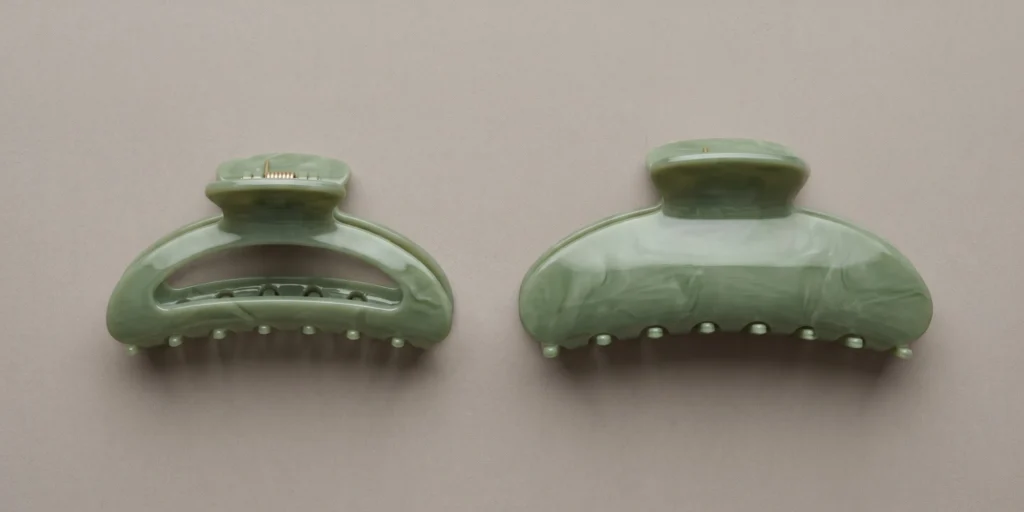
Claw clips are highly effective for curly hair bun and half-up styles because they hold the gathered section through spring jaw tension without wrapping around it — eliminating the friction and compression at a wrap point that disrupts the curl pattern. The clip grips the curl section from the outside, holding the style in a defined shape without disturbing the individual curl pattern within the gathered section.
The critical sizing consideration for curly hair is that the clip must be large enough to fully accommodate the gathered volume. Curly hair generates significantly more volume per section than straight hair, so a clip that holds medium-density straight hair will typically be too small for the same individual’s curly hair gathered into a bun. Large (9–10 cm) and oversized (11–12 cm) clips are the most commonly appropriate sizes for medium to thick curly hair. Brands developing claw clip ranges for the curly hair segment should source from an acetate claw clip manufacturer that offers reinforced spring specifications at large and oversized jaw lengths — both variables matter for curly hair hold performance.
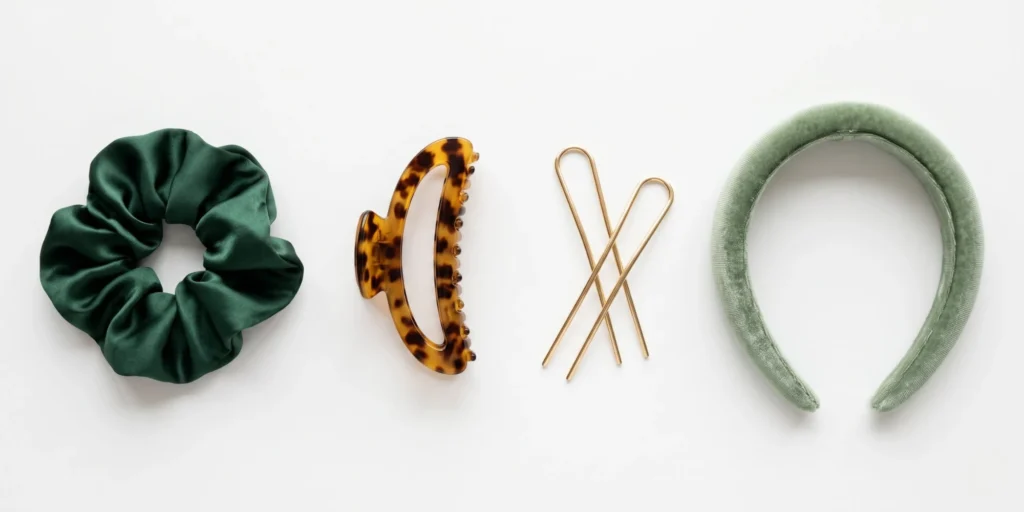
Smooth-tipped hair pins and U-pins are essential tools for securing curly hair updos and bun styles. The U-pin format — an open wire shape without a closed tip — is particularly well-suited to curly hair because it can be worked into the curl pattern to anchor a section without compressing or disturbing adjacent curls. Bobby pins with smooth, intact rubber-tipped prongs work on smaller sections where precision anchoring is needed.
The key requirement for pins on curly hair is smooth tip finishing. Rough, chipped, or worn metal tips snag the irregular curl surface on both insertion and removal, causing tangling and breakage. This is more disruptive on curly hair than on straight hair because the curl’s helical structure means that a snagged strand may pull through multiple adjacent curls as it catches, amplifying the damage from a single rough contact point.
For overnight protective styling — pineappling, loose buns, or gathered sections held at low tension to protect curl definition while sleeping — a loose satin scrunchie or satin ribbon tie is the lowest-damage option. The smooth surface generates minimal friction against the pillow and the curl pattern, and the loose application at low tension avoids the compression and crease that a tighter tie would create.
Silk or satin pillowcases used in combination with a loose satin scrunchie reduce friction-induced frizz from overnight movement significantly more than either intervention alone — the pillow surface and the accessory surface both contribute to the total friction environment during sleep.
Wide fabric headbands — particularly those with a smooth or velvet inner surface — are more effective than thin headbands for keeping curly hair back from the face. The wider contact surface generates more grip against the irregular curl texture, making the band more resistant to being pushed back by the volume of the hair. Thin plastic headbands are frequently displaced by the outward pressure of high-volume curly hair within minutes of application.
For curly hair specifically, headbands with a slightly grippy inner surface — velvet or microfibre — perform better than completely smooth surfaces, as the slight texture engages with the curl pattern rather than sliding over it. The trade-off is marginally higher friction at the contact point — acceptable for short-term wear but less ideal for extended wear where frizz at the hairline is a concern.
The following accessory formats perform poorly on curly hair — either failing to hold reliably or generating frizz and damage at the contact point:
Curly hair spans a wide range of textures and densities — from loose waves to tight coils — and the best accessory choice varies across this range. The following table provides size and format guidance by curl pattern:
| Curl Type | Best Claw Clip Size | Best Hair Tie | Key Consideration |
|---|---|---|---|
| Loose waves (2A–2B) | Medium (7–8.5 cm) | Satin scrunchie, standard tension | Volume moderate — standard sizing often sufficient |
| Wavy-curly (2C–3A) | Large (9–10.5 cm) | Satin scrunchie, standard to high tension | Volume increases significantly — size up from straight hair equivalent |
| Curly (3B) | Large to oversized (10–12 cm) | Satin scrunchie, high tension elastic | High volume; spring tension must be reinforced in clips |
| Tight curly (3C) | Oversized (11–13 cm) | Satin scrunchie, wide high-tension elastic | Very high volume; most standard clips will fail |
| Coily (4A–4B) | Oversized (11–13 cm) or multiple clips | Satin scrunchie, wide elastic or ribbon tie | Highest volume; prioritise low-manipulation styles to minimise frizz |
| Tightly coiled (4C) | Oversized or U-pins for sectioning | Satin ribbon tie or loose satin scrunchie | Low-manipulation priority; avoid tight elastics entirely |
Beyond accessory selection, the following habits reduce frizz and improve hold on curly hair regardless of which specific accessories are used:
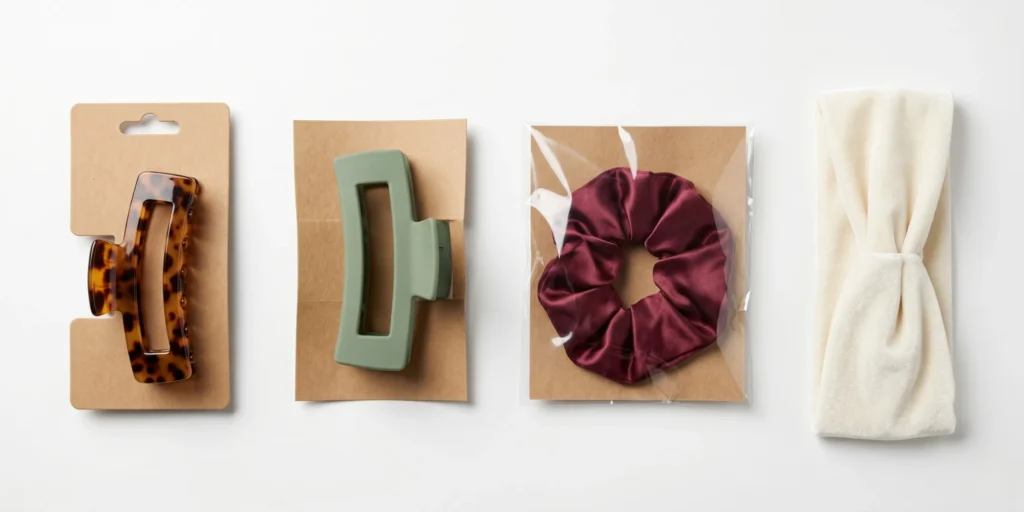
The curly hair consumer segment — spanning loose waves through tight coils — is one of the fastest-growing and most brand-loyal segments in the hair accessories market. Consumers with curly hair have historically been underserved by mainstream hair accessories ranges, which are designed for median (straight to wavy) hair types and frequently fail in the specific ways this guide describes. Brands that develop ranges deliberately specified for curly hair performance — correct size, correct elastic tension, correct surface finish — capture a consumer group that repurchases reliably when a product actually works.
A recommended product mix for a curly hair accessories range includes large and oversized acetate claw clips with reinforced spring specifications, satin scrunchies with wide high-tension elastic across a full colour range, smooth-tipped U-pins and bobby pins in multi-pack formats, and wide fabric headbands with velvet or microfibre inner surfaces. The specification brief for each product should explicitly reference curly hair volume requirements — ensuring that the factory’s quality control process validates hold performance on high-volume hair sections, not just on the median hair density that standard production testing assumes.
Buyers sourcing for this segment should request sample testing at three curl density levels: low-density waves, medium-density curls, and high-density coils. A clip that holds medium-density curly hair may fail at high density; a scrunchie with standard elastic tension may hold low-density waves but slip on high-volume coily hair. Testing across the range eliminates this failure mode before a production run is committed.
For brands sourcing both clip formats and scrunchie formats within a single supplier relationship, an OEM hair accessories manufacturing partner that produces both injection-moulded clip components and sewn fabric scrunchies within a single facility simplifies quality management and enables blended MOQ negotiation across the range.
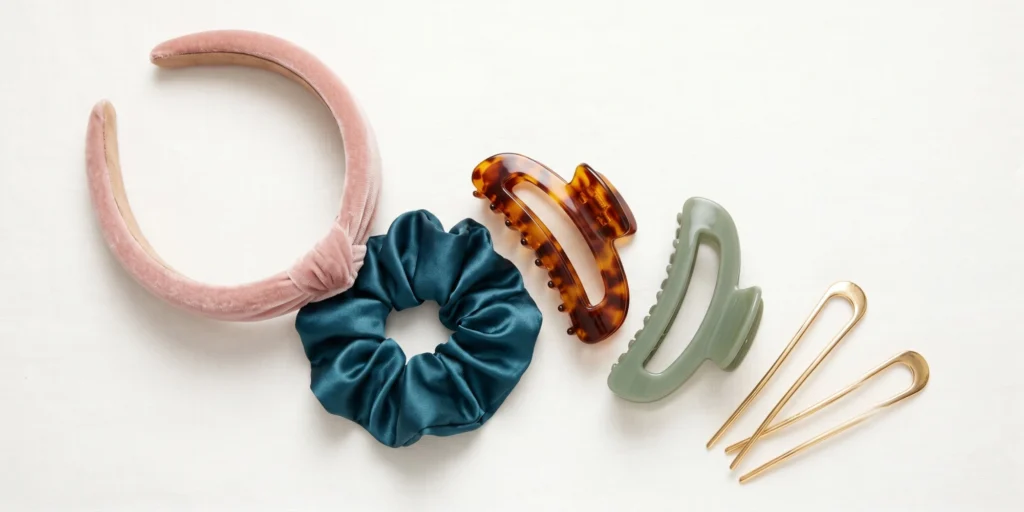
Satin scrunchies are the best hair tie for curly hair without causing frizz — the smooth satin surface generates minimal friction against the curl cuticle, reducing the friction-induced frizz that bare elastics and rougher fabrics cause at the tie point. For bun and half-up styles, a large smooth-finished claw clip is the best option because it holds the gathered curl section without wrapping around it at all, eliminating the wrap-point friction and curl compression that any elastic format creates. The combination of satin scrunchies for ponytails and large claw clips for buns covers the two primary styling contexts for curly hair with the lowest possible frizz induction.
Curly hair requires larger claw clips than straight or wavy hair of the same length and strand count, because the curl structure creates significantly more volume in a gathered section. As a practical guide: loose waves typically need a medium to large clip (8–10 cm); medium curls need a large clip (10–11 cm); thick or tight curls need an oversized clip (11–13 cm). If your current clip pops open when you apply it or loosens after a short time, the spring is operating at its compression limit — size up to a longer clip with a reinforced spring specification.
Claw clips and scrunchies are better for different curly hair styling contexts rather than one being categorically superior. Claw clips are better for bun and half-up styles because they hold the shape structurally without wrapping around the curl section — preserving curl pattern within the gathered style. Scrunchies are better for ponytails because the elastic’s self-adjusting compression accommodates the high volume of a curly ponytail more reliably than a fixed-jaw spring mechanism. Many curly hair consumers use both regularly for different styling purposes.
Yes — bobby pins are useful for curly hair when used correctly. The key requirements are smooth, intact rubber-tipped prongs (rough or worn tips snag the irregular curl surface and can pull through multiple adjacent curls on removal), and U-pins for anchoring larger curl sections in updos (the open U shape works into the curl pattern without compressing it the way a closed bobby pin does). Bobby pins on curly hair work best for precision anchoring of specific sections rather than as the primary hold mechanism for large curl volumes.
Thin plastic headbands slide back in curly hair because the narrow smooth surface cannot grip the irregular curl texture against the outward pressure of the hair volume. The solution is to use a wider headband — 4 cm or more — with a slightly grippy inner surface such as velvet or microfibre, which engages with the curl pattern rather than sliding over it. Some consumers also anchor a wide headband by placing it over a thin invisible elastic or using a small bobby pin at each temple to secure the band ends to the hair.
For claw clips: large and oversized jaw lengths (10–13 cm); reinforced spring tension specifications rather than standard gauge; smooth, burr-free tooth finishing verified by sample removal testing on textured hair. For scrunchies: genuine satin or silk fabric; wide-gauge elastic (1.5–2 cm) at high tension specification; smooth finished seam without exposed raw edges. For hair pins: intact rubber or silicone tip coating; U-pin format for anchoring larger curl sections. For headbands: width of 4 cm or greater; velvet or microfibre inner surface for grip; no hard interior teeth. Across all formats, request sample testing against high-volume curl sections rather than accepting standard production samples tested against median hair density.
Curly hair holds best with accessories that are correctly sized for its volume, have low-friction contact surfaces, and do not require wrapping through the curl pattern on removal. Satin scrunchies with wide, high-tension elastic lead the hair tie category for curly hair; large and oversized smooth-finished claw clips lead the clip category. Smooth-tipped pins and wide-surface headbands with grip-texture inner surfaces round out a complete curly hair accessory range that addresses every styling context without disrupting the curl pattern.
For B2B buyers, the curly hair segment is commercially significant, brand-loyal, and systematically underserved by standard hair accessories ranges. Sourcing accessories with the specifications outlined in this guide — and validating those specifications against high-volume curly hair samples before production commitment — produces a range that performs where mainstream alternatives fail. Manufacturers such as JunYi Beauty, which produces large and oversized acetate claw clips with variable spring specifications, satin scrunchies with wide elastic options, and hair pins across multiple formats at its Dongguan facility under ISO 9001:2015 and amfori BSCI certification, represent the type of factory-direct OEM partner suited to brands developing a deliberately specified curly hair accessories range.
👉 Searching for Hair Accessories ? Your brand deserves the best.