Home
Product
Contact
Odm/Oem
About
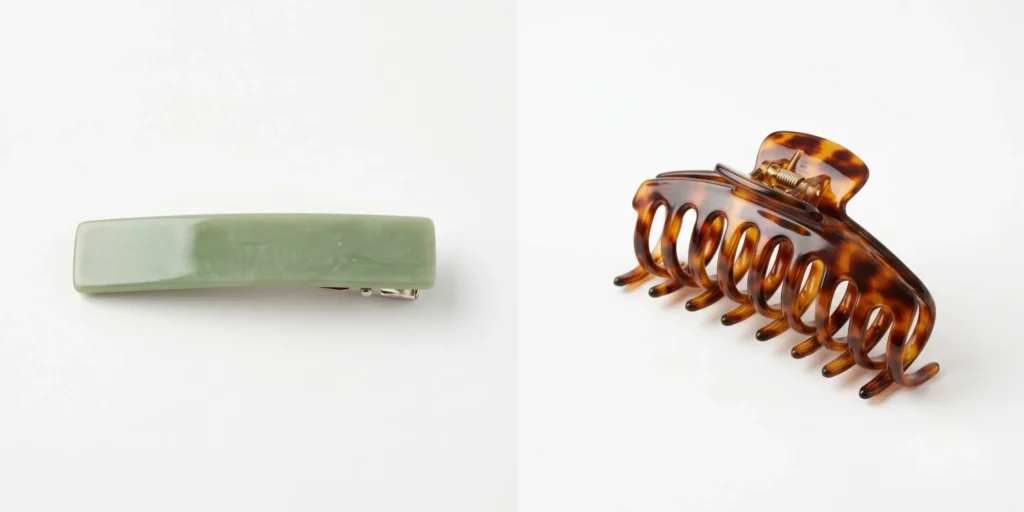
Flat hair clips and claw clips are both hair fastening accessories, but they operate through fundamentally different mechanisms, hold different volumes of hair, and serve distinct styling functions. Choosing between them is not a matter of preference — it is a matter of matching the accessory to the styling task, the hair type, and the look being created. Using a claw clip where a flat clip is needed, or vice versa, produces a result that is either over-engineered or insufficiently functional for the context.
This guide explains the structural and functional differences between flat clips and claw clips across every relevant variable — hold mechanism, hair volume capacity, profile when worn, styling suitability, hair health impact, material, and B2B sourcing considerations — to support informed product decisions for both consumers and buyers.
The defining difference between flat clips and claw clips is dimensional — how the clip body relates to the hair surface when worn.
A flat clip closes flat against the hair surface. The clip body, when worn, remains parallel to or flush with the hair section it is securing — projecting minimal height above the scalp or hair surface. The snap barrette (the most common flat clip format) closes a hinged lever across a gathered section; the French clip slides a bar through a flat frame; the alligator clip closes serrated jaws flat. In each case, the clip sits close to the hair and does not surround the hair within a raised structure.
A claw clip surrounds the hair. The spring-loaded jaw mechanism projects above and below the gathered hair section, enclosing it within the clip’s three-dimensional jaw structure. When worn, the claw clip body rises visibly above the hair surface — the clip is a three-dimensional object that grips the hair from both sides of a raised jaw opening. This three-dimensional grip is what allows claw clips to hold large gathered volumes of hair that flat clips cannot reach around.
This structural difference drives every practical difference between the two formats that follows.
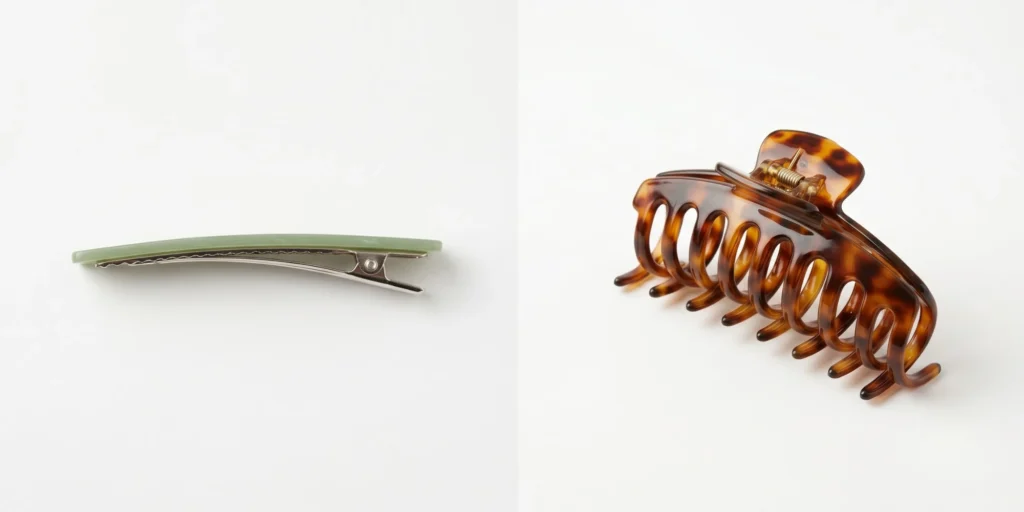
Flat clips hold hair by closing across a gathered section — clamping the hair between two flat surfaces. A snap barrette presses a hinged lever against the underside of a gathered section, with the hair squeezed between the decorative outer face and the lever. A French clip slides a bar through frame loops over a gathered section, pressing the hair flat against the frame. In both cases, the hold mechanism is compressive — the clip squeezes the hair section between two surfaces — and the grip operates in the plane of the hair surface rather than from above and below a raised gathering.
The practical consequence is that flat clips hold hair sections that are already gathered close to the scalp or lying relatively flat. They are not designed to grip the full three-dimensional volume of a twisted bun that projects away from the head — a geometry that only a claw clip’s raised jaw can accommodate.
Claw clips hold hair by surrounding a gathered section with a spring-loaded jaw that closes from both sides simultaneously. The user presses the clip open, positions it around the gathered section, and releases — the spring tension closes the jaw and the interlocking teeth grip the hair from both sides. The hold operates perpendicularly to the hair surface: the teeth grip from above and below, while the hair section sits within the jaw opening in three-dimensional space.
This mechanism allows claw clips to hold the full volume of a twisted bun, a gathered updo, or a half-up style that projects away from the scalp — styling contexts where there is no flat surface for a flat clip’s compressive mechanism to operate against.
Hair volume capacity is the most consequential practical difference between flat clips and claw clips for most consumers.
Flat clips have a defined hold ceiling determined by the lever tension or sliding bar pressure. A standard snap barrette holds fine to medium hair sections reliably; large snap barrettes (8–9 cm) can hold medium-thick sections. But for thick hair or full-head gathered volumes, the flat clip mechanism cannot generate sufficient compressive force — the lever either does not close fully around the thick section or springs open under the load.
Claw clips scale in volume capacity through size and spring specification. A small claw clip (4–6 cm) holds fine accent sections; an oversized claw clip (11–13 cm) with a reinforced spring holds very thick, very long hair in a full bun. The claw clip’s jaw mechanism is inherently scalable in a way that the flat clip’s compressive mechanism is not.
According to research on hair mechanical stress, accessories that distribute grip force across a wider contact area generate lower localised tension per strand — a principle that favours the claw clip’s jaw mechanism (which grips across the full length of the jaw) over the flat clip’s lever mechanism (which concentrates compressive force at the lever contact point) for large hair volumes.
The low profile of a flat clip makes it the preferred format for styling contexts where the accessory should not project visibly above the hair surface. This includes formal updos where the clips are partially or fully concealed within the style, professional settings where understated accessories are preferred, and styling contexts where multiple clips are used at different points in a style and a high-profile claw clip would create visual clutter.
The flat clip’s outer decorative face — the surface visible when the clip is worn — is the primary aesthetic element, and it lies flush with or close to the hair surface. Acetate snap barrettes, embellished metal French clips, and fabric-covered barrettes all use this flat surface as a canvas for decorative treatment. The result is a different aesthetic category from the claw clip: flat clips read as refined and precise where claw clips read as expressive and sculptural.
The raised three-dimensional structure of a claw clip makes it a more visually prominent accessory — the clip body projects above the hair and is visible from multiple angles. This visibility is an advantage in styling contexts where the clip is intended as a deliberate fashion statement: a large tortoiseshell acetate claw clip at the crown is a visible element of the look, not a concealed fastening mechanism. The claw clip’s decorative surface is three-dimensional, with the jaw body, hinge housing, and teeth all contributing to the visual profile of the worn accessory.
| Styling Context | Better Format | Reason |
|---|---|---|
| Full bun or updo — all hair gathered | Claw clip | Volume too large for flat clip hold mechanism |
| Half-up style — top section pinned back | Either — context dependent | Flat clip for low-profile refined look; claw clip for statement aesthetic |
| Single section pinned at temple | Flat clip | Small section suits flat clip scale; claw clip oversized |
| Formal updo — clips partially concealed | Flat clip (French clip) | Low profile needed; French clip holds formal sections securely |
| Casual messy bun, everyday updo | Claw clip | Volume and structural hold; three-dimensional grip |
| Professional setting, minimal accessories | Flat clip | Low-profile and refined; less visually prominent |
| Statement fashion accessory | Claw clip (large acetate) | Three-dimensional visible presence; decorative impact |
| Salon sectioning during styling | Flat clip (alligator/duckbill) | Holds flat sections close to scalp during service |
| Bridal and occasion hair | Flat clip (embellished barrette) | Refined jewellery-adjacent aesthetic; low profile |
| Short hair — insufficient length for bun | Flat clip | Claw clip cannot gather sufficient volume on short hair |
| Overnight or sleep styling | Neither — scrunchie preferred | Both clip formats create pressure points during sleep |
Both flat clips and claw clips present lower hair breakage risk than bare elastic bands when correctly specified and used. However, they generate mechanical stress through different mechanisms, and the relative risk depends on the specific format and use context.
The primary hair health risk from flat clips is the lever contact point — the inner surface of the snap barrette lever or the sliding bar of a French clip presses against the hair section at a relatively concentrated point. If the lever surface has teeth, serrations, or rough edges, these can snag individual strands on removal. No-crease flat clips with smooth, silicone-coated inner surfaces eliminate this snagging risk. Flat clips do not wrap around the hair and therefore generate no wrap-point tension or tension crease — which is an advantage over elastic-based formats for hair health.
The primary hair health risk from claw clips is the tooth surface finish. Smooth, well-finished teeth on premium acetate or ABS clips slide through the hair on application and release cleanly on removal. Poorly finished teeth with burrs or sharp edges snag individual strands, generating breakage at the grip point. Correctly sized claw clips operating well within their spring range apply lower per-tooth pressure than undersized clips working at maximum spring compression.
Claw clips generate no wrap-point tension, no friction from wrapping or unwinding, and no tension crease — all advantages over elastic-based accessories. For color-treated, fragile, or fine hair, both well-finished flat clips and well-finished claw clips are appropriate low-damage daily accessories when correctly sized.
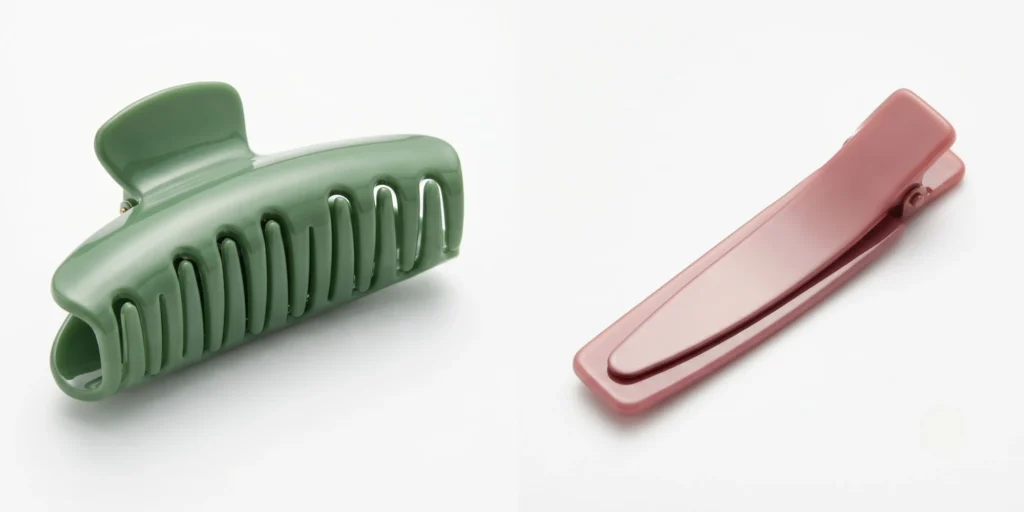
Both flat clips and claw clips are produced across the same material range — ABS plastic, cellulose acetate, metal, and fabric-covered formats — but the pricing dynamics differ between the two categories at equivalent material specifications.
| Variable | Flat Clip (snap barrette) | Claw Clip |
|---|---|---|
| Mass-market material | ABS plastic | ABS plastic |
| Premium material | Cellulose acetate, embellished metal | Cellulose acetate |
| Typical retail price (ABS) | $3–$8 per clip | $4–$10 per clip |
| Typical retail price (acetate) | $8–$25 per clip | $10–$35 per clip |
| Production complexity | Medium — 3–5 components | Medium to high — 4–6 components + spring |
| OEM MOQ (standard) | 300–500 units per style/colour | 300–500 units per style/colour |
| Gift suitability | High (French clips, embellished barrettes) | High (premium acetate) |
| Occasion wear suitability | Very high (French clips, metal barrettes) | Moderate |
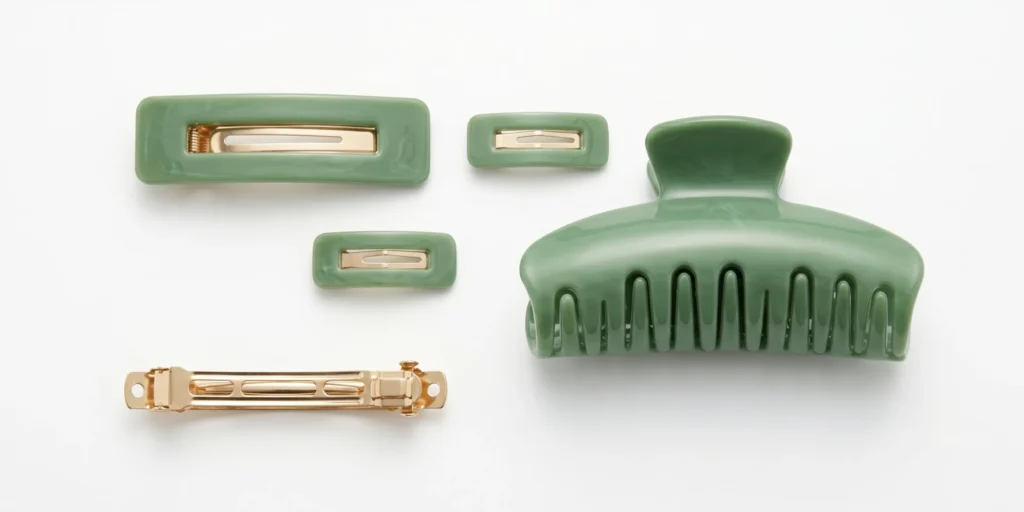
For B2B buyers, flat clips and claw clips are not competing SKUs within the same category — they address different consumer styling needs and should be ranged together as complementary product tiers rather than alternatives.
A range that includes only claw clips leaves consumers without options for formal styling, short hair, accent detail, and professional settings where a raised claw clip is too prominent. A range that includes only flat clips leaves consumers without options for full buns, everyday updos, and the thick-hair segment that flat clips cannot hold.
A commercially balanced hair clip range typically includes snap barrettes in ABS (everyday accessible) and acetate (premium), French clips in metal for the occasion and gift channel, and claw clips across small through oversized sizes in both ABS and acetate. This structure covers the full consumer need spectrum — from short-hair accent styling through full bun hold for very thick hair — within a single coherent accessory category. Brands sourcing across both flat clip and claw clip formats benefit from working with a custom hair clip manufacturer that produces both formats within a single facility, ensuring consistent finish standards, spring quality, and surface specifications across the full range.
Buyers seeking to develop a complete range that spans flat clips, claw clips, scrunchies, and headbands within a single supplier relationship should evaluate OEM hair accessories manufacturing partners on the basis of production breadth — confirming that the factory operates both injection moulding lines (for plastic and acetate components) and metal processing lines (for French clips, bobby pins, and metal barrette frames) before committing to a development programme.
Q: What is the difference between a flat hair clip and a claw clip?
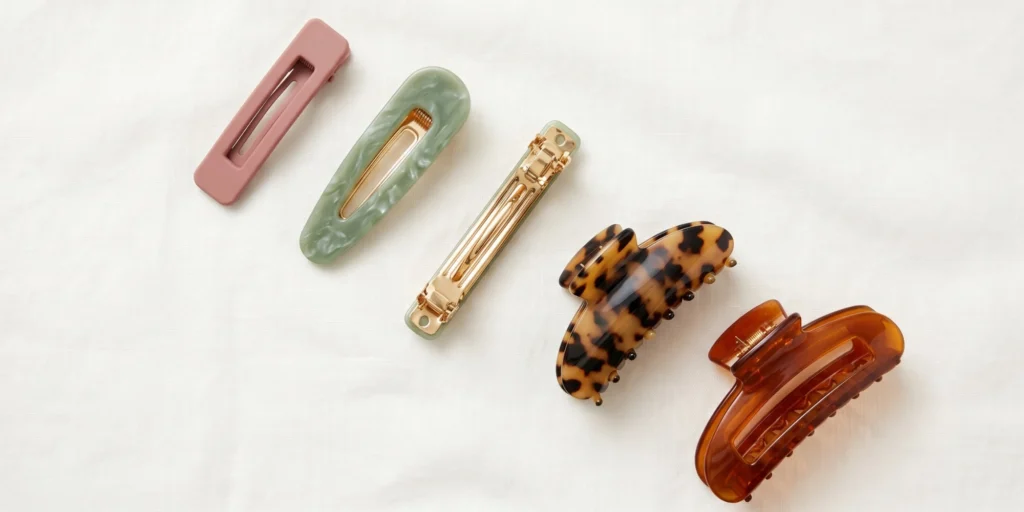
A flat hair clip closes flat against the hair surface — the clip body remains parallel to or flush with the hair section it is securing, with minimal projection above the scalp. A claw clip surrounds the gathered hair within a raised spring-loaded jaw that projects above and below the hair section, gripping it from both sides. The flat clip is designed for securing individual sections and small to medium volumes of hair in a low-profile way; the claw clip is designed for holding larger gathered volumes — full buns, half-up styles, and updos — that project away from the scalp and cannot be held by a flat compressive mechanism.
Q: When should I use a flat clip instead of a claw clip?
Use a flat clip when you need a low-profile accessory that sits close to the hair surface — for formal updos where the clip should be partially concealed, for pinning back individual sections or layers at the temple or crown, for professional settings where a raised claw clip would be too visually prominent, or for short hair that does not have sufficient length to gather into a claw clip. A flat clip (specifically a French clip) is also the better choice for formal occasion styling where a jewellery-adjacent aesthetic and refined hold are priorities over the casual statement aesthetic of a claw clip.
Q: Can flat clips hold as much hair as claw clips?
No — flat clips have a lower hair volume capacity than claw clips. The compressive lever or sliding bar mechanism of a flat clip cannot generate sufficient hold for large gathered volumes of hair, particularly thick hair or full-head updo styles. Large snap barrettes (8–9 cm) hold medium-thick sections effectively, but the flat clip format reaches a practical hold ceiling well below what a correctly sized claw clip can accommodate. For full buns, half-up styles gathering significant volume, and thick hair styling, a claw clip provides substantially more reliable hold than any flat clip format.
Q: Are flat clips or claw clips better for fine hair?
Both work well for fine hair in different styling contexts. Small to medium flat clips (4–7 cm) are effective for pinning back fine hair sections in accent and partial styles — the compressive mechanism grips fine hair well on a flat surface. Small to medium claw clips (6–8 cm) are more effective for full buns and half-up styles on fine hair because the jaw mechanism can accommodate the three-dimensional geometry of a twisted bun that a flat clip cannot reach around. For fine hair, the key specification for both formats is smooth inner surfaces — whether the lever surface of a flat clip or the tooth surface of a claw clip — to avoid snagging the more fragile fine strands on removal.
Q: Which is better for a formal or professional setting — flat clips or claw clips?
Flat clips are generally better suited to formal and professional settings than claw clips. The low-profile flat clip — particularly the French clip or an understated embellished barrette — creates a refined, polished aesthetic that reads as intentional and considered in formal contexts. A claw clip’s raised three-dimensional profile is more casual and expressive in its aesthetic language, which suits everyday and fashion-forward styling contexts better than formal occasion or professional settings where understated accessories are expected. For formal occasion hair, a French clip or embellished snap barrette in metal or acetate is the more appropriate choice.
Q: What MOQ should buyers expect when sourcing both flat clips and claw clips from the same OEM manufacturer?
Standard MOQs for both snap barrettes and claw clips from factory-direct OEM suppliers typically begin at 300–500 units per style per colour for standard constructions using existing tooling. French clips typically begin at 300–500 units per style. When sourcing both flat clips and claw clips within a single purchase order from the same manufacturer, buyers can often negotiate blended minimum requirements — where a combined order across multiple SKUs meets the factory’s overall volume threshold even if individual SKUs are below their individual minimums. Confirming the factory produces both metal-frame and injection-moulded plastic components is a prerequisite for consolidated sourcing of both formats.
Flat hair clips and claw clips are not interchangeable — they address fundamentally different styling needs through different structural mechanisms. Flat clips secure small to medium hair sections with a low-profile compressive hold that keeps the clip body close to the hair surface, making them the correct choice for formal styling, accent detail, short hair, and professional contexts. Claw clips secure larger gathered volumes with a raised spring jaw that surrounds the hair from both sides, making them the correct choice for full buns, half-up styles, thick hair, and everyday expressive styling.
For B2B buyers, a range that includes both formats — flat snap barrettes and French clips alongside small through oversized claw clips — covers the full spectrum of consumer hair clip needs without gaps. Manufacturers such as JunYi Beauty, which produces both flat snap barrettes and acetate claw clips across multiple sizes and materials at its Dongguan facility under ISO 9001:2015 and amfori BSCI certification, represent the type of factory-direct OEM partner suited to brands building a complete hair clip range from a single supplier relationship.
👉 Searching for Hair Accessories ? Your brand deserves the best.