Home
Product
Contact
Odm/Oem
About
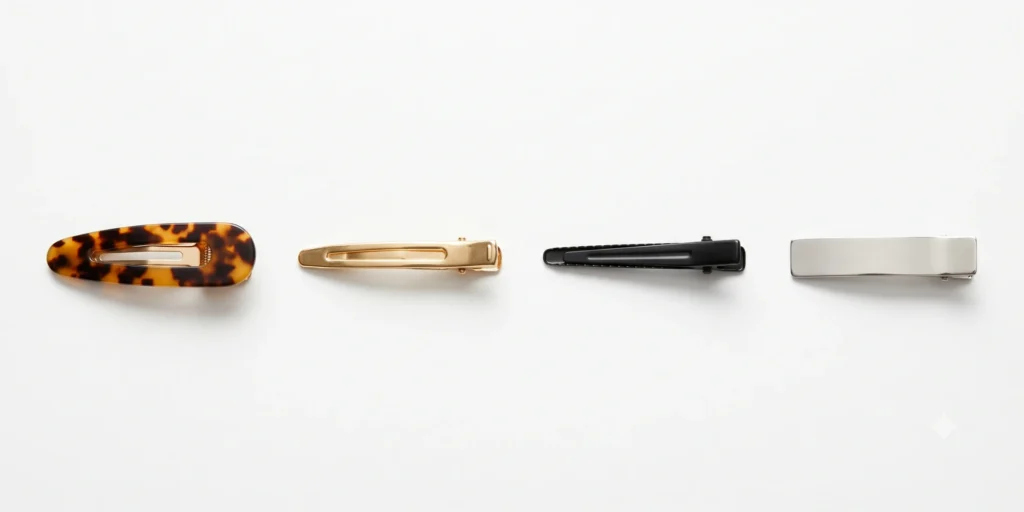
A flat hair clip is a hair fastening accessory defined by its low-profile, flat construction — the clip sits close to the hair surface when worn, projecting minimal height above the scalp or hair section it secures. This distinguishes flat clips from three-dimensional accessories such as claw clips, which grip hair within a raised jaw structure, or scrunchies, which create volume at the tie point. Flat clips secure hair through a hinged or sliding mechanism that closes flat against the hair, holding a section in place with the clip body remaining parallel to or flush with the hair surface.
The flat clip category encompasses several distinct product formats that share the low-profile structural characteristic but differ substantially in their hold mechanism, appropriate use context, material, and aesthetic function. This guide defines the flat hair clip category, describes every major format within it, and provides sourcing guidance for B2B buyers developing flat clip ranges.
The defining structural characteristic of a flat hair clip is that the clip body — when closed and worn — remains within a low vertical profile relative to the hair surface. In functional terms, this means the clip fastens a hair section by closing flat across it rather than by surrounding it within a raised jaw or encircling it with elastic.
This flat profile serves two purposes: it keeps the accessory visually unobtrusive when that is the styling intention (professional settings, updos where the clips are hidden, underlayers of styled hair), and it allows the clip to sit against the scalp or hair surface without creating the visible lift or projection of a claw clip or barrette with a raised decorative element.
Not all barrettes and hair clips are flat — a decorative barrette with a raised sculptural element on the outer face is not a flat clip by this definition even though it uses a flat closure mechanism. The flat clip category specifically refers to accessories where the clip body itself is flat or very low-profile in its closed wearing position.
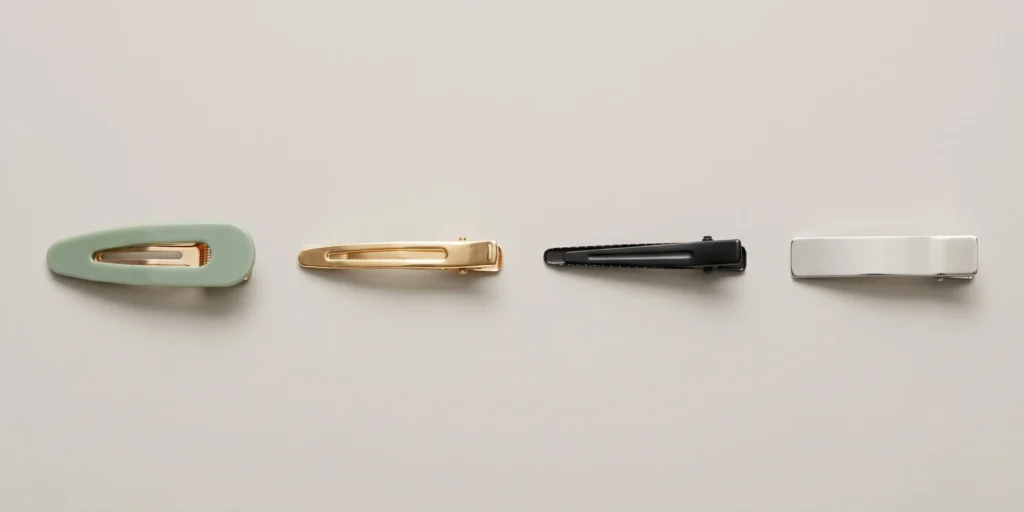
A snap barrette is a flat hinged clip consisting of a decorative outer face and a hinged lever that snaps shut across a gathered hair section. The outer face — the surface that is visible when worn — is the primary aesthetic element of the clip, and the lever on the underside is the functional closure mechanism. When the lever is pressed open, it creates a gap between the outer face and the lever into which a hair section is placed; when released, the lever snaps shut against the outer face, gripping the hair section between the two.
Snap barrettes are produced in lengths ranging from approximately 4 cm (small, for fine hair or accent styling) to 9 cm (large, for medium to thick hair sections). The outer face may be flat and smooth (for a minimal, low-profile aesthetic), embellished with metal hardware, rhinestones, or enamel details, or produced in patterned acetate for a premium visual effect. The lever and frame are typically metal; the outer decorative face may be metal, acetate, resin, or fabric-covered. Snap barrettes are the most versatile flat clip format and the dominant category within the broader flat clip market.
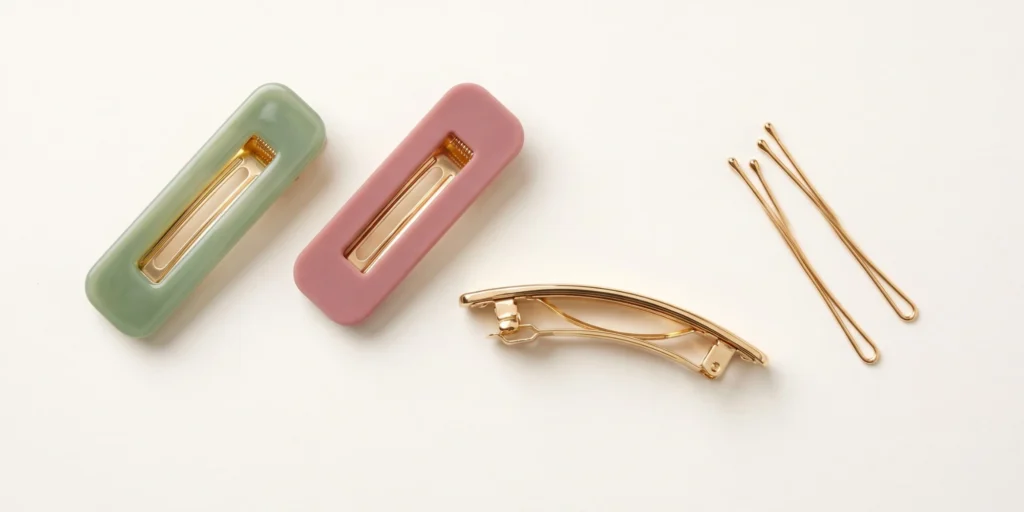
A French clip is a flat metal hair accessory consisting of a rectangular or elongated metal frame and a separate sliding bar that passes through loops on the frame’s underside. Hair is gathered over the frame and the bar is slid through the loops to lock the hair against the frame, creating a flat, secure hold with a very low profile. French clips are particularly effective for fine to medium hair in formal updo and half-up styles because the sliding bar mechanism distributes hold across the full length of the clip rather than at a single snap point.
French clips are almost exclusively produced in metal — typically brass, zinc alloy, or steel — with surface treatments including gold-tone plating, silver-tone plating, and oxidised finishes. The metal construction gives French clips a refined, jewellery-adjacent aesthetic that positions them in the premium and occasion wear segment. They are not suitable for thick hair because the sliding bar mechanism cannot generate sufficient compressive force for high-volume hair sections.
An alligator clip is a spring-loaded flat clip with serrated or toothed inner jaws, named for the resemblance of the toothed jaw profile to the snout of an alligator. The clip opens by pressing the outer arms together, which compresses the spring and separates the jaws; releasing the arms allows the spring to close the jaws around the hair or object being secured. Alligator clips are primarily professional styling tools rather than consumer retail accessories — they are used by hairdressers and stylists to section hair during cutting, colouring, blow-drying, and setting services.
At retail, alligator clips are found in professional salon supply channels and in multi-pack styling tool sets. They are not typically the target format for fashion or premium hair accessories positioning, but they are an important category for B2B buyers serving salon supply or professional styling tool channels. The serrated teeth of alligator clips provide strong grip on large hair sections, making them functionally superior to snap barrettes for salon sectioning work.
No-crease flat clips are flat snap-style clips designed with smooth, non-toothed inner surfaces specifically to avoid leaving an indentation in the hair when removed. Standard snap barrettes with metal inner teeth or serrated lever surfaces leave a visible crease or dent in the hair section after removal — an issue for styling contexts where the hair must look smooth and undisturbed after the clip is taken out. No-crease clips use silicone-coated, rubber-cushioned, or smooth metal inner surfaces that hold the hair without the teeth contact that creates creasing.
No-crease clips are positioned in the functional styling segment and are particularly relevant for consumers who use clips to set wet hair, section hair during heat styling, or pin up sections temporarily during a longer styling process. They are produced primarily in metal with silicone or rubber coating on the inner jaw surfaces.
Duckbill clips are a flat spring-loaded clip format with a wide, flat jaw shape — the open jaw profile resembles a duck’s bill in cross-section. They are used primarily for sectioning hair during blow-drying and styling services, holding a flat gathered section close to the scalp without creating significant lift. Like alligator clips, duckbill clips are professional styling tools rather than retail fashion accessories, though small decorative versions occasionally appear in consumer accessories ranges.
Bobby pins and U-pins are the flattest hair fastening accessories — two-pronged metal pins that slide into the hair and hold through friction and spring tension between the prongs. While technically distinct from the clip formats above, they fall within the broad flat hair accessory category because they secure hair with a completely flat, low-profile profile. Bobby pins hold small sections flat against the scalp; U-pins secure larger sections in updos with minimal visible profile.
Flat clips and claw clips address different styling needs and are most effectively used as complementary accessories rather than alternatives. The following table summarises the primary differences:
| Variable | Flat Clip (snap barrette / French clip) | Claw Clip |
|---|---|---|
| Profile when worn | Very low — sits flush with hair surface | Raised — projects above hair section |
| Hair volume held | Small to medium sections | Medium to full head of hair |
| Hold mechanism | Snap lever or sliding bar across hair | Spring jaw closing around gathered section |
| Primary function | Section securing, accent styling, formal updo | Full bun, half-up, everyday updo |
| Visibility when worn | Visible on surface; decorative outer face | Visible; three-dimensional decorative element |
| Suitable for thick hair | Limited — snap mechanisms have hold ceiling | Yes — with oversized reinforced spring |
| Professional / salon use | High — alligator and duckbill for sectioning | Moderate |
| Formal / occasion use | High — French clips, embellished barrettes | Moderate — primarily casual and everyday |
| Retail price range | $4–$35 depending on material and embellishment | $5–$40 depending on size and material |
Premium snap barrettes are produced in cellulose acetate — the same semi-synthetic, plant-derived material used for premium claw clips. Acetate barrettes produce the translucent, marbled, and tortoiseshell visual effects that distinguish premium flat clips from mass-market alternatives. The outer face of an acetate snap barrette is typically cut and polished from acetate sheet, while the lever and frame are metal. Brands developing premium flat clip ranges should work with a custom hair clip manufacturer that offers acetate face production alongside metal frame assembly within a single production relationship.
ABS plastic is the dominant substrate for mass-market snap barrettes. The clip body and lever may both be ABS, or the lever may be metal with an ABS decorative outer face. ABS barrettes offer a wide colour range, consistent dimensional accuracy, and accessible price points — making them the standard format for everyday, trend-responsive, and multi-pack retail formats.
French clips, alligator clips, no-crease clips, and many snap barrette frames are produced in metal — typically brass, zinc alloy, or steel — with surface treatments including gold-tone, silver-tone, and rose gold plating. Metal construction gives clips a premium tactile quality and a jewellery-adjacent aesthetic that plastic cannot replicate. Metal flat clips in the French clip and embellished snap barrette formats are the dominant format in the occasion wear and gift channel.
Some snap barrettes and flat clips are produced with fabric-covered outer faces — satin, velvet, or grosgrain ribbon over a metal or plastic frame. Fabric-covered flat clips occupy a specific niche between the decorative acetate/metal premium segment and the mass-market plastic segment: they offer a soft, luxurious aesthetic at mid-market price points and are particularly effective in the bridal and occasion wear channel where satin or velvet textures complement formal fabrics.
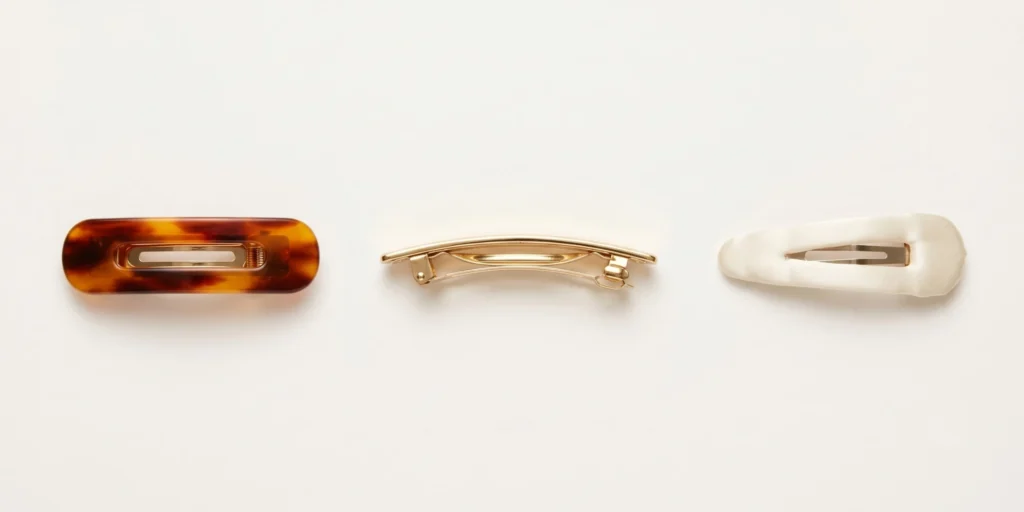
To apply a snap barrette, press the lever downward to open the gap between the outer face and the lever. Place the gathered hair section over the outer face of the clip — the hair sits on top of the outer face, not inside a jaw. Close the lever upward to snap shut, pressing the lever against the underside of the hair section. The clip holds the hair between the outer face (below) and the closed lever (above). To remove, press the lever down and slide the clip out horizontally without pulling through the hair.
To apply a French clip, hold the frame against the hair section with the looped side facing outward. Feed the sliding bar through the first loop on one side, over the gathered hair section, and through the loop on the other side. Slide the bar to the end of its travel to lock the hair against the frame. To remove, slide the bar back out and lift the frame free of the hair.
Flat snap barrettes are most effectively used for half-up accent styles (a single barrette pinning back a side section at the temple), formal updos where the clip body is partially concealed within the style, and accent detail on already-styled hair. French clips are most effective for securing gathered hair sections in formal updo styles — twisted chignons, low knots, and formal half-up styles where a low-profile secure hold is required. Bobby pins and U-pins are used for anchoring individual sections, pinning the edges of updos, and securing decorative elements to the hair.
| Hair Type | Best Flat Clip Format | Size / Specification | Notes |
|---|---|---|---|
| Fine, straight hair | Snap barrette, French clip | Small to medium (4–7 cm) | Grip of fine hair is good on flat surfaces; no-crease format recommended |
| Medium density hair | Snap barrette, French clip | Medium (6–8 cm) | Most flat clip formats perform well on medium hair |
| Thick hair | Large snap barrette, alligator clip | Large (8–9 cm), strong lever | Standard snap may not grip thick sections; alligator clips more secure |
| Curly hair | Snap barrette with smooth lever | Medium to large | Avoid toothed levers; smooth surfaces release without snagging curl pattern |
| Color-treated hair | No-crease flat clip, smooth snap barrette | Any | Avoid serrated or rough inner surfaces; smooth lever minimises cuticle abrasion |
| Very short hair | Small snap barrette, bobby pin | Small (3–5 cm) or pin | Flat clips work on short hair where claw clips cannot gather sufficient volume |
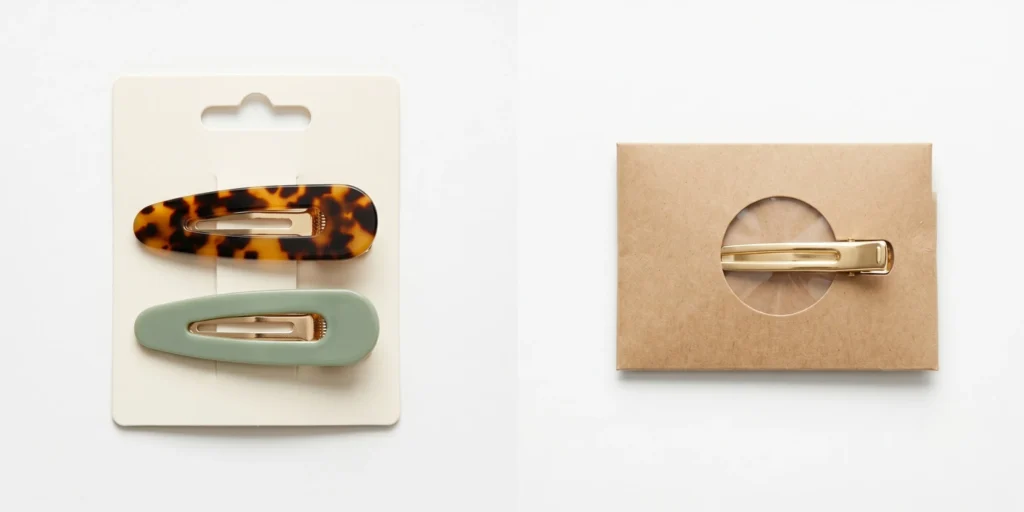
Snap barrettes require tooling for the outer face (which varies by design), the lever, the frame, and the hinge pin — typically three to five components per SKU depending on the construction. Manufacturers with existing mould libraries for standard snap barrette silhouettes can produce standard shapes without custom tooling investment; custom shapes require new outer face tooling. Standard MOQs from factory-direct suppliers begin at 300–500 units per style per colour. Key quality control variables include lever tension consistency, hinge pin retention, outer face finish uniformity, and inner lever surface smoothness.
French clips are entirely metal constructions that require stamping or casting for the frame and sliding bar, plus a surface plating process for the finish. Lead times are typically longer than plastic clip formats due to the metal processing steps. MOQs for standard French clip silhouettes begin at 300–500 units; custom shapes or non-standard lengths may require higher minimums. Gold-tone and silver-tone plating are the most standard finishes; rose gold is increasingly common in the premium segment.
A commercially effective flat clip range for most B2B buyers includes snap barrettes in both ABS (for the accessible everyday tier) and acetate (for the premium tier), French clips in gold and silver-tone metal for the occasion and gift channel, and no-crease clips for the functional styling segment. Bobby pins in multi-pack formats anchor the functional end of the range. Buyers sourcing flat clips alongside claw clips and scrunchies benefit from working with an OEM hair accessories manufacturing partner that produces across all three formats within a single production relationship — enabling consolidated quality management, blended MOQ negotiation, and consistent finish standards across the full range.
Q: What are flat hair clips used for?
Flat hair clips are used to secure, pin, or accent hair sections in a low-profile way that keeps the clip body close to the hair surface. Their primary uses include pinning back individual sections or layers (snap barrettes at the temple or crown), securing formal updo and half-up styles with a refined low-profile hold (French clips), sectioning hair during styling or colouring services (alligator and duckbill clips), and anchoring small sections in updos without visible bulk (bobby pins and U-pins). They are the format of choice when the hair accessory should complement the hairstyle without dominating it visually, or when a completely flat profile is required for the style to sit correctly.
Q: What is the difference between a snap barrette and a French clip?
A snap barrette has a hinged lever that snaps shut across the hair section, pressing the hair between the outer decorative face and the lever underside. A French clip has a sliding bar that threads through loops on a metal frame, securing the hair between the frame and the bar. The snap barrette is easier to apply and remove with one hand; the French clip requires both hands but provides a more distributed, even hold across its full length. French clips are more effective for formal updo styles; snap barrettes are more versatile for everyday accent and half-up styling.
Q: Are flat hair clips good for thick hair?
Standard snap barrettes and French clips have a practical hold ceiling for thick hair — the lever or sliding bar mechanism cannot generate sufficient compressive force for very thick or voluminous hair sections. Large snap barrettes (8–9 cm) with strong lever tension can hold medium-thick hair effectively. For thick hair, alligator clips or large snap barrettes with reinforced lever specifications are the most reliable flat clip format. Very thick hair that cannot be held with a flat clip of any format is better served by a claw clip with an appropriately reinforced spring.
Q: What materials are flat hair clips made from?
Flat hair clips are produced in a range of materials depending on the format and price segment. The outer decorative face of snap barrettes may be cellulose acetate (premium), ABS plastic (mass-market), metal (hardware and occasion wear), or fabric-covered (bridal and gift segments). The frame and lever of snap barrettes are typically metal regardless of the outer face material. French clips, alligator clips, and no-crease clips are almost entirely metal — brass, zinc alloy, or steel with surface plating treatments. Bobby pins are steel or brass with lacquer or plating surface treatments.
Q: What is a no-crease hair clip?
A no-crease hair clip is a flat snap-style clip with smooth, non-toothed inner surfaces — typically silicone-coated or rubber-cushioned — that holds hair without leaving a visible indentation or crease after removal. Standard flat clips with metal teeth or serrated lever surfaces press a crease into the hair section that can persist for hours after the clip is removed. No-crease clips are particularly useful for setting wet hair, pinning sections during heat styling, and situations where the hair will be worn down after the clip is removed and must look smooth and undisturbed.
Q: What is the typical MOQ for sourcing flat hair clips from an OEM manufacturer?
Standard MOQs for snap barrettes and French clips from factory-direct OEM suppliers typically begin at 300–500 units per style per colour for standard constructions using existing tooling. Custom outer face shapes for snap barrettes may require higher minimums if new mould tooling is involved. Bobby pins typically carry higher MOQs of 1,000–5,000 units per style per colour, reflecting their high-volume, low-cost production economics. Buyers sourcing multiple flat clip formats within a single order can often negotiate blended minimum requirements with manufacturing partners that produce across the full flat clip range.
Flat hair clips are the low-profile counterpart to the raised, three-dimensional accessories — claw clips, scrunchies, and headbands — that dominate the hair accessories market. They secure hair through snap lever, sliding bar, or spring jaw mechanisms that close flat against the hair surface, keeping the clip body parallel to or flush with the hair section being held. The category spans five main formats — snap barrettes, French clips, alligator clips, no-crease clips, and flat pins — each with distinct hold mechanisms, appropriate use contexts, and material specifications.
For B2B buyers, flat clips address consumer styling needs that claw clips and elastic-based accessories cannot: formal updo styling, professional sectioning, accent detail in finished styles, and low-profile everyday pinning. A range that includes flat snap barrettes, French clips, and multi-pack bobby pins alongside claw clips and scrunchies covers the full spectrum of hair accessory consumer needs within a single coherent product category. Manufacturers such as JunYi Beauty, which produces snap barrettes in both ABS and acetate formats alongside a complete range of hair accessories at its Dongguan facility under ISO 9001:2015 and amfori BSCI certification, represent the type of factory-direct OEM partner suited to brands building a complete hair accessories range from a single supplier.
👉 Searching for Hair Accessories ? Your brand deserves the best.