Home
Product
Contact
Odm/Oem
About
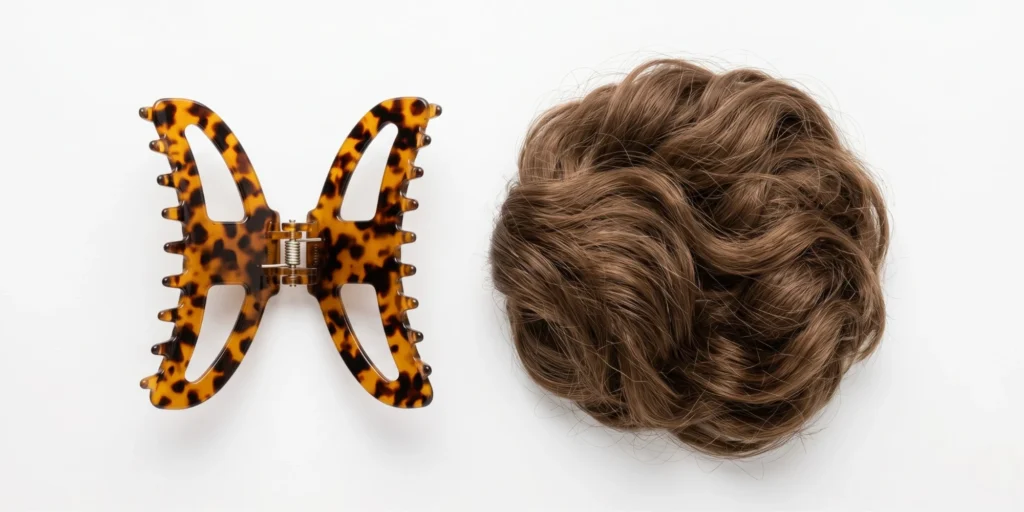
Long hair and claw clips have a specific compatibility problem that medium or short hair does not: the sheer length and weight of a long hair section generates more downward torque on the clip hinge than a standard spring can resist, and the volume of hair gathered into a bun exceeds the jaw span of most standard clips. The result is a clip that either pops open under the load or holds briefly before the hair gradually slides down and out.
This is not a technique problem in most cases. It is a specification problem — the wrong clip for the length and density of the hair. Once the correct clip is in hand, the techniques in this guide will hold long hair reliably for a full day. Without the correct clip, no technique will compensate for a spring that is too light or a jaw span that is too narrow for the hair volume being secured.
Long hair creates two mechanical challenges that do not exist for medium or short hair in the same degree.
The first is weight. A longer hair section is simply heavier than a shorter one — the same strand density but more length means more mass hanging from the clip’s grip point. This downward load applies torque to the hinge of the clip in addition to the outward spring compression force that the gathered section’s volume applies. A spring that generates sufficient closing force for the volume of a medium-length bun may not generate sufficient closing force against the combined outward pressure plus downward torque of a long-hair bun.
The second challenge is tail management. Long hair generates a ponytail tail that extends beyond the clip body after the bun is formed. If this tail is not correctly managed — tucked into the bun, folded under, or allowed to fall in a controlled way — it applies additional outward and downward force on the clip as gravity acts on it.
The practical solutions to both challenges are covered in the techniques below. But the prerequisite for all of them is a correctly sized clip.
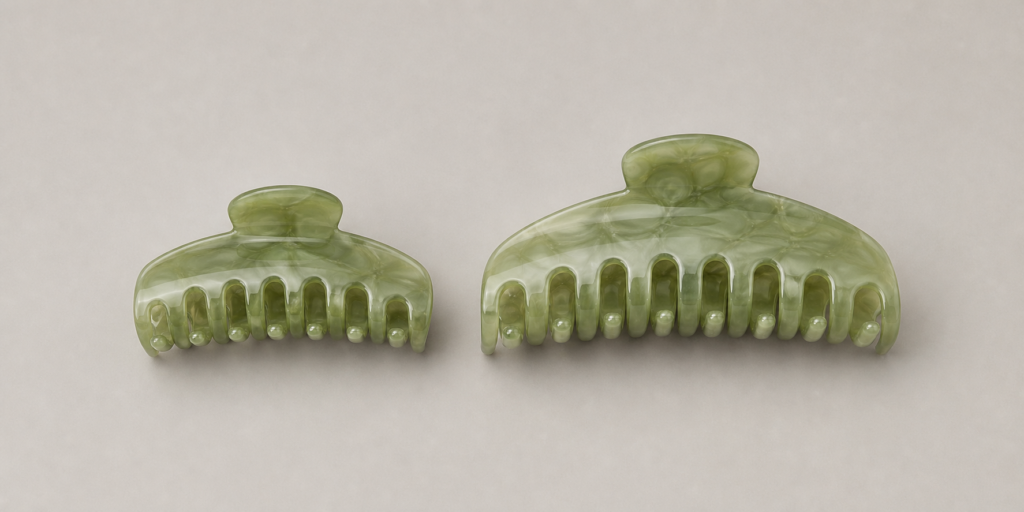
Long hair almost always requires a large (9–10.5 cm) or oversized (11–13 cm) clip. The jaw span must be sufficient to close fully around the full gathered volume of the hair, and the spring must be specified to a medium or heavy gauge to resist the combined outward and downward load that long hair generates.
A standard-sized clip — 7–8 cm — is designed for medium-length, medium-density hair. On long hair, even if the hair is fine, the gathered section is typically too voluminous for a standard clip to close fully. If your clip is not closing with a clean, audible click and staying closed when you release your hand, it is too small. Brands developing claw clip ranges that perform specifically on long hair should source from an acetate claw clip manufacturer that offers reinforced spring specifications at large and oversized jaw lengths — both variables are essential for long-hair hold.
This is the foundational method for long hair and the starting point for every variation. It works on fine to medium long hair with a single large clip.
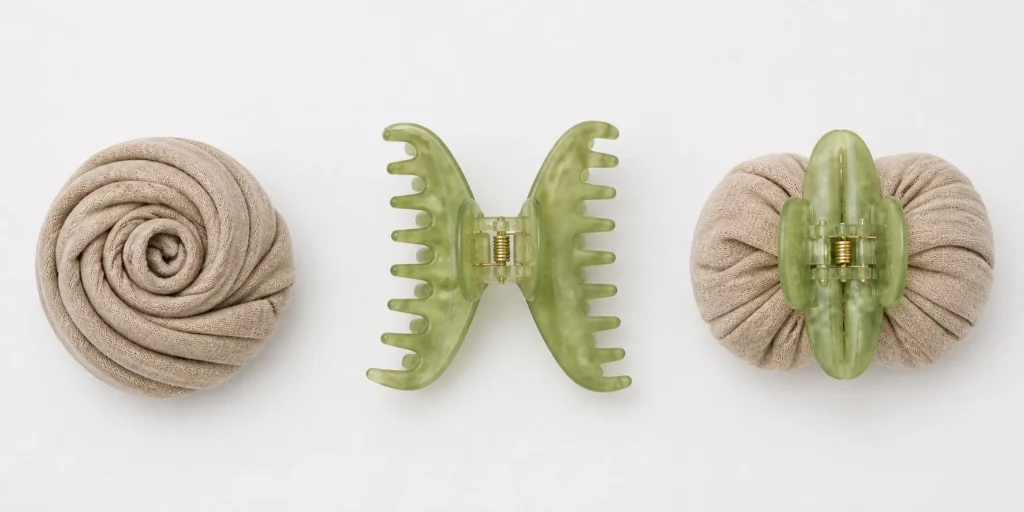
For hair that is both long and thick — mid-back to waist length at medium to high density — a single clip often cannot accommodate the full gathered volume even at oversized dimensions. The two-section method solves this by dividing the hair into manageable layers before clipping.
The half-up style — gathering the top portion of the hair while leaving the lower portion down — is easier to hold with a claw clip on long hair than a full bun, because the gathered section is lighter and the tail management problem is eliminated (the tail becomes part of the down hair rather than something to be tucked).
The low bun positions the clip at the nape, which is mechanically the most stable position for long hair because the hair weight is distributed above the clip rather than hanging below it. The downward torque problem that makes high buns difficult on long hair is minimised at low positions.
| Symptom | Most Likely Cause | Fix |
|---|---|---|
| Clip pops open immediately on release | Clip too small — spring at maximum compression | Size up to an oversized clip (11–13 cm) |
| Clip holds for 20–30 minutes then slides out | Tail not tucked; weight of hanging tail pulls bun down | Tuck the tail completely before clipping |
| Clip holds but bun gradually droops downward | Bun not pressed close enough to scalp; lever arm too long | Press the coil flatter against the head before clipping |
| Hair too heavy for clip to hold all day | Standard spring cannot resist combined volume and weight | Request reinforced/heavy spring specification; try two clips in criss-cross |
| Clip closes but only grips a thin section | Hair not twisted tightly enough; bun not compact | Twist more firmly; compress the coil before clipping |
| Fine long hair slips through teeth | Teeth spacing too wide for fine strands; clip oversized | Size down or use two medium clips rather than one large |
| Clip comfortable initially but hurts after an hour | High bun position creates sustained downward torque on scalp | Lower the bun position; try mid-height or low bun |
For very long, very thick hair where a single clip consistently fails regardless of technique, the criss-cross method provides the most secure hold achievable with claw clips alone.
This technique requires two identical large or oversized clips and works best when both are the same size and spring specification. Mixing sizes produces uneven hold because one clip bears more load than the other.
| Hair Type | Length | Recommended Clip Size | Spring Spec | Method |
|---|---|---|---|---|
| Fine, long | Mid-back to waist | Large (9–10 cm) | Standard to medium | Standard twist-and-clip; two medium clips for fine strands |
| Medium density, long | Mid-back to waist | Large to oversized (10–12 cm) | Medium | Standard twist-and-clip; low bun for maximum stability |
| Thick, long | Mid-back to waist | Oversized (11–13 cm) | Heavy/reinforced | Two-section method; criss-cross double clip |
| Very thick, very long | Waist to hip | Oversized (12–13 cm) | Heavy/reinforced | Criss-cross double clip; low bun position only |
| Curly, long | Mid-back (stretched) | Oversized (11–13 cm) | Heavy/reinforced | Loose twist; two-section method for high-density curls |
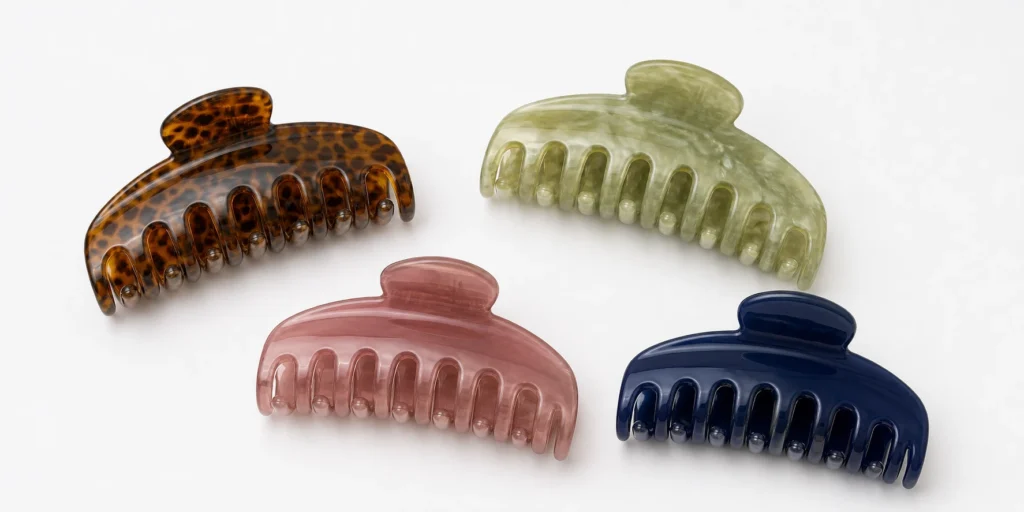
Long hair is a distinct consumer segment with specific product requirements that standard claw clip ranges do not fully address. The failure modes described in this guide — clips popping open, buns drooping, tails pulling the style out — are all downstream consequences of product specifications that were designed for median hair length and density rather than for the specific mechanical challenges of long hair.
For B2B buyers, the commercial opportunity is straightforward: a range that explicitly positions large and oversized clips with reinforced spring specifications for long hair — and communicates this positioning clearly at retail — captures a consumer group that is actively failing with standard clips and actively seeking alternatives that work. The specification difference between a standard large clip and a long-hair-optimised large clip is primarily the spring — a variable that most factories can accommodate within existing tooling at modest cost premium.
Buyers developing a long-hair clip range should request three sample variants at the target jaw length: standard spring, medium spring, and heavy spring. Tested on hair volumes that represent fine-long, medium-long, and thick-long hair densities, the correct spring specification for each target consumer type becomes immediately apparent. This testing protocol adds one sample round to the development process and eliminates the most common long-hair clip failure mode before production commitment. Brands sourcing across the large and oversized size range should work with an OEM hair accessories manufacturing partner that offers spring tension as a specifiable variable rather than a fixed production default.
Q: Can a claw clip hold long hair all day?
Yes — a correctly specified and correctly applied claw clip holds long hair reliably for a full day. The two prerequisites are the right clip size (large to oversized, 9–13 cm, depending on hair density) and a technique that manages the tail of the hair before clipping. A clip that is too small will pop open regardless of technique. A correctly sized clip applied with a tight twist, a tucked tail, and the bun pressed close to the scalp holds long hair through a full day of normal activity without adjustment.
Q: What size claw clip do I need for long hair?
Long hair requires a large (9–10.5 cm) or oversized (11–13 cm) clip in most cases. Fine long hair typically suits a large clip (9–10 cm); medium-density long hair suits an oversized clip (10–12 cm); thick long hair requires a fully oversized clip (11–13 cm) with a reinforced spring. The jaw must close fully around the gathered long-hair section — if the clip does not close with a clean click on release, it is too small. Size up until the clip closes fully at a comfortable spring compression level, not at the spring’s maximum range.
Q: Why does my claw clip keep sliding out of my long hair?
The most common cause of a claw clip sliding out of long hair is an unmanaged tail — the section of hair that extends beyond the coil when the bun is formed. The weight of the hanging tail applies constant downward force on the clip that eventually overcomes the spring’s hold. The solution is to tuck the tail completely into the base of the coil before applying the clip, leaving no free-hanging section for gravity to act on. The second common cause is a bun that sits away from the scalp — pressing the coil as flat as possible against the head before clipping significantly reduces the lever arm and stabilises the hold.
Q: How do you use a claw clip on very long thick hair?
Very long thick hair requires the two-section method combined with a criss-cross double clip technique. Divide the hair horizontally at the occipital bone, form a compact coil from the lower section first, wrap the upper section around it, twist the combined bundle firmly, tuck the tail completely, and apply two oversized clips in criss-cross orientation — one vertical and one horizontal. Two clips in criss-cross distribute the hair’s weight and outward pressure across two independent spring mechanisms, providing significantly more stable hold than a single clip on very high-volume long hair.
Q: Is a low or high bun better for holding long hair with a claw clip?
A low bun is mechanically more stable than a high bun for long hair because the hair weight is distributed above the clip rather than hanging below it. At a high bun position, the full weight of the long hair section hangs below the clip and applies downward torque to the hinge — the heavier and longer the hair, the greater this torque. A low bun at the nape positions the clip so the weight of the hair acts downward along the back of the head rather than away from the clip’s hold point, which is a more stable load direction for the spring mechanism to resist.
Q: What is the MOQ for sourcing large or oversized claw clips with reinforced springs from an OEM manufacturer?
Standard MOQs for large and oversized claw clips from factory-direct OEM suppliers typically begin at 300–500 units per style per colour for constructions using existing mould tooling. Reinforced spring specifications — heavier gauge springs within existing mould housings — are typically available at the same MOQ as standard spring specifications, as the spring gauge is a component variable rather than a tooling variable. Custom jaw lengths beyond existing tooling may require higher minimums to offset mould investment. Buyers sourcing multiple sizes within a single order can typically negotiate blended minimum requirements.
Putting long hair in a claw clip reliably comes down to three things: a correctly sized clip with a spring strong enough to resist the weight and volume of the hair, a tight pre-application twist with the tail completely tucked before clipping, and a bun position pressed as close to the scalp as possible to minimise the lever arm. The techniques in this guide — from the standard twist-and-clip to the two-section method and criss-cross double clip — cover the full range of long hair densities from fine-long through very thick and very long.
For B2B buyers, long hair is an underserved product specification within most claw clip ranges. Brands that source large and oversized clips with variable spring tension specifications — and position them explicitly for long hair hold — capture a high-intent consumer group that has experienced repeated failure with standard clips and is actively seeking a product that works. Manufacturers such as JunYi Beauty, which produces acetate and ABS claw clips across the full large and oversized size range with spring tension as a specifiable variable at its Dongguan facility under ISO 9001:2015 and amfori BSCI certification, represent the type of OEM partner suited to building a long-hair-specific clip range.
👉 Searching for Hair Accessories ? Your brand deserves the best.