Home
Product
Contact
Odm/Oem
About
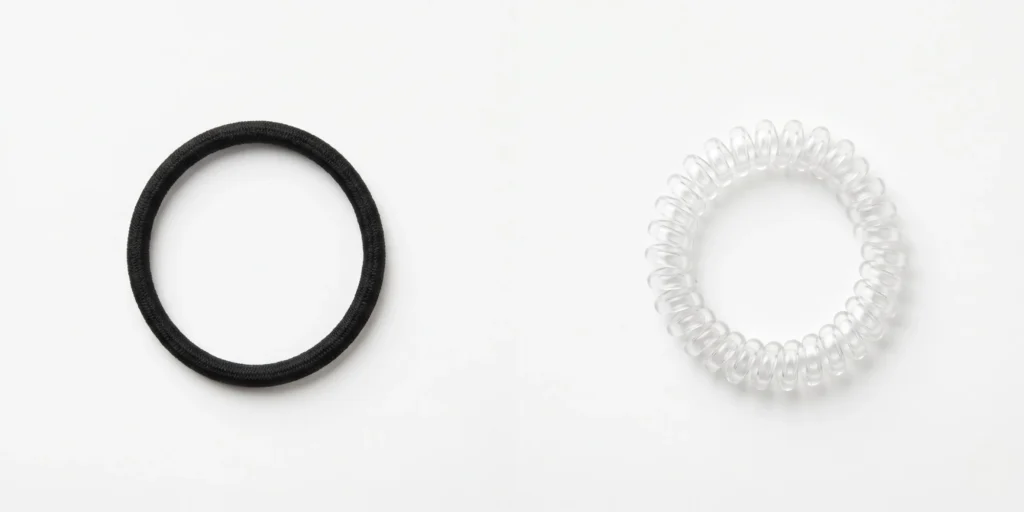
Spiral hair ties cause significantly less breakage than rubber hair ties. This is the direct answer to the question — but understanding why, and under what specific conditions each format performs better or worse, determines whether a spiral tie is the right replacement for a rubber band in a given use context, or whether a different format serves better still.
This guide compares rubber hair ties and spiral hair ties across every dimension of hair damage: surface friction, tension distribution, crease formation, snagging risk, and removal mechanics. It also examines where spiral ties underperform — because they are not universally superior in every styling scenario — and provides sourcing context for B2B buyers considering spiral ties as part of a lower-damage hair accessories range.
A rubber hair tie operates by wrapping circumferentially around a gathered hair section one or more times, generating compressive force through the elastic tension of the band. The band contacts the hair in a narrow circumferential strip at each wrap point, and the compressive force is concentrated in that narrow contact zone. On application and removal, the rubber surface moves against the hair cuticle, generating friction at every point of contact. On removal, individual hair strands that have been caught around or under the tie are pulled in the removal direction until they either release or break.
The design is simple and effective at holding hair — but every element of the mechanism generates some combination of friction, concentrated tension, and snagging risk. There is no design feature in a standard rubber hair tie that mitigates any of these three damage vectors.
A spiral hair tie — also called a phone cord tie, tornado tie, or coil tie — is constructed from a continuous filament of TPU (thermoplastic polyurethane) or acrylic resin coiled into a helix shape. Instead of wrapping circumferentially around the hair section in flat band layers, the coil wraps in a helical pattern — each turn of the coil contacts a different axial position along the gathered hair section rather than the same circumferential position repeatedly.
This helical contact pattern distributes the holding force along the length of the hair section rather than concentrating it at a single circumferential band. The smooth, seamless plastic surface of the coil generates substantially lower friction against the hair cuticle than rubber. And because there is no metal join and no raw edge on the coil, the snagging risk on removal is dramatically reduced relative to a standard metal-jointed elastic.
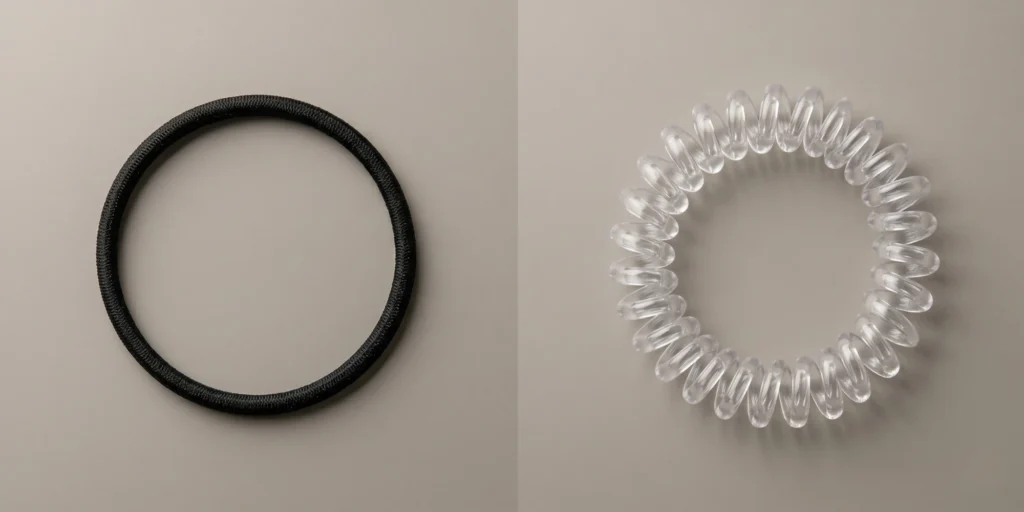
Prompt: Macro flat lay product photography, wide 2:1 banner 2000x1000px, left half shows a standard black elastic hair tie flat and stretched slightly showing the narrow band profile, right half shows a clear spiral coil hair tie slightly expanded showing the helical coil structure and distributed contact points, neutral warm grey background, soft directional macro lighting from upper left emphasising the structural difference between the two formats, no text, no logo, no watermark, high resolution
Rubber generates high friction against the hair cuticle. The surface of a bare rubber band is tacky — designed to grip the surfaces it contacts — and this grip property that makes it effective at holding hair is the same property that abrades the cuticle scale layer on application and removal. Over daily repeated use, this abrasion progressively lifts and breaks the cuticle scales, leaving the cortex exposed and the hair shaft structurally weakened.
The smooth plastic surface of a spiral coil tie generates substantially lower friction against the hair cuticle. TPU and acrylic resin — the materials from which most spiral ties are produced — have smooth, non-tacky surfaces that slide against the hair rather than gripping it. The coefficient of friction between smooth plastic and hair is closer to that of satin fabric than to that of rubber, placing spiral ties in the low-damage zone rather than the high-damage zone for friction-related cuticle abrasion.
According to research on hair cuticle structure and friction-related damage, the surface material in contact with the hair shaft is the primary determinant of friction-induced breakage risk — a finding that directly supports the damage differential between rubber and smooth plastic coil surfaces.
A rubber band concentrates its compressive force in a narrow circumferential band at each wrap point. On thick or long hair requiring three wraps, three narrow bands of high tension are stacked on top of each other at effectively the same axial position on the hair shaft — creating a single high-stress zone where the cumulative compression is three times that of a single wrap. This zone is where tension crease forms, where the hair shaft’s structural integrity is progressively reduced, and where breakage eventually occurs.
A spiral tie distributes its holding force along the length of the hair section. Each turn of the coil contacts the hair at a slightly different axial position, spreading the total compression across multiple distributed contact points rather than concentrating it at one. The result is that no single point on the hair shaft experiences the cumulative tension that the innermost wrap of a multi-wrap rubber band creates. This distributed tension profile is the primary reason spiral ties leave minimal or no crease in the hair — there is no single high-compression point where a crease can form.
Rubber hair tie removal generates two distinct snagging risks. The first is the high friction of the rubber surface against individual strands as the tie is unwound — strands that are wrapped around or under the tie are dragged along with the tie rather than releasing cleanly. The second, and more damaging, is the metal crimp join present on most standard retail elastics. This metal element catches individual strands and tears rather than releases them — it is the single highest-damage element in the standard elastic hair tie and accounts for a disproportionate share of removal-related breakage.
Spiral ties have no metal join and no raw edges — the coil is a continuous formed plastic element without any sharp discontinuity. On removal, the coil simply spirals off the hair section, with each turn releasing cleanly rather than dragging or catching. The smooth surface further reduces the friction of removal. The combination produces a removal experience that is dramatically cleaner than a rubber band — consumers who switch from standard elastics to spiral ties most immediately notice the difference at the removal stage.
The single most significant practical advantage of a spiral tie over a rubber band for many consumers is crease prevention. The narrow circumferential compression of a rubber band creates a visible dent in the hair at the wrap point — a crease that persists for hours after removal and that, on fine or processed hair, may require heat styling to eliminate. The distributed helical contact of a spiral tie leaves effectively no crease — the hair at the former tie position returns to its natural profile almost immediately after removal.
For consumers who style their hair before wearing it up — blow-dried, straightened, or set — and want to remove the tie later in the day without a visible crease disrupting the style, spiral ties offer a meaningful functional advantage that rubber bands cannot match regardless of how carefully the rubber band is applied or removed.
The reduced friction and distributed tension of a spiral tie make it significantly safer than rubber bands on color-treated, bleached, or chemically processed hair. Treated hair has a compromised cuticle that is more susceptible to friction-induced abrasion at the same applied force levels — meaning that the damage differential between rubber and spiral is larger on treated hair than on healthy unprocessed hair. For consumers managing breakage from chemical processing, switching from rubber bands to spiral ties reduces two of the three primary damage vectors simultaneously.
The distributed tension profile of a spiral tie also reduces the concentrated scalp pressure at the wrap point that causes tension headaches in some rubber band wearers. Because no single point on the scalp experiences the full compressive force of the tie, the localised pressure that generates discomfort in tight ponytail wearers is substantially reduced. This is a comfort benefit that is secondary to hair health but commercially relevant for positioning in the wellness segment.
Spiral ties are not superior to rubber bands in all use cases. The following scenarios favour rubber bands:
The smooth plastic surface of a spiral tie that makes it low-friction is also the property that limits its grip on very fine or silky hair. On fine hair, the coil may slip rather than grip — particularly if the hair is also freshly conditioned or coated in styling product, which further reduces surface friction between the hair and the coil. Rubber bands, precisely because of their high friction surface, grip fine silky hair more reliably than spiral ties. For fine-hair consumers, a thin fabric-covered elastic or satin scrunchie is a lower-damage alternative that retains sufficient grip.
For vigorous physical activity where the ponytail is subject to significant movement, rubber bands typically provide stronger hold retention than spiral ties. The elastic’s continuous circumferential compression maintains grip through movement in a way that the helical coil’s distributed hold may not. Sport-specific elastics or wide seamless bands are better choices for active wear than spiral ties if hold security is the priority.
On very thick hair, a spiral tie may not generate sufficient compressive force to hold the full hair section reliably, particularly for styles that require strong structural hold. Wide-elastic satin scrunchies or seamless wide bands provide higher total hold force for thick hair than most spiral tie specifications.
| Variable | Rubber Hair Tie | Spiral Hair Tie |
|---|---|---|
| Surface friction on cuticle | High — rubber grips hair surface | Very low — smooth plastic slides cleanly |
| Tension concentration | High — narrow circumferential band per wrap | Low — distributed helically along hair section |
| Crease formation | Significant — visible dent at wrap point | Minimal to none — no single high-pressure point |
| Snagging on removal | High — rubber surface drags; metal join tears | Very low — smooth coil spirals off cleanly |
| Overall breakage risk | High (standard elastic) / Very high (metal join) | Very low |
| Hold on fine hair | Good — high friction grips fine strands | Poor to moderate — may slip on silky hair |
| Hold on medium hair | Good | Good |
| Hold on thick hair | Good (multiple wraps) | Moderate — may lack sufficient force |
| Hold during active wear | Good — elastic maintains circumferential grip | Moderate — coil may shift under vigorous movement |
| Crease-free removal | No — leaves visible dent | Yes — no crease in most hair types |
| Comfort (extended wear) | Variable — tight wraps cause headaches | Better — distributed tension reduces scalp pressure |
| Longevity | Short — elastic degrades with use and heat | Longer — plastic coil resists degradation |
| Retail price tier | Low — commodity format | Mid — positioned as premium functional |
The benefit of switching from rubber bands to spiral ties is not uniform across hair types. The following groups see the largest reduction in breakage:
The groups that benefit less from spiral ties — and for whom a satin scrunchie may be a better alternative — are consumers with very fine silky hair (where slip is a concern), consumers with thick or coily hair (where the coil may lack hold force), and consumers using ties for high-intensity active wear (where circumferential elastic hold is more reliable).
Not all spiral ties perform equally. The following specification variables determine how well a specific spiral tie holds and how low-damage it is in practice:
The diameter of the coil — the width of the individual turns — affects how many times the tie wraps around a given ponytail diameter and therefore how the holding force is distributed. A smaller-diameter coil makes more turns around a given section, distributing force across more contact points. A larger-diameter coil makes fewer turns, concentrating hold in a shorter axial length. For most hair volumes, a coil diameter that produces four to six turns around the gathered section provides the best balance of hold and tension distribution.
The thickness of the plastic filament from which the coil is formed determines the stiffness and total holding force of the tie. Thicker filaments generate more spring-back force and hold more securely — at the cost of slightly more tension per contact point. Thinner filaments are gentler but may slip on thicker or heavier hair sections. Most retail spiral ties use a filament thickness calibrated for median hair volume; buyers sourcing for specific hair type segments should specify filament thickness explicitly.
TPU (thermoplastic polyurethane) produces a more flexible, slightly softer coil that conforms better to irregular hair sections and is less likely to catch at the coil ends. Acrylic produces a firmer coil with more defined spring-back and stronger hold, but the ends may be slightly sharper if not well-finished. For a hair health-positioned product, TPU with smooth, rounded coil ends is the preferred specification.
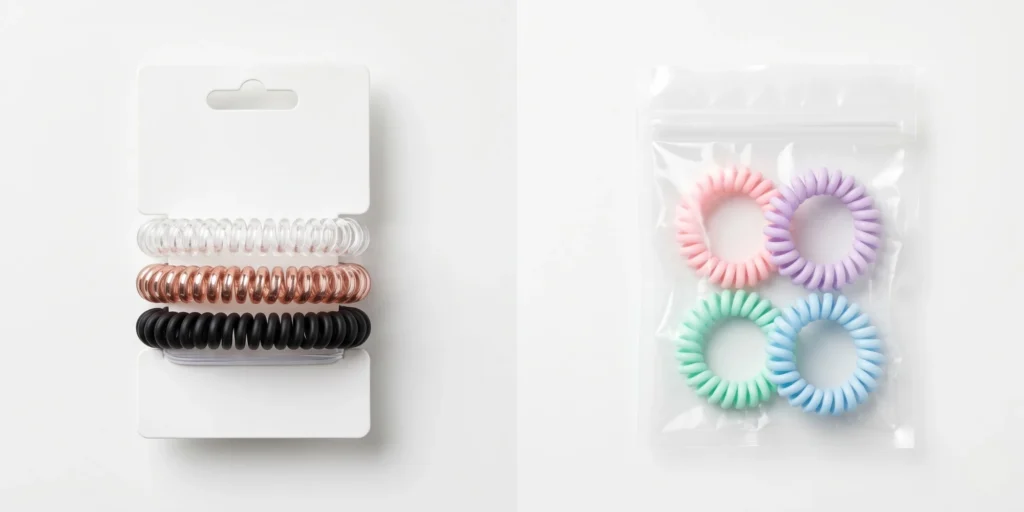
Spiral coil hair ties occupy a well-defined commercial position within a lower-damage hair accessories range: they address the crease-aversion and breakage-reduction needs of the medium-density hair consumer at a mid-market price point that is clearly above commodity elastic but accessible to everyday purchase decisions.
From a sourcing standpoint, spiral ties require injection moulding tooling — the coil form is produced by moulding the plastic filament around a mandrel — which means tooling investment is higher than for sewn scrunchies but lower than for multi-component clip assemblies. Standard MOQs from factory-direct suppliers typically begin at 500–1,000 units per style per colour, reflecting the injection moulding economics. Buyers sourcing spiral ties alongside satin scrunchies within a single lower-damage range can often negotiate blended MOQ arrangements with OEM partners that produce both formats.
Key quality control variables for spiral ties include coil end finish (sharp ends are a snagging risk), filament diameter consistency (uneven filament produces uneven tension distribution), and coil diameter calibration (which determines the number of turns per standard ponytail volume). Requesting samples tested on three hair density levels — fine, medium, and thick — before production commitment validates hold performance across the target consumer range.
Brands building a complete lower-damage hair tie range that combines satin scrunchies with spiral coil ties should source from an OEM hair accessories manufacturing partner that produces both formats within a single production relationship — ensuring quality consistency across the range and enabling consolidated MOQ negotiation.
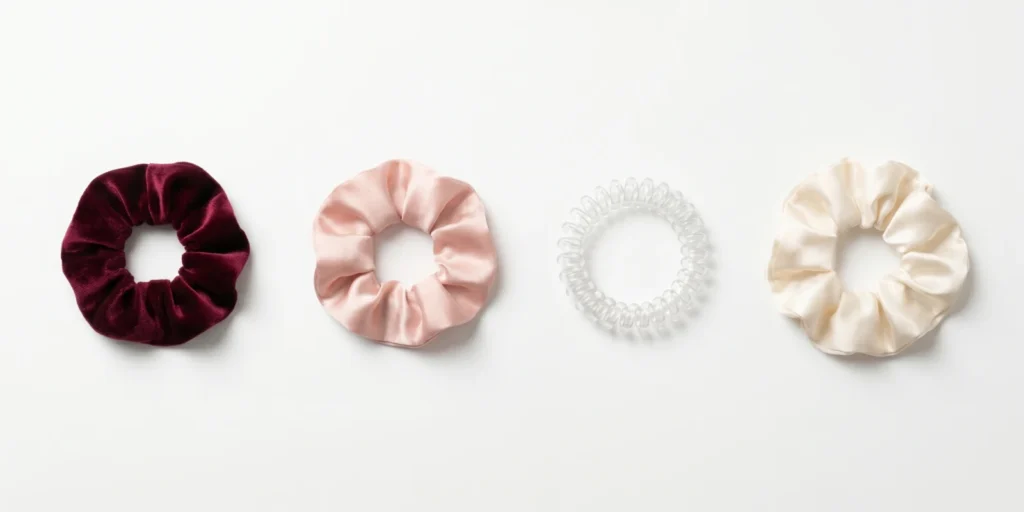
Yes — spiral hair ties cause significantly less breakage than standard rubber elastic bands in most use contexts. They generate lower surface friction against the hair cuticle, distribute holding tension along the length of the hair section rather than concentrating it at a narrow wrap point, and release cleanly on removal without the snagging risk of the metal crimp join present on most standard elastics. The difference is most pronounced on color-treated, fine to medium, or crease-prone hair where the damage mechanisms of rubber bands cause the most visible harm.
A spiral hair tie is a continuous coiled filament of plastic — typically TPU or acrylic — that wraps around a gathered hair section in a helical pattern rather than a flat circumferential band. Each turn of the coil contacts a slightly different axial position along the hair section, distributing the holding force across multiple contact points rather than concentrating it at a single wrap point. The smooth seamless plastic surface generates very low friction against the hair cuticle, and the absence of any metal join or sharp edge eliminates the primary snagging risk of conventional elastics.
Spiral ties work adequately for medium-density hair but may not provide sufficient hold for very thick or high-volume hair in demanding styling contexts. The coil’s total holding force is limited by the filament thickness and spring-back properties of the plastic — which are typically calibrated for median hair volumes. For thick hair, a wide-elastic satin scrunchie or a seamless wide band provides higher total hold force while still maintaining a lower-damage profile than a standard rubber band. Spiral ties work best for fine to medium density hair in everyday low-to-moderate activity wear.
Spiral ties leave minimal to no crease in the hair on removal — this is one of their most practically significant advantages over rubber bands. The distributed helical contact pattern means no single point on the hair shaft is under sufficient concentrated compression to form a defined dent. Consumers who regularly blow-dry or style their hair and then wear it up report that spiral ties are the only elastic-type hair tie that allows them to let their hair down later in the day without a visible crease disrupting the style.
Both are significantly better than rubber bands for damaged hair, but they address different damage vectors and suit different styling contexts. Satin scrunchies produce lower surface friction than spiral ties because satin fabric has a lower coefficient of friction against hair than smooth plastic — making them the better choice for friction-sensitive damaged hair in ponytail styling. Spiral ties produce less tension crease than scrunchies because the helical force distribution is more even than even a wide elastic — making them better for crease-averse styling. For most damaged hair consumers, satin scrunchies are the better everyday recommendation; spiral ties are the better choice when crease prevention is the priority.
The key quality control variables for spiral ties are coil end finish (ends should be smooth and rounded, not sharp — a sharp end is a snagging risk that defeats the purpose of switching from elastic bands), filament diameter consistency across the coil length (uneven filament produces uneven tension distribution and inconsistent hold), coil diameter calibration for the target hair volume, and material selection — TPU produces a softer, more conforming coil than acrylic and is the preferred specification for a hair health-positioned product. Request samples tested on fine, medium, and thick hair densities before committing to a production run.
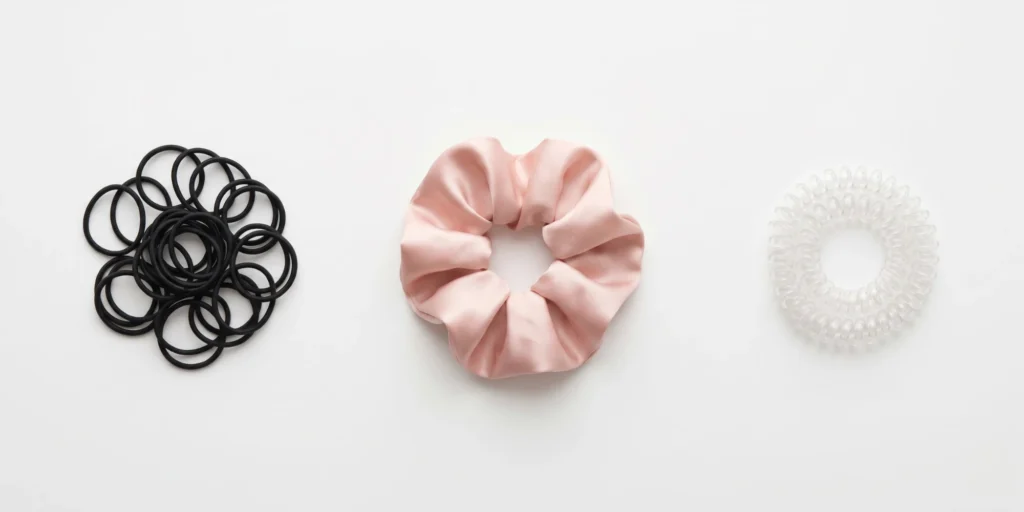
Spiral hair ties cause less breakage than rubber hair ties across all three primary damage mechanisms — friction, tension concentration, and snagging. The smooth plastic coil surface generates a fraction of the friction that rubber generates against the cuticle; the helical force distribution eliminates the concentrated wrap-point tension that causes crease and structural weakening; and the seamless plastic construction removes the metal join that is the single most damaging element of standard rubber band removal. For medium-density hair in everyday styling contexts, a spiral tie is a straightforward, practical upgrade from a rubber band that delivers a noticeable reduction in breakage and crease.
The qualification is that spiral ties are not the optimal lower-damage format for every hair type or use context — very fine hair may slip, very thick hair may need more hold force than a coil provides, and active wear may favour the circumferential grip of an elastic over the helical hold of a coil. For these contexts, a satin scrunchie with wide-gauge high-tension elastic remains the best lower-damage elastic-based alternative. A range that includes both spiral ties and satin scrunchies covers the full lower-damage hair tie market across hair types and use contexts. Manufacturers such as JunYi Beauty, which produces spiral coil ties and satin scrunchies alongside a complete hair accessories range at its Dongguan facility under ISO 9001:2015 and amfori BSCI certification, represent the type of OEM partner suited to brands building this combined lower-damage range.
👉 Searching for Hair Accessories ? Your brand deserves the best.